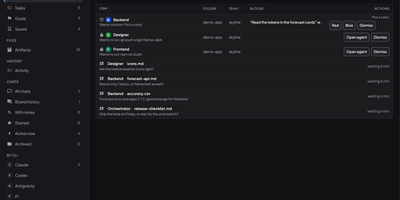
Coral by Subgentic
No more hunting through terminal tabs for the coding agent that stalled on a permission prompt, because Coral queues every question, approval, and file review in one Inbox. Claude Code, Codex, and Antigravity run side by side as one team, each in its own terminal session, sharing a message board and a task queue where dependencies wait on outcomes and required artifacts. Goals carry a checkable Done when line, and review gates hold dependent tasks until a reviewer approves. Files an agent produces open in a versioned viewer where you comment on passages, mark up images with a pen, arrow, or box, compare version two against version one, then approve, approve with a note, or request changes. A changed-files panel shows each agent's diff beside its chat, and optional git worktrees keep the main checkout clean. Idle agents sleep and wake when a message arrives, and whole teams can sleep through a restart. Scheduled jobs and multi-step workflows run regression suites and audits on a cron, resource queues keep concurrent agents off the same build rig, and analytics break token spend down by provider, model, thinking level, team, and task. A QR-paired phone client approves prompts on the go, and a self-hosted hub follows agents across computers. Running on a dedicated VPS on RepoCloud with guaranteed CPU, RAM, and SSD, full root SSH access, and a browser serial console. Apache-2.0 licensed.
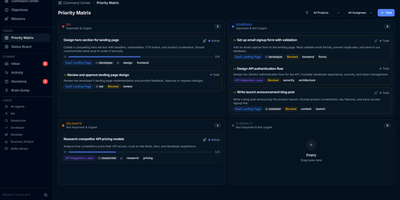
Mission Control
With over 600 GitHub stars and a featured Show HN launch, Mission Control is the agent-first command center that replaces the chaos of manually shepherding AI agents with structured delegation, approval workflows, and autonomous execution. The Next.js 15 web UI delivers an Eisenhower priority matrix with drag-and-drop quadrants, a Kanban board tracking tasks through Not Started, In Progress, and Done columns, and a goal hierarchy with milestone progress bars — powered by shadcn/ui, Radix UI, and @dnd-kit. Six built-in agent roles — Researcher, Developer, Marketer, Business Analyst, Tester, and You — receive tasks through a token-optimized API compressing context by 92 percent to approximately 50 tokens versus 5,400 unfiltered. The autonomous daemon polls task queues on cron schedules, spawns Claude Code sessions via the official CLI, enforces concurrency limits, and auto-retries with loop detection that escalates to human decisions after three failures. Field Ops extends execution to 64 external services across 16 categories with working X, Ethereum with MetaMask signing, and Reddit adapters, protected by AES-256-GCM encrypted vault with scrypt key derivation, per-service and global spend limits, a circuit breaker, and three autonomy levels. All data lives in local JSON files with Zod validation and async-mutex locking ensuring safe concurrent writes, backed by 193 automated Vitest tests. Running on a dedicated VPS on RepoCloud with guaranteed CPU, RAM, and SSD, full root SSH access, and a browser serial console. AGPL-3.0 licensed.
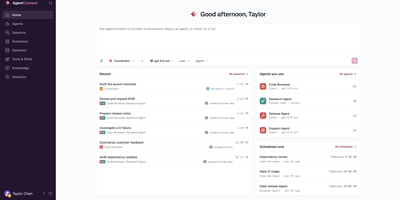
AgentConnect
AgentConnect brings Claude Code, Codex, Grok Build, DeepSeek, and any other ACP-compatible coding agent into the chat channels and repositories where your team already works, each with a role of its own. Mention an agent in Slack, Microsoft Teams, Google Chat, Lark, Discord, or Telegram and it replies in the thread, calls on a colleague agent when needed, and keeps its session visible to teammates who can step in. Work can also start from a GitHub, GitLab, Gitea, or Azure DevOps pull request, a Linear issue, a webhook, or a schedule. The web console organizes the fleet into Agents, Sessions, Schedules, Tools and Skills, Knowledge, and Daemons views. Every agent gets its own memory, skills, MCP servers, workspace, and sandbox policy, and reviewed Knowledge pages can be published for all agents to search. Decisions route new conversations to specialist agents and pick the runtime and model for each session. Review bots can run several reviewers with separate instructions on one pull request. Set who may see each agent or session, which repositories it can touch, and which agents it may call. Running on a dedicated VPS on RepoCloud with guaranteed CPU, RAM, and SSD, full root SSH access, and a browser serial console. Apache-2.0 licensed.
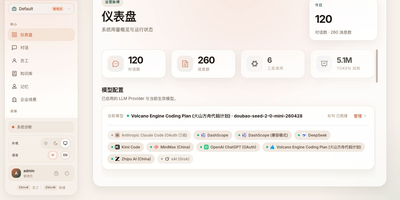
MateClaw
MateClaw delivers a multi-agent AI platform where digital employees run as persistent team members with roles, goals, and accumulated skills rather than stateless chat completions. The Spring Boot backend on Spring AI Alibaba provides ReAct iterative reasoning and Plan-and-Execute decomposition on a StateGraph runtime, with parallel delegation between employees and dynamic context pruning for multi-step tasks. Five career templates ship ready (Product Researcher, Customer Support, Knowledge Curator, Data Analyst, Executive Assistant) while custom employees inherit configurable backstories, pixel-art avatars, and dedicated tool bindings. The MCP integration supports stdio, SSE, and Streamable HTTP transports with per-employee tool isolation preventing capability bleed between agents. ACP bridges bring Claude Code, Codex, and other coding agents in as first-class employees. Workflow orchestration composes multiple employees and system actions into publishable linear DSL processes with seven step modes: sequential, fan_out, collect, conditional, await_approval, dispatch_channel, and write_memory. The trigger system wires cron schedules, webhooks, channel messages, employee lifecycle events, content matches, and workflow completions to automated flows. The Admin Runtime Console provides real-time visibility into running employees with token usage tracking and one-click force-recycle. Spring Boot Actuator monitoring, full audit trail, and per-channel error isolation deliver production-grade reliability. Running on a dedicated VPS on RepoCloud with guaranteed CPU, RAM, and SSD, full root SSH access, and a browser serial console. Apache-2.0 licensed.
MulmoTerminal
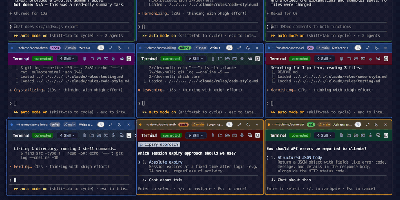
MulmoTerminal is a browser cockpit for running many AI coding agents at once, laying every session out in a color-coded grid so you can see at a glance which agents are working, which are finished, and which are sitting idle waiting on you. Each cell is a real terminal running Claude Code, Codex, Muse, GitHub Copilot CLI, Cursor CLI, Grok, or Antigravity, and its border turns amber with a chime the moment a permission prompt or question blocks progress. Zoom into one session and the cockpit roster keeps the rest in view as one-line summaries with your last prompt, the agent's latest reply, and each branch's pull request phase. Agents hand you more than text: a Canvas panel renders documents, forms, charts, and generated images they produce, while per-session context, token, and cost readouts keep spending legible. Isolate parallel work in one-click git worktrees, review the diff, then commit, push, and open the pull request without leaving the grid. Sessions persist through tmux across restarts, Web Push pings your phone when a task finishes or needs input, and per-directory themes and name badges keep a wall of agents readable. Running on a dedicated VPS on RepoCloud with guaranteed CPU, RAM, and SSD, full root SSH access, and a browser serial console. MIT licensed.
Synapse AI
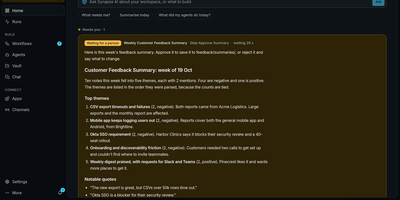
Hand a repeating job to Synapse AI and it drafts readable steps, runs them the same way every time, and stops to ask before anything goes out. Each workflow is a graph of steps that can call agents, tools, scripts, and different language models from over a dozen providers, local or cloud. An AI builder drafts the graph from a description, and a visual editor handles hand adjustments. Human approval steps pause a run until someone says yes, in the web interface or from Slack, Discord, Telegram, Teams, or WhatsApp. Cron and interval schedules start jobs automatically, and a run viewer shows the path, timing, tokens, and cost of every step. Any REST endpoint, Python script, webhook, or MCP server becomes a tool agents can call, and a shared vault stores files between runs. A template gallery offers ready-made workflows for research, reporting, and content, and an embeddable chat widget puts a knowledge-grounded assistant on your own site. A versioned REST API enqueues, streams, and cancels runs from your products. Running on a dedicated VPS on RepoCloud with guaranteed CPU, RAM, and SSD, full root SSH access, and a browser serial console. AGPL-3.0 licensed.
Veritas Kanban
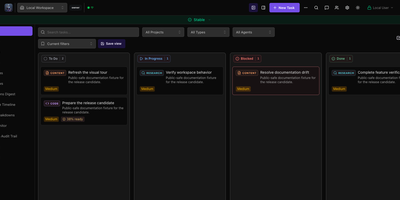
A drag-and-drop task board that works fine on its own and can also hand cards to AI coding agents, Veritas Kanban shows what each agent is doing, what it changed, and what is waiting for your approval. Start with no agents at all. Cards move through To Do, In Progress, Blocked, and Done, and each one carries subtasks, dependencies, time tracking, comments, and an activity log. When you are ready, connect Codex, Claude Code, Copilot CLI, Hermes, or OpenClaw, give every agent an Intern, Specialist, or Lead permission level, and follow each agent's status and model on a live dashboard. Let a task run in its own Git worktree, read the diff, leave inline comments, approve or request changes, and open a GitHub pull request from the task panel. Squad Chat gives agents one shared channel that posts spawned, completed, and failed events. Workflows chain steps with parallel branches, loops, and human approval gates. Policy rules allow, deny, or hold agent actions for review. Assistants reach the board through an MCP server, a command-line client, or a REST API. Running on a dedicated VPS on RepoCloud with guaranteed CPU, RAM, and SSD, full root SSH access, and a browser serial console. MIT licensed.
Evonic
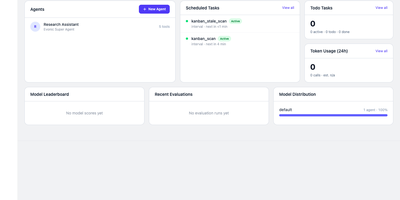
AI agents that delegate to each other, remember past conversations, and stay inside your safety rules all live in one self-hosted platform called Evonic. Every agent in Evonic has its own identity, model, tools, knowledge base, channels, and skills, and a guided first-run wizard creates the first one in minutes against OpenRouter, Together AI, Ollama, DeepSeek, llama.cpp, or any custom OpenAI-compatible endpoint. Agents message and delegate to each other, run commands in a Docker, Podman, or bubblewrap sandbox, and execute on a local folder, an SSH server, or a tunnel device that needs no public IP. A built-in Kanban board hands tasks to agents, a scheduler fires cron jobs and reminders, and Telegram, WhatsApp, and Discord channels put agents where users already chat. Markdown knowledge bases with wiki-links form an interactive graph, a memory engine recalls facts across sessions, and an organizer sub-agent extracts entities and merges duplicates. Safety layers inspect actions for mass deletion or remote code execution and escalate to a human, and an injection guard blocks prompt manipulation. Evaluation dashboards score models across domains, a token monitor tracks usage per agent and model, and bundled skills, 12 plugins, backup and restore, and themed light and dark modes round it out. Running on a dedicated VPS on RepoCloud with guaranteed CPU, RAM, and SSD, full root SSH access, and a browser serial console. AGPL-3.0 licensed.
AI Team OS
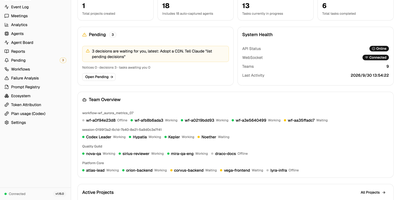
A shared project brain for Claude Code and Codex sessions: AI Team OS keeps tasks, decisions, memory, and reports in one record, so the next session can pick up where the last one stopped. Tasks sit on a live wall of pending, in-progress, and done work. Each one can carry an owner, parent and child links, dependencies, and an explicit wait on a person or an agent. Project memory holds your preferences and design decisions. One search box finds tasks, memos, reports, and workflow IDs without a model call. Agents talk through project, team, and global channels, with @mentions and acknowledgements. Eight meeting templates and four-round Advocate, Critic, Response, Judge debates end in recorded conclusions. The dashboard opens on a command center that shows every active team on one screen. Pending Decisions lists the questions agents raised for you, each with options and a recommendation. Claude Code Workflow runs get phase swim lanes with per-agent tokens, duration, and tool-call counts. Twenty-five role templates cover engineering, testing, research, and management. Guardrails flag seven dangerous patterns and two agents editing the same file. Storage, hooks, MCP tools, and the dashboard all run on your own server, so no hosted service of its own is needed. Running on a dedicated VPS on RepoCloud with guaranteed CPU, RAM, and SSD, full root SSH access, and a browser serial console. MIT licensed.
Shep
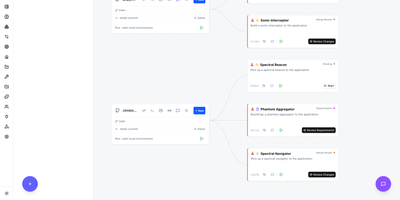
Type one sentence about a feature, and Shep spins up an AI coding agent on its own branch and worktree, then carries the work through commit, push, CI, and a draft pull request. Run three features, five, or ten at once, with Claude Code, Codex, Copilot, Cursor, Gemini, Kimi Code, Cline, or local models picked per feature. A control center draws every repository and feature as a live graph with a fleet bar that counts what is cruising, queued, waiting on you, or failed. When an agent is unsure it asks a blocking question with a recommended answer and a deadline, and you reply from the web, the CLI, chat, or the terminal console. Optional spec-driven mode writes requirements, research, and a plan as YAML for you to approve before any code exists. CI watch reads failing logs and pushes fixes, a checkpoint follows every agent step so you can diff or restore it, and nothing merges without your approval. Tool pages, skills, plugins, webhooks, project memory, and per-feature chat round out the workspace, and an app starter plans a brand new project from a prompt. State stays in a local SQLite database, and usage metrics can be switched off. Running on a dedicated VPS on RepoCloud with guaranteed CPU, RAM, and SSD, full root SSH access, and a browser serial console. MIT licensed.
Automatos AI
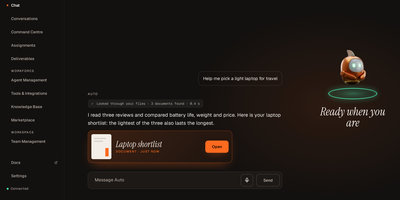
Command a whole team of AI agents from one chat box and collect finished reports, code, and content on a server you control. Say what you need and Auto routes the request to the right agent, tool, or Playbook, streams its thinking, shows every tool call, and files a ticket for another agent when the job needs one. Each agent has its own model, persona, skills, and success metrics, and the Command Centre shows the board, live status, calendar, and questions waiting for you. Playbooks turn repeatable work into multi-step automations, and Missions coordinate several agents on one goal. The marketplace installs ready-made agents, skills, and packages, and Composio connects more than a thousand outside apps once you add your own key. Models come from OpenRouter, direct provider keys, NVIDIA's free hosted models, or your own Claude Code sessions paired as agents. Knowledge bases index your documents into a searchable graph, analytics break spend down by provider and agent, and installable themes redraw the interface with voice control built in. Nothing here is locked behind a paywall, the local edition has no login so put it behind your own gate, and the whole stack starts from one Docker Compose command. Running on a dedicated VPS on RepoCloud with guaranteed CPU, RAM, and SSD, full root SSH access, and a browser serial console. Apache-2.0 licensed.
LIA
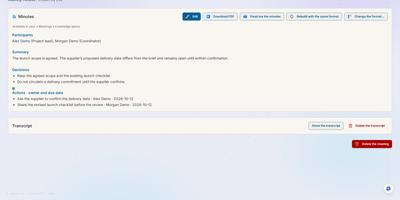
LIA is a self-hosted AI assistant that works out what you agreed with each person from your own mail, calendar, files, and meeting minutes, then drafts the follow-up for you to approve, edit, or refuse. Connect Google, Apple, or Microsoft accounts, and the Tools area opens mail, calendars, tasks, and contacts for hand browsing without a model call. Relations gathers each person's recent exchanges, debrief, and open commitments on one card. Record or import a meeting and LIA writes minutes from thirty built-in templates, with decisions and owners listed. Knowledge spaces index your documents in more than fifteen formats for hybrid search, memory keeps pinned rules and preferences you can edit or delete, and routines, reminders, and a daily briefing anticipate what is due. Administrators assign a provider and model to each pipeline stage, set per-user token and cost limits, and cap daily instance spend, with Grafana dashboards for monitoring. The interface covers six languages, with voice mode and a Telegram channel as options. Running on a dedicated VPS on RepoCloud with guaranteed CPU, RAM, and SSD, full root SSH access, and a browser serial console. AGPL-3.0 licensed.
Retinue
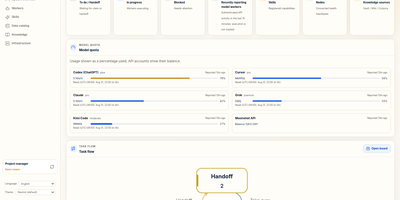
Retinue shows who is doing what across a fleet of AI agents, on a shared board where every task is a card with exactly one holder, a written acceptance check, and a receipt chain that cannot be rewritten. Operators publish cards, agents claim them through MCP or a token-scoped HTTP API, report progress, and hand off, and an agent that is not the holder gets a refusal when it tries to write. The Home dashboard counts what is waiting, running, and blocked, charts task flow and dispatch, and shows quota gauges for Claude, Codex, Cursor, Grok, and Kimi subscriptions. A collaboration workspace draws delegation graphs, device and model timelines, module contributions, and message conversations for any selected task. Operations pages report token usage by worker, and a data health page flags stale reports and duplicate identities. Read-only importers pull session data from Claude Code and Codex, and optional Lark, Feishu, and Telegram bridges turn chat messages into intents. The interface switches between English and Simplified Chinese. Running on a dedicated VPS on RepoCloud with guaranteed CPU, RAM, and SSD, full root SSH access, and a browser serial console. AGPL-3.0 licensed.