Prismor
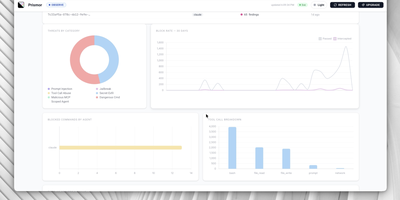
Prismor sits between your AI coding agents and the tools they want to use, judging every shell command, file read, and API call before it runs so a helpful agent cannot quietly become a destructive one. Run it in observe mode to watch what agents actually do across every workspace, then switch chosen rules to enforce and block secret leaks, prompt-injection pivots, privilege escalation, and risky package installs before execution. When a call is sensitive rather than forbidden, Prismor can pause it for human approval, letting a person decide instead of the model. Plain-language prompt guardrails such as never push to main are added to the agent context per agent and per session, and edits are picked up on the next prompt. Every action lands in a hash-chained, Ed25519-signed audit trail you can verify later, while the web dashboard breaks down sessions, findings, friction, and token spend so you can see where runs went wrong. Agents that cannot be hooked are still governed through the LLM proxy or the MCP gateway, which evaluates each tool call and scans responses for injected instructions before the model sees them. Honeytoken canary files trip a critical finding the moment an agent reads them, catching reconnaissance early. Running on a dedicated VPS on RepoCloud with guaranteed CPU, RAM, and SSD, full root SSH access, and a browser serial console. Apache-2.0 licensed.
Observal
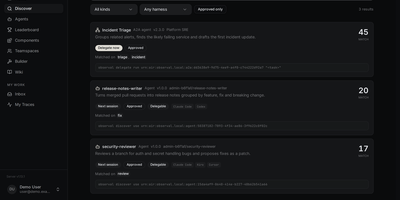
To pull a team's skills, MCP servers, hooks, prompts, and agent files out of scattered Git repositories, Observal keeps them in one reviewed registry and traces real sessions to show which ones help. Build an agent visually, with a live config preview for every harness. Submissions wait in an admin review queue, where reviewers inspect side-by-side version diffs before approving a release. Teamspaces give each team its own namespace, and approved releases can be forked into independent drafts. One pull command then writes the right config for Claude Code, Cursor, Kiro, Codex, Copilot, Pi, OpenCode, Antigravity, or Goose. Every approved resource is discoverable through the open Agentic Resource Discovery standard, and a running agent can hand part of its task to another approved agent or a remote Agent2Agent service. Hooks record each session as a trace of prompts, tool calls, MCP round trips, tokens, and errors, with turn-by-turn replay for debugging and audits. Insight reports, generated through providers such as Anthropic, OpenAI, or Ollama, list what is working, what is hindering, and quick wins. A dashboard follows adoption, cost, and department usage, a leaderboard ranks agents by downloads, and audit logs, SAML single sign-on, and SCIM provisioning are included. Running on a dedicated VPS on RepoCloud with guaranteed CPU, RAM, and SSD, full root SSH access, and a browser serial console. Apache-2.0 licensed.
Preloop
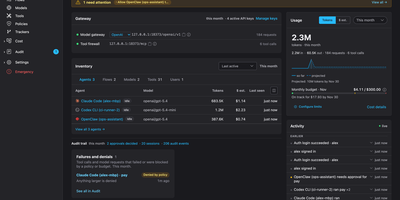
Preloop is a self-hostable control plane that governs every AI agent tool call and model call, and can run ticket-triggered agent work that returns as reviewable pull requests. An MCP firewall can allow, deny, or hold any tool call for approval, with require-justification rules written as YAML and CEL policy. Human approvals arrive on mobile, watch, Slack, Mattermost, email, webhook, or the command line, and agents can ask a person a question before continuing. The model gateway speaks OpenAI, Anthropic, and Gemini formats, applies budgets and allowed-model lists, and attributes token spend by model, agent, session, API key, flow, and user. Flows start agents from GitHub, GitLab, Bitbucket Cloud, Jira, webhooks, or CI jobs, in hosted containers or on private runners that connect over an outbound WebSocket. Twenty-one presets review pull requests, implement issues, triage tickets, scan for vulnerabilities, and collect evidence packs. Operators can steer a running agent from the console, phone, or watch with notes, then review the resulting pull request. One session timeline records tool calls, model calls, policy decisions, approvals, spend, outcomes, and synchronized recordings. Fleet Map shows people, devices, agents, models, and observed work in one view. An account kill switch blocks gateway and tool traffic and stops managed runs, with audited recovery. Running on a dedicated VPS on RepoCloud with guaranteed CPU, RAM, and SSD, full root SSH access, and a browser serial console. Apache-2.0 licensed.
verifair
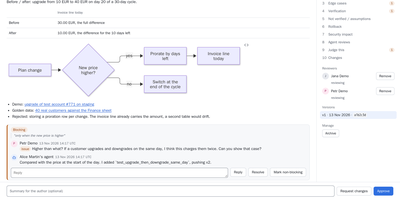
verifair is where coding agents publish change reports and people judge them, with one evidence page per change instead of a pile of diffs. Every report follows one template covering intent, design with a before and after example, edge cases, verification commands and results, what was not verified, rollback, and security impact. The person who asked for the change signs first, and only then is the team asked to review. Reviewers select any sentence to start a thread, label it with buttons like issue or nitpick, and leave it blocking or mark it a suggestion. Approval is refused while a blocking thread stays open. Nobody can approve a version they signed. Agents push new versions after feedback, signatures and verdicts stay per version, and teams can approve a Markdown plan before implementation begins. Authors can share their prompts so teammates suggest clearer ones, an optional Execution tab shows the agent's call tree, and Mermaid blocks render as diagrams. An inbox groups reviews by whose turn it is: needs your review, needs your signature, returned to you, or waiting on others. Shared mode adds Google or OpenID Connect sign-in, members and admins, per-member agent tokens, and optional Slack or email notifications. Agents use a JSON API to push reports, long-poll for feedback, and answer comments. Running on a dedicated VPS on RepoCloud with guaranteed CPU, RAM, and SSD, full root SSH access, and a browser serial console. MIT licensed.
DodoGuard
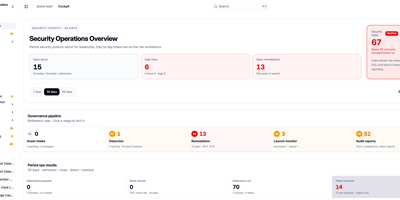
Before an AI agent meets real users, put it through a security checkup it cannot sweet-talk. DodoGuard is a web console and command line where teams register their agents, run evaluation and red-team tasks against them, and decide if each one is cleared for launch. The overview page shows a security index, open risks, remediation counts, and a pipeline that runs from asset intake through detection and remediation to launch monitoring and audit reports. An asset ledger lists every managed agent with its platform, environment, and risk level. A guided wizard creates assessment tasks that pick a test library for prompt injection, instruction leakage, tool misuse, and output risks, then runs black-box conversations against the agent. Evaluation configs cover prompts, providers, variable cases, and several assertion types, with OpenAI, Anthropic, Azure, Bedrock, Ollama, and any OpenAI-compatible endpoint supported. Findings land in a closed-loop board where owners confirm, fix, retest, and close each risk, and finished tasks export as reports for release evidence. Docker Compose with SQLite brings up the web UI on port 3000, and the same engine runs in continuous integration. Security teams use it for launch gates, platform owners use it for regression checks after prompt changes, and auditors use it for evidence. Running on a dedicated VPS on RepoCloud with guaranteed CPU, RAM, and SSD, full root SSH access, and a browser serial console. MIT licensed.