NornicDB
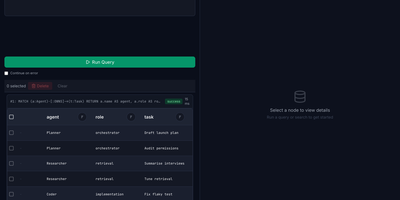
Agents forget things, and a graph database that learns is a fine place to keep what they should remember. NornicDB stores connected data as nodes and relationships, then answers Cypher queries from the browser console or from any Bolt driver you already use. Results appear in a sortable table, and selecting a row opens node details with labels, properties, and a Find Similar action. Switch to the Graph Explorer to see a node's neighborhood drawn as a graph, with a depth setting and filters for labels, edge types, and properties. Vector and full-text search run beside traversal, so one database can answer both who is connected and what is similar. Historical reads keep earlier states available through MVCC, and a lifecycle page shows pressure, prune runs, and schedules. Knowledge policies define decay and promotion rules for agent memory, and API tokens secure MCP and other integrations. Running on a dedicated VPS on RepoCloud with guaranteed CPU, RAM, and SSD, full root SSH access, and a browser serial console. MIT licensed.
Nao
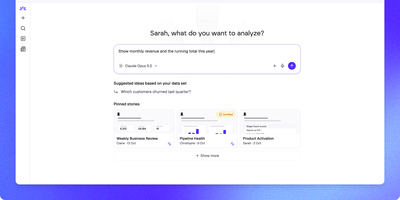
Your analysts write the context once, and everyone else just asks questions: nao turns your warehouse into an analytics agent that answers in plain English, showing the SQL and source files behind every answer. The data team builds the context layer by syncing warehouse schemas, dbt projects, documentation, and business rules into files the agent reads, then tests key questions offline against expected SQL before any change ships. Colleagues ask from the web chat, Slack, Teams, or any MCP client, and turn good answers into live dashboards, data apps, and slide stories they share with their team. Every conversation can be replayed, and when an answer earns a downvote, context recommendations turn the mistake into a fix that arrives as a pull request. You bring your own model key from any provider, sign people in with Google, GitHub, or GitLab, and keep warehouse permissions intact as queries run. Dashboards from Metabase or Tableau migrate over instead of starting blank. Running on a dedicated VPS on RepoCloud with guaranteed CPU, RAM, and SSD, full root SSH access, and a browser serial console. Apache-2.0 licensed.
Relaticle
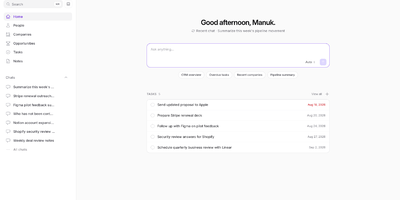
Relaticle delivers the first CRM built from the ground up for both human operators and AI agents — a self-hosted platform where Claude, GPT, Gemini, or any custom model connects through a production-grade MCP server exposing 30 tools for full CRUD operations across companies, people, opportunities, tasks, and notes without a single line of integration code. The 22 custom field types include text, email, phone, currency, date, select, multiselect, entity relationships, conditional visibility rules, and per-field encryption — all configurable through the UI without database migrations or code changes. Multi-team isolation enforces data boundaries through a 5-layer authorization system with team-scoped workspaces, API tokens, and granular permissions. The JSON:API REST surface provides Spatie QueryBuilder filtering, sorting, and pagination with schema discovery endpoints that let agents introspect your data model at runtime. A built-in AI chat connects directly to CRM data for natural language queries, while the external MCP server gives any compatible agent the same 30-tool access. Docker Compose deployment runs five containers — app (nginx + PHP-FPM), Horizon queue worker, scheduler, PostgreSQL 17, and Redis 7 — with automatic migrations on startup and demo data seeding for new teams. Running on a dedicated VPS on RepoCloud with guaranteed CPU, RAM, and SSD, full root SSH access, and a browser serial console. AGPL-3.0 licensed.
Mirobody
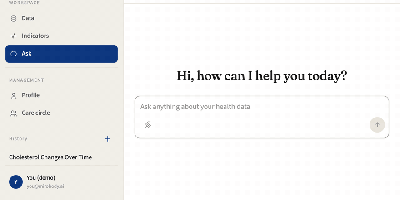
Three lab PDFs, a phone photo of a printed slip, and a spreadsheet become one cholesterol trend in Mirobody, a health data engine you host yourself, with the source file behind every number. Upload reports in 23 file types, import an Apple Health export, or connect Garmin, Oura, and Whoop, and every reading keeps a link to the page it was read from. Test names in English, Chinese, Japanese, and other languages resolve offline to LOINC codes and UCUM units, so HbA1c and Glycated Hemoglobin land on one series, and a name it cannot place stays unresolved instead of guessed. Ask questions in plain language and the agent shows each step as it works, charts the trend, and opens the reading and file behind every figure. A health journal turns one typed sentence into coded symptoms, blood pressure readings, and a medication entry, and a denied symptom like no fever is never logged. Genetic exports from 23andMe, AncestryDNA, and WeGene, or a VCF, can be queried by rsID, gene, or region. A care circle lets relatives share their own records on their own terms, and Claude Code, Codex, and Cursor can read your record through the built-in MCP endpoint. Choose OpenRouter, OpenAI, Gemini, Anthropic, or DeepSeek for answers, or keep every model on your own machine. Running on a dedicated VPS on RepoCloud with guaranteed CPU, RAM, and SSD, full root SSH access, and a browser serial console. Apache-2.0 licensed.
Obsidian Arc
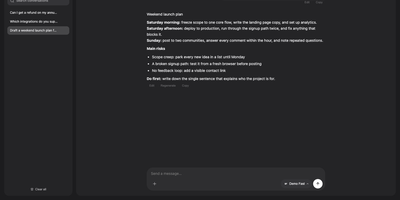
Teams and communities sign in to a private AI chat site, and one admin console routes and meters every request. Users pick a model from the menu and chat with streamed answers, visible reasoning, projects that share a system prompt, searchable history, archives, and an Image Lab for generated pictures. Administrators connect providers that speak the OpenAI or Anthropic protocols, map several models onto each, and place users in groups with their own allowances counted in requests, tokens, or credits per five hours, week, or month. A developer endpoint accepts API keys and serves chat completions, Anthropic messages, responses, images, and a model list, so coding assistants and scripts can share the same pool. The dashboard charts requests, tokens, and spend by model and by person, and Availability probes idle models and trips a circuit breaker after repeated failures. Registration can be open, invite-only, or closed, with invite codes, email rules, authenticator-app two-step sign-in, and GitHub, Google, or OpenID Connect login. Announcements, a feedback inbox, an optional leaderboard, a guest trial chat, and scheduled backups to S3-compatible storage round out the operator toolkit. A company AI portal, a classroom, a research group, or a paid community with trial codes can all run on it. Running on a dedicated VPS on RepoCloud with guaranteed CPU, RAM, and SSD, full root SSH access, and a browser serial console. MIT licensed.
Kite
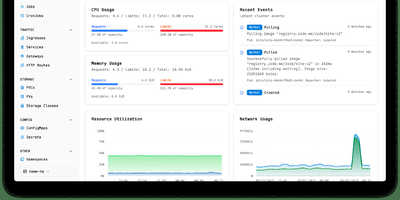
With nearly 3,000 GitHub stars and 14 releases since its June 2025 launch, Kite delivers a lightweight Kubernetes dashboard that replaces the fragmented workflow of switching between kubectl, Lens, and separate monitoring tools with a unified multi-cluster management platform. The dashboard automatically discovers clusters from kubeconfig files and supports independent Prometheus configurations per cluster, providing real-time CPU, memory, and network charts alongside live pod log streaming with filtering and search. A built-in web terminal opens shells directly into pods and nodes without kubectl port-forward, while the Monaco-based YAML editor offers syntax highlighting and validation for in-place resource editing. The integrated AI agent, powered by OpenAI or Anthropic models via native Go SDK integrations, translates natural language into precise client-go API calls — querying cluster health, analyzing pod logs, scaling deployments, patching resources, and cleaning up failed jobs — all operating strictly within the logged-in user's RBAC permissions. Enterprise governance includes OAuth 2.0 single sign-on, multi-factor authentication, FIDO2 passkeys, granular role-based access control with per-namespace permissions, and comprehensive audit logging. Helm chart management enables browsing, installing, and upgrading releases directly from the UI, while the Docker registry integration provides quick image tag selection. Deploy via a single Docker container with SQLite or use the official OCI Helm chart with PostgreSQL or MySQL for production. Running on a dedicated VPS on RepoCloud with guaranteed CPU, RAM, and SSD, full root SSH access, and a browser serial console. Apache 2.0 licensed.
TraceRoot
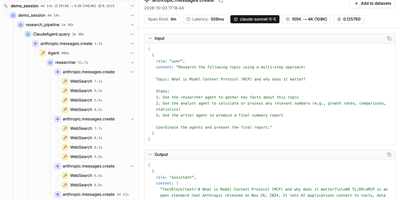
An agent run can finish without errors and still give the wrong answer, so TraceRoot traces every model and tool call, flags the production runs that missed the mark, and helps your coding agent ship verified fixes. Each run becomes a browsable call tree with inputs, outputs, latency, and cost, searchable by session or filter. Instrument with the Python or TypeScript SDK, the agent-native CLI, or any OpenTelemetry exporter, with ready integrations for LangChain, LangGraph, OpenAI Agents SDK, CrewAI, Vercel AI SDK, Mastra, and Pydantic AI. Detectors use LLM judges to score live traffic against the behavior you define and can post alerts to Slack. Judge outputs cluster into signals, then a background coding agent reads the traces and your connected GitHub code in a sandbox and recommends changes down to the commit, file, and line. Datasets, test cases, and scored eval runs compare versions so regressions surface before a release, and dashboards of widgets chart your trace data. The CLI hands your coding agent, such as Claude Code or Codex, the traces, signals, detectors, and evals to work from. Self-hosting keeps all of that trace data on infrastructure you control. Running on a dedicated VPS on RepoCloud with guaranteed CPU, RAM, and SSD, full root SSH access, and a browser serial console. Apache-2.0 licensed (core edition).
AutoGen Studio
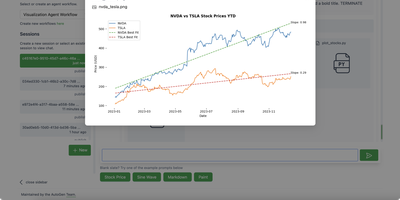
Prototype multi-agent AI systems without writing orchestration code: AutoGen Studio is Microsoft's low-code interface over the AutoGen AgentChat framework. You compose teams of LLM-powered agents in a visual Team Builder, either by drag-and-drop from a component library or by editing the declarative JSON specification directly. Each agent gets a model, a prompt, tools (Python functions), and the team gets termination conditions and an orchestration pattern, sequential or LLM-driven. The Playground runs teams interactively with live message streaming between agents, a visual control-transition graph, tool-call and code-execution tracking, and pause/stop controls, which makes it a practical debugger for agent behavior. Finished teams export as JSON for use in any Python application via the TeamManager class, or serve as an API endpoint. Any OpenAI-compatible model endpoint works, including local servers like Ollama or vLLM. Microsoft labels it a research prototype: use it for prototyping and evaluation, and build production systems on the underlying AutoGen framework.
Open Game Master
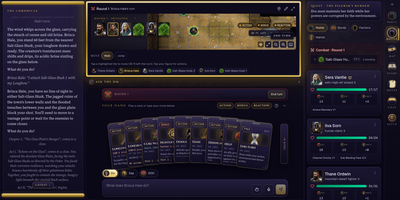
Start a fantasy campaign tonight, share an invite code with friends, and let an AI narrate the story as the server does the rolling. The model never owns the numbers: dice, hit points, spell slots, conditions, and the death track are computed and clamped by the backend, and the model changes game state only through validated tools. Players get a hand of action cards under a fogged battle map with initiative order, a chronicle of the story so far, and a party panel. A guided wizard builds SRD 5.1 characters from 48 classes and 49 backgrounds, and AI companions have real sheets that level up with the party. A secret story arc advances as chapters close and surfaces as a quest log. The workshop and map studio handle prep: paint maps, build encounters, cast, factions, bestiary entries, roll tables, and lore, then import them into any campaign. Pick the narrator from llama.cpp, Ollama, LM Studio, vLLM, OpenAI, OpenRouter, or a Codex, Grok Build, Claude Code, or opencode subscription. Optional ComfyUI or OpenAI images paint portraits and scene art, and live voice chat, ambience, and a 3D dice tray round out the table. A human Game Master mode keeps sheets and dice straight for a person narrating. Data stays in an encrypted SQLite database with no telemetry. Running on a dedicated VPS on RepoCloud with guaranteed CPU, RAM, and SSD, full root SSH access, and a browser serial console. MIT licensed.
LiteLLM Agent Control Plane
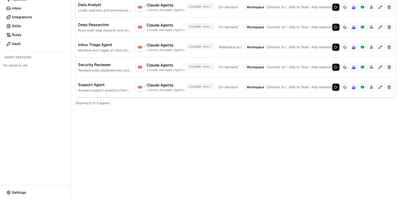
Agents scattered across vendor consoles become one tidy workspace in LiteLLM Agent Control Plane, which puts Claude Managed Agents, Cursor, OpenCode, OpenClaw, Deep Agents, and Hermes behind a single login, one API, and one dashboard. Describe an agent in plain language or start from a template for a deep researcher, an inbox triager, or a security reviewer, then tick the tools, skills, and MCP integrations it may use and pick the runtime that executes it. Chat happens inline with streamed output, sessions persist across runs, and a memory layer carries context from one session to the next. Routines launch agents on a cron schedule, and each scheduled run lands in the history as its own session. An MCP proxy injects upstream credentials at the wire, so agents never hold real secrets, and provider keys sit encrypted in a vault. Colleagues can reach the same agents from Slack, Microsoft Teams, Google Chat, or a webhook, and developers can drive everything through a REST API with a live try-it reference. Administrators issue per-user virtual keys with budgets, model limits, and expiry dates, and an inbox gathers anything that needs a human decision. Running on a dedicated VPS on RepoCloud with guaranteed CPU, RAM, and SSD, full root SSH access, and a browser serial console. MIT licensed.
FLUJO
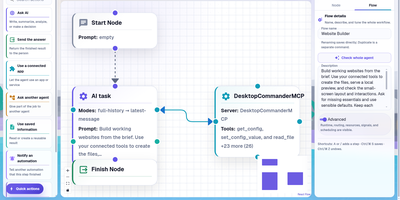
Building an AI agent in FLUJO means saving a model connection once, adding plain-language steps or dragging nodes onto a visual graph, and attaching tools from any MCP server, all inside one open-source workspace you host yourself. Connections cover OpenAI, Azure OpenAI, Anthropic, Google Gemini, xAI, OpenRouter, and local Ollama models, with ordered fallback connections for rate limits and outages plus a built-in connection test. The Connected Apps screen imports MCP servers from curated apps, the MCP Registry, a remote URL, a GitHub repository, or a local command, then lets you call their tools and read their resources before an agent touches them. Easy mode assembles an agent one recipe step at a time, Expert mode exposes Start, AI, connected-app, Static, and Subflow nodes with branching handoffs and loops, and both open the same saved agent. Talk runs agents in a live chat with a context-window meter, optional tool approvals, file and audio attachments, message editing, and a visual debugger that sets breakpoints and steps through nodes. Triggers start flows from schedules, webhooks, file changes, polled MCP tools, changed websites, or another flow finishing. Experimental Personas keep memories and goals between sessions, and Meetings seat several agents in one conversation. Any saved flow answers as a model on an OpenAI-compatible /v1 endpoint, so Cline, Cursor, or SDK clients can call it. Running on a dedicated VPS on RepoCloud with guaranteed CPU, RAM, and SSD, full root SSH access, and a browser serial console. MIT licensed.
Farfalle
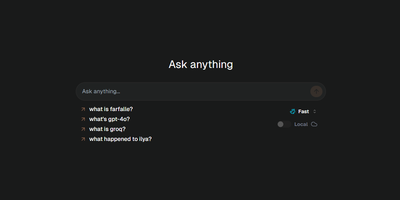
Live web search plus an LLM of your choice: Farfalle is an open-source, self-hosted answer engine in the Perplexity mold. Queries route through one of several search providers - self-hosted SearXNG for a fully independent stack, or Tavily, Serper, and Bing APIs - and the model composes a cited answer from the retrieved results. Model flexibility is the core design: run llama3, mistral, gemma, or phi3 locally through Ollama for zero per-query cost and full privacy, use cloud models like GPT-4o or Groq-hosted Llama 3 for speed, or route to any provider via LiteLLM. An Expert Search mode uses an agent that plans a multi-step search strategy and executes it for harder questions, and chat history keeps prior research sessions available. The stack is a Next.js and shadcn/ui frontend over a FastAPI backend with Redis rate limiting, shipped as a pre-built Docker image. A browser search-engine entry pointing at your instance makes it the default search from the address bar. Paired with SearXNG and Ollama, the whole pipeline runs with no external API at all.
Codel
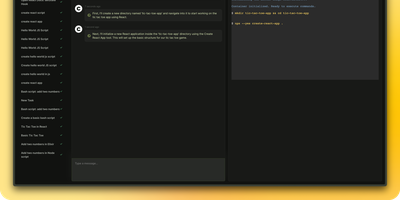
Meet your new digital sidekick, the Fully Autonomous AI Agent! This isn't just any AI; it's like having a superhero in your terminal, browser, and editor. Ready to tackle complex tasks and projects with a single command, this AI Agent is your go-to for making tech magic happen. And with RepoCloud, you're not just saving on costs, you're also joining a league of extraordinary users harnessing the power of open-source collaboration. Get ready to elevate your productivity to legendary levels!
Siftly
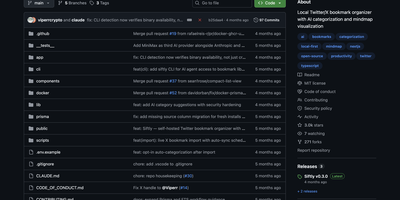
Siftly transforms your Twitter/X bookmarks from a chaotic pile of saved tweets into a searchable, AI-categorized knowledge base with an interactive visual mindmap. With over 2,700 GitHub stars since March 2026, the platform runs a four-stage enrichment pipeline on each bookmark: entity extraction mines hashtags, URLs, @mentions, and 100+ known tool domains without API calls; vision analysis generates 30-40 visual tags per image using the Anthropic SDK; semantic tagging produces 25-35 searchable descriptors; and categorization assigns one to three categories with confidence scores. Search combines SQLite FTS5 full-text indexing with Claude-based semantic reranking, narrowing candidates through keyword matching, category-intent detection, and deduplication before sending a bounded set for LLM relevance scoring, letting you find bookmarks by meaning rather than exact keywords. The interactive mindmap built on @xyflow/react renders your entire collection as a force-directed graph organized by category with expandable nodes, color-coded legends, and direct links to original tweets. Import bookmarks through a built-in bookmarklet or console script without browser extensions, then browse in grid or list view with filters for category, media type, and date range. Export as CSV, JSON, or category-grouped ZIP archives. Prisma 7 manages the local SQLite database with FTS5 built in, requiring zero external database setup. A bundled CLI provides JSON-output commands for stats, search, and category management. Running on a dedicated VPS on RepoCloud with guaranteed CPU, RAM, and SSD, full root SSH access, and a browser serial console. MIT licensed.
Tale
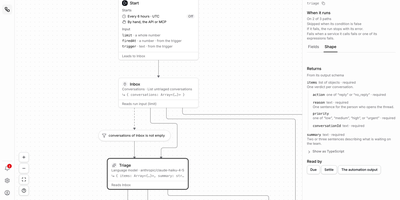
One workspace for the whole job: Tale puts your team and your AI agents on the same project board, so a question becomes an assigned task, a reviewed report, and files you can open. Describe the work with a brief, source files, and completion criteria, then assign it to a teammate or an agent. Agents get their own runtime (Claude Code, Codex, Cursor, Gemini CLI, Hermes, OpenClaw, OpenCode, Pi, or Qwen Code), model, skills, and tools, and work in a persistent sandbox; a manager agent can delegate ready tasks. Steer with @mentions in task comments, then accept the result or send it back. Chat shows the sources behind an answer and compares two models side by side in Arena. Knowledge holds documents, short entries, crawled websites, products, and contacts for retrieval within each team's access. Automations are versioned workflows with schedule, webhook, and event triggers, tests before deployment, playback of finished runs, and approval before protected writes; ready-made templates triage Gmail, Outlook, and IMAP inboxes, review pull requests, and send daily task digests. Coding agents connect over MCP with an access level you choose and can revoke. Roles, teams, budgets, guardrails, and a hash-chained audit log keep the work governed. Running on a dedicated VPS on RepoCloud with guaranteed CPU, RAM, and SSD, full root SSH access, and a browser serial console. MIT licensed.
Grasp
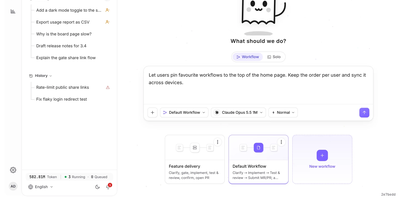
One sentence in, one reviewed pull request out: Grasp sends coding agents through a visual workflow in isolated sandboxes and leaves every approval to people. Describe a task on the home page and run it as a workflow or a Solo session. A clarify agent first asks one question at a time as clickable option cards with a recommended answer, then writes a requirement spec and plan and builds a page mock you can annotate. Workflows are drawn on a visual canvas with six node types, and failure and rollback edges send work back to an earlier step. Eight agent CLIs, including Claude Code, Codex, Cursor, and OpenCode, can run as agent nodes in a Docker, Kubernetes, or E2B sandbox shared by the nodes of a run. Runs pause at human gates in a shared inbox, and a temporary one-time link lets a reviewer without an account approve or reject. Solo sessions give a single agent an IDE, terminal, and browser, and a noVNC panel lets you watch its Chromium and take over with a click. Specs, plans, test results, and HTML previews are kept as versioned artifacts. A token page breaks cost down by workflow, source, and model. Agents push branches and open pull requests or merge requests through gh, glab, or SSH credentials stored per repository. Running on a dedicated VPS on RepoCloud with guaranteed CPU, RAM, and SSD, full root SSH access, and a browser serial console. MIT licensed.
LobeHub
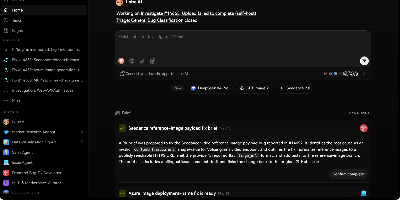
With over 82,000 GitHub stars and 700,000+ downloads, LobeHub has evolved from its origins as LobeChat into a comprehensive multi-agent AI collaboration platform where humans and autonomous agent teams co-evolve. The platform's Agent Harness architecture functions as an operating system between AI models and applications, handling prompt presets, tool orchestration, lifecycle hooks, planning, filesystem access, and sub-agent management across 25+ model providers including OpenAI, Anthropic Claude, Google Gemini, DeepSeek, Mistral, Groq, AWS Bedrock, Azure OpenAI, and local models through Ollama. Agent Groups enable sophisticated collaboration with sequential, parallel, iterative, and debate orchestration modes, allowing multiple specialized agents to tackle complex workflows simultaneously. The Agent Builder creates production-ready agents from natural language descriptions with auto-configuration, drawing from a marketplace of 505+ pre-built agents and 10,000+ MCP-compatible skills and plugins. Pages provide collaborative document editing with multi-agent co-authoring, while Schedules automate agent runs around the clock without human supervision. The knowledge base leverages PostgreSQL with pgvector for RAG-powered retrieval, and Personal Memory gives agents transparent, editable context that evolves through continual learning. The full self-hosted stack deploys via Docker Compose with PostgreSQL, Redis, RustFS for S3-compatible storage, and SearXNG for private web search, all configurable through environment variables. Running on a dedicated VPS on RepoCloud with guaranteed CPU, RAM, and SSD, full root SSH access, and a browser serial console. LobeHub Community licensed.
Plandex
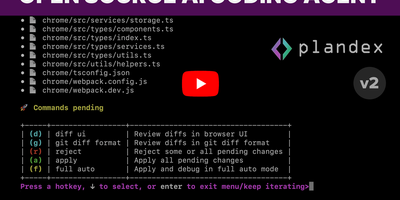
With 15,500 GitHub stars and over 1,100 forks, Plandex delivers a terminal-based AI coding agent purpose-built for the complex, multi-file tasks that overwhelm single-file AI assistants. The Go-powered server maintains a cumulative diff review sandbox that quarantines all AI-generated changes from your project files until you explicitly approve them — enabling 20-file refactors where you cherry-pick good changes and reject bad ones without touching git. A 2M token effective context window loads only what each step requires, while tree-sitter project maps index repositories exceeding 20M tokens across 30+ programming languages, providing structural awareness of class hierarchies, function signatures, and import graphs without burning tokens on full file content. The configurable model pack system assigns different models to different roles — Claude for planning, GPT for coding, Gemini for summarization — supporting Anthropic, OpenAI, Google, OpenRouter, Azure OpenAI, AWS Bedrock, DeepSeek, Perplexity, and Ollama for local models. Full auto mode handles end-to-end autonomous workflows including high-level planning, context loading, implementation, terminal command execution, and automated debugging of both terminal and browser applications. The interactive REPL provides fuzzy auto-complete, version-controlled sandbox branching, rewind to any previous point, and Git integration for commit message generation. The Plandex Server exposes 60+ REST API endpoints for programmatic orchestration across organizations, projects, plans, and branches. Deploy via Docker Compose for self-hosted operation with your own API keys. Running on a dedicated VPS on RepoCloud with guaranteed CPU, RAM, and SSD, full root SSH access, and a browser serial console. MIT licensed.