QuickStack
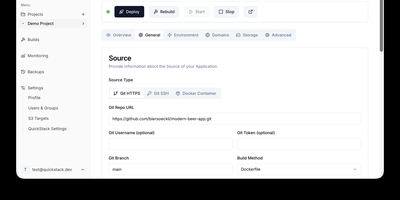
QuickStack transforms your standalone Linux server or cluster into a self-hosted platform-as-a-service that automatically compiles, deploys, and monitors full-stack applications and relational databases without vendor lock-in. Developers can trigger instant deployments directly from public or private Git repositories, upload custom Dockerfiles, or pull container images straight from private registries with automated webhook synchronization. The built-in application catalog enables one-click provisioning of production databases including PostgreSQL, MySQL, MariaDB, MongoDB, and Redis with preconfigured internal network isolation. Administrators can route traffic across custom domains with automated Let's Encrypt SSL certificate issuance, inspect real-time CPU and memory telemetry, stream container runtime logs, and launch in-browser web terminals. Teams can configure granular role-based access controls with single sign-on authentication, establish zero-trust ingress and egress network security policies, and orchestrate automated volume snapshots directly to S3 object storage. When infrastructure requirements expand, operators can attach additional worker nodes using lightweight join tokens to distribute workloads seamlessly across high-availability compute pools. Running on a dedicated VPS on RepoCloud with guaranteed CPU, RAM, and SSD, full root SSH access, and a browser serial console. GNU GPL v3.0 licensed.

Surmai
When a family vacation or group expedition spans multiple airlines, hotels, rental cars, and currencies, Surmai brings every reservation and shared cost into one collaborative travel planner. Each trip breaks down into dedicated sections for transportation legs, lodging stays, daily activities, and travel notes. Confirmation codes, terminal numbers, departure times, and street addresses stay right where everyone in your party can find them. Built-in airport, city, and airline directories auto-complete flight routes in seconds, or you can forward booking confirmation emails directly into an active trip for automatic parsing. The chronological itinerary view then weaves flights, hotel check-ins, and excursions into a clean day-by-day timeline so your group can spot layover gaps immediately. Boarding passes, train tickets, and PDF vouchers live inside a central attachment vault. Installing the Progressive Web App caches your entire itinerary and travel documents on your phone for offline viewing at airport gates or remote trailheads. A built-in expense ledger logs shared purchases across multiple currencies so nobody has to guess who paid for dinner. Administrators can invite fellow travelers over SMTP email, enable OAuth2 or OpenID Connect login with Authentik, Keycloak, Google, or Microsoft, and replicate backups continuously to S3-compatible object storage. Running on a dedicated VPS on RepoCloud with guaranteed CPU, RAM, and SSD, full root SSH access, and a browser serial console. MIT licensed.
Stormkit
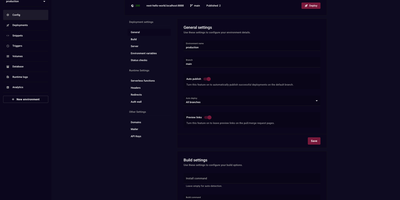
Stormkit delivers a self-hostable PaaS that eliminates vendor lock-in while providing Vercel-class deployment workflows. The Go backend handles build orchestration, hosting, and background job processing while the React frontend provides a complete management dashboard for applications, environments, and team collaboration. Git integration with GitHub, GitLab, and Bitbucket enables push-to-deploy workflows where every commit triggers automated builds with preview links posted directly to pull requests. Serverless functions use filesystem-based routing — each TypeScript or Node.js file in the API directory becomes an endpoint automatically, deploying to AWS Lambda with configurable timeouts. PostgreSQL database schemas ship with automatic migrations, isolated credentials per environment, and secure environment variable injection preventing credential leakage between staging and production. Custom domains provision TLS certificates automatically through Let's Encrypt with support for custom certificates and headers. The environment system creates isolated deployment contexts for production, staging, and development with independent variables, domain bindings, and auto-publish rules per branch. Privacy-respecting server-side analytics track visitors, referrers, and top paths without client cookies or third-party scripts. Role-based access control manages team permissions across applications. Docker Compose deployment provisions the full stack including the API server, hosting service, build runner, and worker server. Running on a dedicated VPS on RepoCloud with guaranteed CPU, RAM, and SSD, full root SSH access, and a browser serial console. AGPL-3.0 licensed.
Zusam
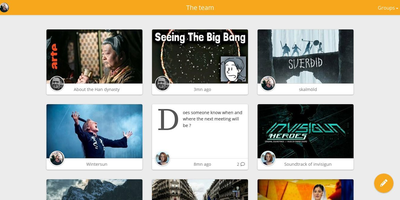
From the German "zusammen," together: Zusam is a private social space for a group of friends - a self-hosted alternative to the family WhatsApp group or the friends Facebook group, with no ads, algorithms, or data harvesting in between. The AGPLv3 project is deliberately modest in scope and stack: a Symfony PHP backend exposing a REST API over SQLite, with a lightweight Preact single-page frontend, designed for a low server footprint that runs comfortably on small hardware. Groups post messages into shared feeds that handle real life well: video and image uploads (with FFmpeg processing), photo albums for trips and events, and rich link previews with inline embeds for YouTube, Vimeo, Imgur, SoundCloud, Twitch, and Bandcamp - so sharing a song or a clip looks the way it should. When something needs to leave the circle, public link generation exposes a single message to non-members without opening the group. The interface is fully responsive and mobile-friendly, targeting Firefox ESR and recent Chrome. It is the small-web answer to a real question: where does a group chat's shared history live when you want it owned by the group instead of a platform?
Knock-Knock
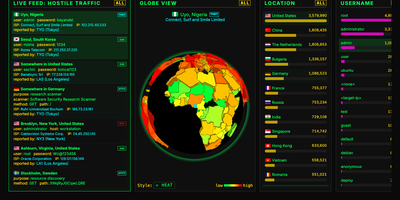
Bots that knock on your server's login ports are always turned away by Knock-Knock, a multi-protocol honeypot that shows every attempt on a live dashboard. Honeypots answer on the standard ports for SSH, Telnet, FTP, RDP, SMB, SIP, HTTP, and SMTP, with MQTT, Node-RED, Modbus, S7, and SNMP as optional extras. Authentication is always rejected, so no bot ever gets a shell. Who is knocking? The live feed shows each attempt's country, username, password, ISP, IP, and protocol. From where? A 3D globe marks the origin in one of six styles, including an extruded country heat map. Trying what? Leaderboards rank countries, usernames, passwords, ISPs, and IP addresses, and a trivia panel explains why bots favor certain credentials. A protocol filter re-slices the feed, globe, and leaderboards together; SIP shows dialed numbers and toll-call destinations, and RDP shows hostnames and accounts. Too fast? Press the space bar to pause, right-click any knock for details, or switch on a virtual Geiger counter that clicks as attacks arrive. Want to fight back? Download hourly 30-day and 365-day blocklists with recipes for CSF, CrowdSec, ipset, nftables, and pfSense, or query the optional API for any IP, CIDR range, or ASN. Several honeypot servers can stream into one aggregated dashboard. Running on a dedicated VPS on RepoCloud with guaranteed CPU, RAM, and SSD, full root SSH access, and a browser serial console. MIT licensed.
DispatchMail
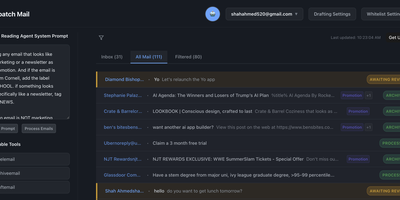
DispatchMail is an SuperHuman alternative and delivers a self-hosted AI email assistant that processes your Gmail inbox through configurable OpenAI prompts without sending data to third-party cloud services beyond the LLM API itself. The Flask backend connects to Gmail via IMAP, retrieves new messages according to your schedule, and routes them through customizable whitelist rules based on sender address, subject keywords, or natural language descriptions before AI processing begins. Two distinct prompt configurations control behavior — the Reading Prompt instructs how the AI should analyze and classify incoming messages, while the Draft Prompt defines how responses should be composed, letting you maintain consistent tone and policy across all automated replies. Whitelist filtering ensures the AI only processes messages you explicitly authorize, preventing unnecessary API costs and keeping sensitive emails out of the LLM pipeline entirely. The React web interface provides inbox management with message previews, AI-generated summaries, draft editing with human-in-the-loop approval before sending, and configuration panels for prompts and rules. Automatic labeling and archival organize processed messages into categories without manual intervention. The sender research feature uses LLM-powered deep analysis to build background profiles of email contacts. All email content, credentials, and processing results persist in a local SQLite database with zero cloud storage dependencies. Running on a dedicated VPS on RepoCloud with guaranteed CPU, RAM, and SSD, full root SSH access, and a browser serial console. Apache-2.0 licensed.
AKB
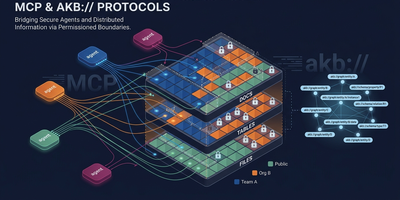
Achieving 98.4% Recall@5 on LongMemEval-S without a reranker, AKB is the agent-native knowledge infrastructure giving Claude Code, Cursor, Windsurf, and any MCP-aware agent persistent organizational memory — a drop-in replacement for Confluence or Notion where AI agents read and write directly rather than scraping human-formatted pages. Documents are stored as Markdown with YAML frontmatter in Git bare repositories (full version history, branching, diff), while PostgreSQL 16 serves as source of truth for chunk text, metadata, and BM25 vocabulary, with dense embeddings handled by a pluggable vector store (pgvector default, Qdrant optional, or managed Seahorse). Agents interact through 20+ MCP tools — akb_put, akb_search, akb_browse, akb_relations, akb_sql, akb_edit, akb_history — performing hybrid dense plus BM25 search fused via Reciprocal Rank Fusion in one call. The URI graph (depends_on, related_to, implements relations) lets agents traverse knowledge connections without external graph databases. Multi-tenant vault isolation is enforced at the PostgreSQL ACL level with per-user roles and SET LOCAL ROLE for SQL sandboxing. Event fanout streams structured events to Redis Streams for external consumers (synthesis bots, digest agents, audit trails), and a hash-chained append-only audit log integrates with enterprise SIEMs. Ships with agent plugins for Claude Code and Codex (session capture, wiki ingest, lifecycle hooks), Kubernetes kustomize manifests, and Open Knowledge Format export. Running on a dedicated VPS on RepoCloud with guaranteed CPU, RAM, and SSD, full root SSH access, and a browser serial console. BSL 1.1 licensed (free under 100 seats, auto-converts to Apache 2.0 after four years).
EverShelf
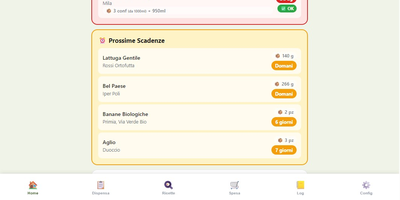
That yogurt hiding behind the ketchup expired three weeks ago, and the flour you bought "just in case" has been sitting in the pantry since last winter. EverShelf replaces mental guesswork with a structured inventory system that tracks every item across pantry, fridge, freezer, and custom locations with precise quantities, expiry dates, and consumption patterns. Scan barcodes with your phone camera to add products instantly, or let the Gemini AI identify items from a photo and estimate shelf life based on storage location. The dashboard surfaces expired items and upcoming expirations with color-coded urgency badges, while anomaly detection flags suspicious quantities and consumption predictions that deviate from your history. Opened products get reduced shelf-life calculations; vacuum-sealed items get extended dates automatically. The recipe engine generates context-aware meal suggestions from your current inventory, prioritizing ingredients approaching expiry so nothing goes to waste; each recipe includes step-by-step cooking mode with text-to-speech narration and timer integration. A smart shopping list auto-populates when stock hits zero and syncs bidirectionally with the Bring! app, with AI-estimated prices per item and consumption forecasts showing when you will need to restock. For Home Assistant users, a native HACS integration provides 22 sensors, expiry calendars, bidirectional todo-list sync, and voice assistant support for adding items hands-free. A dedicated Kiosk mode optimizes the interface for wall-mounted tablets with BLE scale integration. Running on a dedicated VPS on RepoCloud with guaranteed CPU, RAM, and SSD, full root SSH access, and a browser serial console. MIT licensed.
UWAS
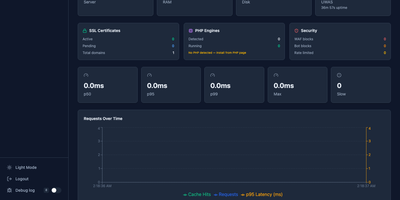
One 18 MB Go binary does the job of Apache, Nginx, Varnish, Caddy, and cPanel combined. Point UWAS at your /var/www directory and it auto-detects sites, provisions Let's Encrypt certificates, enables HTTP/3 via QUIC, and activates a two-tier caching engine with L1 memory shards and L2 disk storage, all before you write a single line of configuration. The React 19 admin dashboard provides 42 management pages for domains, PHP versions, databases, cron jobs, DNS records, file management, backup and restore, SFTP users, and uptime monitoring with real-time SSE updates. PHP sites run through FastCGI with connection pooling and full .htaccess compatibility, so WordPress, Laravel, and legacy applications work without migration effort. The built-in WAF catches SQL injection, XSS, path traversal, and shell exploits, while per-domain rate limiting and bandwidth caps protect against abuse. Reverse proxy mode supports five load balancing algorithms, circuit breakers, canary deployments, and mirroring for blue-green rollouts. Git deploy clones your repository, runs the build, checks health, and restarts the service with rollback on failure. An MCP server lets AI agents manage domains, cache, and deployments through natural language. The Nginx and Apache migration CLI converts existing configurations to UWAS format automatically. Deploy on a dedicated VPS on RepoCloud with guaranteed CPU, RAM, and SSD, full root SSH access, and a browser serial console. AGPL-3.0 licensed.

RocketplaneIO
RocketplaneIO is a self-hosted AI SRE platform that gives Kubernetes clusters zero-instrumentation eBPF observability plus a copilot capable of safely diagnosing and fixing issues without your telemetry ever leaving your infrastructure. Point it at any cluster, and an eBPF DaemonSet starts capturing HTTP, gRPC, SQL, Redis, and Kafka spans across every service, including compiled binaries, with cross-service context propagation and no code changes required. The live service map draws itself from actual network traffic, matching technology logos from container images and coloring each node's health from RED metrics. Every log line sits two clicks from its parent distributed trace, and a PromQL query engine, embedded from the real Prometheus evaluator, runs over ClickHouse for long-term metric retention. The complete Kubernetes inventory (Services, Ingress, ConfigMaps, network policies, persistent volumes, CRDs) syncs continuously and is searchable alongside traces and logs. When the copilot identifies a problem, it picks from a catalog of roughly 30 risk-classified safe actions; each action verifies its preconditions, captures a before-state snapshot, executes, checks the result, and rolls back automatically on failure. Disruptive operations pause for explicit human approval before proceeding. An MCP endpoint exposes the identical guardrailed toolbox to external AI agents, so Claude Code or Cursor can operate the cluster through the same safety boundary the browser copilot uses. Complex remediations compose as searchable, forkable Starlark workflows that compile deterministically at save. Running on a dedicated VPS on RepoCloud with guaranteed CPU, RAM, and SSD, full root SSH access, and a browser serial console. Apache-2.0 licensed.