Portabase
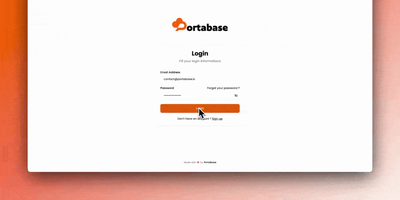
Portabase takes a zero-trust approach to database backups: lightweight Rust/Tokio agents deploy next to each database, encrypt dumps with AES-GCM before data ever leaves the host, and poll the Next.js control plane outbound every five seconds requiring zero inbound firewall rules. This architecture contains blast radius if the dashboard is compromised while supporting ten engines with stable backup and restore: PostgreSQL 12 through 18, MySQL 5.7 through 9, MariaDB 10 and 11, MongoDB 4 through 8, SQLite 3.x, Redis 2.8+, Valkey 7.2+, Firebird 3.0 through 5.0, Microsoft SQL Server 2017 through 2022 including Azure SQL, and Docker volumes on Engine 20.10+. Encrypted backups store on configurable backends including local filesystems, any S3-compatible provider (AWS, MinIO, RustFS), Google Cloud Storage, and Azure Blob Storage. Cron-based scheduling with Grandfather-Father-Son retention policies automates backup lifecycle management, while on-demand restore targets any compatible server for cross-environment recovery. The CLI installs agents with a single command and auto-updates when new versions ship. A RESTful API with MCP server integration enables automation from CI/CD pipelines and AI agent workflows. Developed by a non-profit under Apache-2.0. 1,270+ stars and 174 releases since October 2024. Running on a dedicated VPS on RepoCloud with guaranteed CPU, RAM, and SSD, full root SSH access, and a browser serial console.
Kodus AI
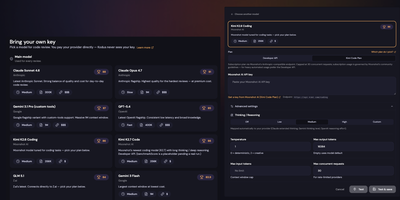
Kodus AI automates pull request code review with inline AI comments across GitHub, GitLab, Bitbucket, and Azure DevOps, supporting any LLM provider at cost with zero token markup. The multi-service TypeScript architecture deploys via Docker Compose, running an API server, background worker, webhooks service, and React dashboard backed by PostgreSQL with pgvector, MongoDB, and RabbitMQ. Integration covers both cloud platforms and their enterprise flavors (GitHub Enterprise Server, GitLab Self-Managed, Bitbucket Data Center) using standard OAuth flows and webhook signing to keep the review loop entirely inside your network. The platform is model-agnostic with Bring Your Own Key support for Claude, GPT, Gemini, Llama, and any OpenAI-compatible endpoint including locally-hosted models. Custom review rules combine your team's coding standards with requirements pulled from Jira, Linear, and Notion, automatically checking every PR against documented specifications. The CLI enables local reviews against working trees, staged diffs, branches, or specific commits, integrating into CI/CD pipelines as pre-merge gates. Source code is never stored and never used for model training, with all data encrypted in transit and at rest. 1,270+ stars and 129+ releases since March 2025. Running on a dedicated VPS on RepoCloud with guaranteed CPU, RAM, and SSD, full root SSH access, and a browser serial console. AGPL-3.0 licensed.
ExcaliDash
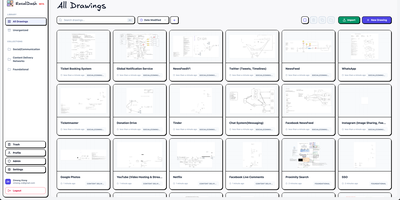
ExcaliDash adds persistent storage, access control, version history, and real-time collaboration to Excalidraw, transforming ephemeral whiteboarding sessions into a managed drawing library your team can rely on. The Node.js/Express backend with React/TypeScript frontend deploys via Docker Compose on port 6767, using Prisma ORM on SQLite for all drawings, users, and metadata. WebSocket-powered collaboration lets multiple users edit the same canvas simultaneously with live cursor presence. Drawing snapshots preserve every revision with visual preview and one-click restore to any previous state. Three authentication modes handle different deployment needs: local email/password for personal use, hybrid mode mixing native credentials with OIDC for gradual enterprise adoption, and enforced OIDC-only for organizations requiring SSO through providers like Authentik or Keycloak. Scoped sharing controls determine whether drawings stay private, shared internally with team members, or accessible via external links without authentication. Collections organize drawings through drag-and-drop grouping, full-text search locates any diagram instantly, and exports use the non-proprietary .excalidraw format ensuring complete data portability. 1,350+ stars since November 2025. Running on a dedicated VPS on RepoCloud with guaranteed CPU, RAM, and SSD, full root SSH access, and a browser serial console. AGPL-3.0 licensed.
Securo
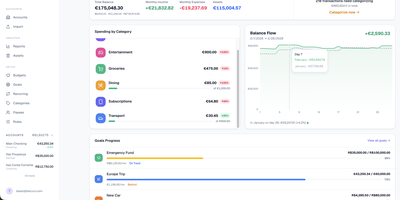
Securo is a privacy-first personal finance platform that keeps all your financial data in your own PostgreSQL instance while connecting to 2,500+ banks across three continents for automated transaction sync. The FastAPI backend with React/TypeScript frontend deploys via Docker Compose on ports 3000 and 8000, with Redis-backed Celery workers handling background synchronization. Bank connections span approximately 2,500 European PSD2 institutions through Enable Banking across 29 countries, US and international banks via SimpleFIN's open protocol, and Brazilian banks through Pluggy, all refreshing automatically every four hours. Multi-account management tracks checking, savings, credit cards, and investments with running balances. The auto-categorization rules engine applies pattern-matching across merchants and amounts. Goal tracking monitors savings targets with progress visualization, asset management handles stocks and custom instruments with configurable valuation growth rules, and reports generate Net Worth and Income vs Expenses charts with category sparklines. Optional AI Agents provide LLM chat with tool-use over your financial data through MCP, supporting OpenAI, Anthropic, Ollama, and compatible providers with per-agent RAG knowledge bases accessible via a global command palette. Multi-user support includes OIDC login, passkey authentication, TOTP two-factor, privacy mode, and multi-currency FX conversion via Open Exchange Rates. 1,500+ stars since March 2026. Running on a dedicated VPS on RepoCloud with guaranteed CPU, RAM, and SSD, full root SSH access, and a browser serial console. AGPL-3.0 licensed.
Databasement
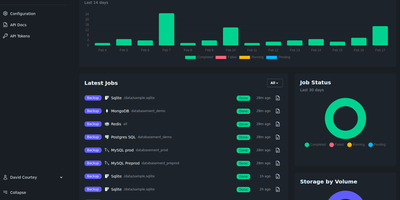
Databasement puts scheduled backup and restore for nine database engines behind one polished web interface, deployed as a single Docker container on port 2226. The Laravel and Livewire backend uses native CLI tools for MySQL 5.6 through 9.x, PostgreSQL 12 through 18, MariaDB 10.x through 12.x, Microsoft SQL Server 2017 through Azure SQL, MongoDB 4.2 through 8.0, SQLite 3.x, Firebird 3.x through 5.x, Redis 2.8+, and Valkey 7.2+ with full restore support including cross-server recovery. SSH tunnel connectivity reaches databases behind firewalls via bastion servers with password or private key authentication, and remote agents handle isolated networks by connecting outbound over HTTPS without inbound ports. Scheduling supports arbitrary cron expressions with GFS grandfather-father-son retention alongside simple time-based cleanup. Storage spans local disk, S3-compatible services including AWS and MinIO, Azure Blob, Samba/SMB shares, and SFTP/FTP servers. Scheduled restores automate production-to-staging synchronization on recurring intervals. Failure notifications alert via Email, Slack, Discord, Telegram, Pushover, Gotify, and webhooks with detailed job logs. The REST API and built-in MCP server enable CI/CD pipeline integration and AI assistant access from Claude, Cursor, and VS Code Copilot. 1,700+ stars since November 2025. Running on a dedicated VPS on RepoCloud with guaranteed CPU, RAM, and SSD, full root SSH access, and a browser serial console. MIT licensed.
Speakr
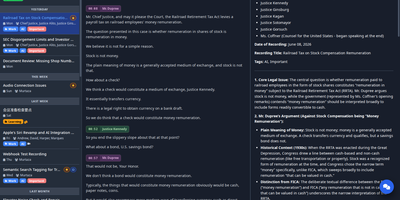
Speakr transforms audio recordings into organized, searchable, AI-enhanced notes with speaker recognition that identifies who said what across your entire recording library. The Python/Flask backend with Vue.js 3 and Tailwind CSS frontend deploys via Docker on port 8899, offering multiple transcription engines through auto-detected connectors: WhisperX for local processing with speaker diarization and voice embeddings, OpenAI Whisper and GPT-4o-transcribe, Mistral Voxtral for cloud diarization, AssemblyAI for multi-hour files, and any custom ASR webservice. Speaker voice profiles use embedding comparison to recognize individuals across different recordings automatically, while custom vocabulary biases the transcriber toward domain-specific jargon. The AI layer goes well beyond transcription: customizable summaries with per-recording, per-tag, and per-folder prompt templates; event extraction surfacing action items and calendar events; per-recording chat with streaming responses; and Inquire Mode for semantic search and natural-language queries across your entire library simultaneously. Smart tags execute custom AI prompts on transcripts for automatic categorization. The REST API with Swagger documentation supports signed webhooks integrating with n8n, Zapier, and Make. Auto-export pushes to Obsidian and Logseq, auto-processing watches directories, and the installable PWA provides mobile-first, offline-capable access with share-target support. 3,600+ stars since May 2025. Running on a dedicated VPS on RepoCloud with guaranteed CPU, RAM, and SSD, full root SSH access, and a browser serial console. AGPL-3.0 licensed.
Pulse
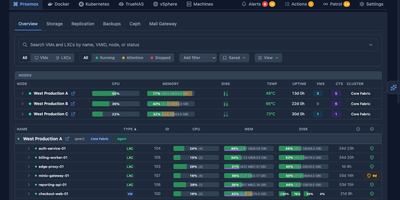
Pulse monitors your entire heterogeneous infrastructure from one screen: Proxmox VE, Proxmox Backup Server, Proxmox Mail Gateway, Docker, Podman, Docker Swarm, Kubernetes, TrueNAS SCALE/CORE, VMware vSphere, and standalone Linux/Windows/macOS machines. The Go binary embeds a SolidJS/TypeScript frontend, delivering WebSocket-driven dashboards with sub-second metric updates on port 7655. A unified agent auto-detects Docker, Podman, Kubernetes, and Proxmox on each host without manual configuration and self-updates silently, while Proxmox nodes need only API credentials with zero agent installation. Smart alerts use adaptive hysteresis-based thresholds to prevent notification floods, pushing to Discord, Slack, Telegram, Teams, email, ntfy.sh, Gotify, and generic webhooks with per-resource overrides. The standout feature is Pulse Patrol: scheduled AI health checks running every ten minutes to seven days using OpenAI, Anthropic, Gemini, or local Ollama models. Patrol catches silent backup failures, capacity creep, restart loops, unhealthy containers, and clock drift that dashboards miss when nobody is watching. Platform-specific views render Proxmox nodes, Ceph clusters, Docker Compose projects, Kubernetes workloads, TrueNAS pools, and vSphere VMs in familiar layouts. OIDC, SSO, and SAML authentication with credential encryption at rest secures access. 6,500+ stars and 441 releases since February 2025. Running on a dedicated VPS on RepoCloud with guaranteed CPU, RAM, and SSD, full root SSH access, and a browser serial console. MIT licensed.
Arcane
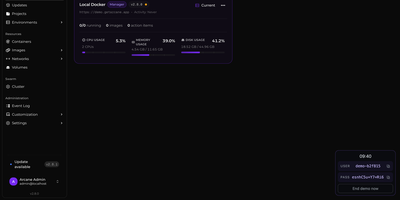
Arcane gives you a single polished dashboard to manage Docker containers, images, volumes, networks, and Compose projects across unlimited remote hosts. The SvelteKit frontend paired with a Go backend delivers real-time resource monitoring with historical graphs, container lifecycle controls including shell exec and live log streaming, and one-click Docker Compose deployment with Git repository synchronization for version-controlled stack definitions. The manager-agent architecture connects remote environments via Direct TCP on port 3553 or Edge mode where agents initiate outbound gRPC/WebSocket connections through NAT and firewalls without requiring inbound ports, all secured with mTLS certificates. Vulnerability scanning identifies security issues in running container images directly from the interface. The backup system enables scheduled container snapshots with configurable retention for disaster recovery. Network and volume administration includes visual relationship mapping between services, and the responsive interface supports dark/light themes with full mobile optimization and community-driven internationalization via Crowdin. 6,500+ stars and 89 releases since April 2025 reflect a rapid development cadence. Running on a dedicated VPS on RepoCloud with guaranteed CPU, RAM, and SSD, full root SSH access, and a browser serial console. BSD-3-Clause licensed.
Frappe
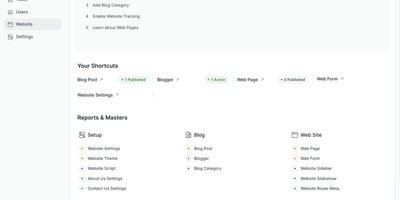
Define a DocType in Frappe and the framework automatically generates database tables, Python ORM classes, REST API endpoints, form views, list views, and role-based permission rules from that single schema definition. The meta-driven architecture stores schemas as database records, letting administrators add fields, reorder layouts, and modify validation rules through the browser-based Form Builder without redeployment. Server-side Python controllers handle business logic through hook-based lifecycle events while client-side JavaScript manages interactive form behavior, with WebSocket connections providing real-time updates across sessions. The built-in workflow engine defines document state machines with role-gated transitions, email notifications, and conditional action visibility. Pre-configured Desk views include list, form, report, tree, kanban, calendar, and dashboard layouts with drag-and-drop workspace customization. The report builder generates grid reports with configurable columns, filters, grouping, and chart visualizations from DocType data or custom SQL and Python scripts. Background job processing uses Redis queues for email delivery, data imports, and periodic tasks. Virtual DocTypes connect external databases to the framework's UI without data migration. Docker deployment via frappe_docker provides production-ready Compose configurations with MariaDB, Redis, Nginx, and worker containers. The foundation powering ERPNext, HRMS, CRM, and Helpdesk in production. Over 10,500 GitHub stars. MIT licensed.
Garnet
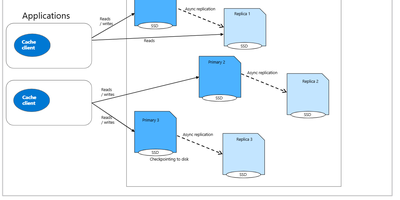
Garnet is Microsoft Research's cache-store built on .NET that speaks the Redis RESP wire protocol while delivering up to 10x higher throughput and 4x lower tail latency than comparable alternatives on identical hardware. The Tsavorite storage engine provides a cache-friendly, shared-memory architecture scaling linearly across CPU cores, supporting both in-memory operation and tiered storage across local SSDs and Azure Storage for datasets exceeding available RAM. Cluster mode enables sharded deployments with replication, dynamic key migration for live rebalancing, non-blocking checkpointing, and automatic failover using standard Redis cluster commands. The RESP implementation covers raw strings, sorted sets, lists, hashes, sets, bitmaps, HyperLogLog, streams, pub/sub, Lua scripting, and client-side transactions, allowing StackExchange.Redis, Jedis, redis-py, and other Redis clients to connect without modification. C#-based extensibility lets developers define custom commands and new data types as server-side stored procedures, compiled and loaded at runtime without restarting the server. TLS encryption, ACL-based access control, and operation logging complete the production feature set. Deployed across Microsoft services including Windows & Web Experiences, Azure Resource Manager, and Azure Resource Graph. Nearly 12,000 GitHub stars. MIT licensed.
Amplication
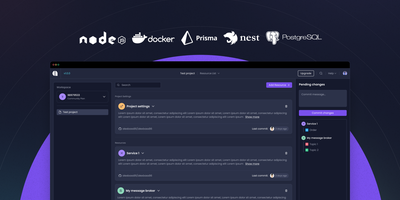
Amplication turns entity definitions into production-ready backend services, generating NestJS with Prisma and Apollo GraphQL for Node.js or ASP.NET Core for .NET, eliminating months of boilerplate. The plugin-driven Data Service Generator hooks into code generation lifecycle events, enabling teams to inject CI/CD manifests, proprietary authentication schemes, testing configurations, and cloud-specific deployment targets for AWS, Azure, and GCP without forking the core generator. Blueprint templates encode organizational architecture standards, security policies, and coding conventions into reusable foundations that keep every generated service consistent across the engineering organization. Jovu AI translates natural language requests into entities, relationships, fields, modules, DTOs, and custom API actions, automatically aligning each resource with predefined standards. Generated services include full CRUD operations with input validation, Swagger/OpenAPI documentation, authentication middleware, database-agnostic ORM via Prisma, optional React Admin interfaces, and Jest test scaffolding. Code output syncs to Git repositories as pull requests, preserving standard review workflows while letting developers edit every generated line and add custom business logic. Supports PostgreSQL, MySQL, and MongoDB as database targets. Over 16,000 GitHub stars with enterprise adoption. Apache 2.0 licensed.
Forge
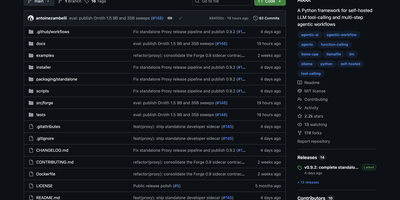
Forge intercepts failing LLM tool calls and fixes them before they derail your agent workflow, applying rescue parsing, retry nudges, response validation, and step enforcement between your AI clients and local model backends. The proxy server mode drops in as a transparent intermediary speaking both the OpenAI chat-completions API and the Anthropic Messages API, so tools like Aider, Claude Code, Continue, and opencode connect through it without configuration changes. Under the hood, the WorkflowRunner provides a complete agentic loop manager with system prompt injection, tool execution, context compaction with configurable thresholds, and VRAM budgeting for consumer GPUs with 12-32 GB. SlotWorker enables priority-queued access to shared inference slots with automatic preemption for multi-agent architectures. The guardrails middleware exposes a two-method check-and-record API that wraps into any existing orchestration loop, providing malformed tool-call rescue parsing, retry nudge generation, required step enforcement, and prerequisite ordering without taking over execution control. Backend adapters support generic OpenAI-compatible endpoints, Ollama, llama-server, Llamafile, vLLM, and Anthropic with automatic model discovery and health checking. Architecture Decision Records document every design choice. Launched February 2026, already at 2,200+ GitHub stars. MIT licensed.
Gollum
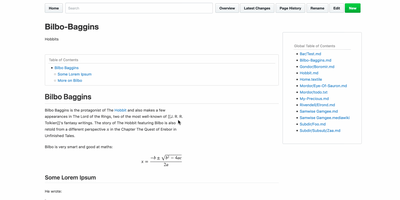
Every wiki page lives as a plain-text file in a standard Git repository, giving you full version history, branching, merging, and the freedom to edit with any text editor or IDE alongside the web interface. Originally built by GitHub's founders as the engine behind GitHub's own wiki feature, Gollum supports Markdown, AsciiDoc, reStructuredText, Org-mode, Textile, MediaWiki, Creole, and Pod markup formats with live preview rendering as you type. PlantUML and Mermaid diagrams render inline for architecture documentation, MathJax handles mathematical notation, and BibTeX integration via Pandoc provides academic citation management. YAML frontmatter controls per-page sidebars, headers, footers, and table of contents generation. CriticMarkup annotations enable editorial review workflows with tracked insertions, deletions, substitutions, and comments. Macros extend pages with dynamic content injection, file includes, and navigation helpers. The wiki maintains compatibility with GitHub and GitLab wiki repositories, so teams can clone existing platform wikis for local editing and offline access. The official Docker image at gollumwiki/gollum exposes port 4567 with volume-mounted repositories, requiring roughly 170 MB of container storage and minimal RAM. Authentication integrates via OmniAuth supporting GitHub, GitLab, Google, and other OAuth providers. Over 14,300 stars on GitHub since 2009. MIT licensed.
OpenMetadata
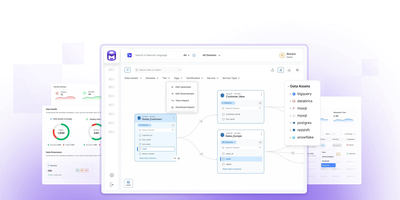
OpenMetadata builds a unified knowledge graph connecting schemas, tables, columns, dashboards, pipelines, ML models, and data products into one searchable catalog accessible at port 8585. The ingestion framework ships 130+ connectors covering Snowflake, BigQuery, Redshift, Databricks, PostgreSQL, MySQL, Kafka, Airflow, dbt, Tableau, Looker, Power BI, Metabase, and Superset, automatically extracting metadata on configurable schedules. Column-level lineage traces data flow across transformations, joins, and aggregations, while built-in data quality testing executes profiling and validation rules as data contracts with automated alerting on failures. Governance features include role-based access control, PII auto-detection, glossary term propagation, and domain-based ownership assignment. The native MCP server and AI SDK expose semantic search, lineage queries, and governance metadata as tools any LLM agent can call, enabling AI systems to discover and reason about enterprise data with full trust context. The architecture requires only PostgreSQL or MySQL plus Elasticsearch, no Kafka, no graph database, and deploys via a single Docker Compose file. Created by the founders of Apache Hadoop, Apache Atlas, and Uber's Databook, the platform has earned over 14,700 GitHub stars and adoption by 3,000+ organizations. Apache 2.0 licensed.
Livebook
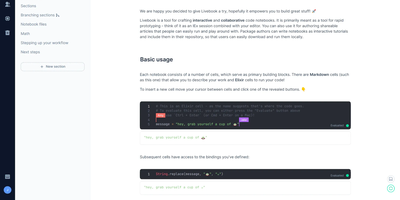
Livebook is an interactive notebook for Elixir where you write code alongside rich Markdown prose, execute it cell by cell with reactive dependency tracking, and deploy finished notebooks as standalone web applications with a single click. Nearly 6,000 GitHub stars reflect the Elixir core team's investment in a platform where code cells run on demand alongside Mermaid diagrams and KaTeX mathematical formulas. The Kino visualization library renders Vega-Lite charts, interactive data tables with sorting and pagination, Leaflet maps, and Mermaid diagrams directly within notebook output cells, while custom Kino components enable building interactive controls with sliders, text inputs, and buttons that feed values back into running code. Smart cells abstract high-level tasks into configurable UI widgets: query PostgreSQL, MySQL, SQLite, and BigQuery databases, train machine learning models with Axon, plot charts, and build map visualizations without writing boilerplate code. Real-time collaboration lets multiple users edit the same notebook simultaneously with cursor presence indicators and synchronized cell evaluation. Notebooks are stored as .livemd files, a Markdown-compatible format that renders cleanly on GitHub and integrates with standard version control workflows. Custom runtimes connect Livebook to existing Elixir applications for live introspection and documentation of running systems. The Docker image at ghcr.io/livebook-dev/livebook exposes ports 8080 and 8081 with password or token authentication. Running on a dedicated VPS on RepoCloud with guaranteed CPU, RAM, and SSD, full root SSH access, and a browser serial console. Apache 2.0 licensed.
Siftly
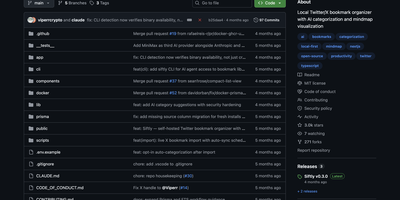
Siftly transforms your Twitter/X bookmarks from a chaotic pile of saved tweets into a searchable, AI-categorized knowledge base with an interactive visual mindmap. With over 2,700 GitHub stars since March 2026, the platform runs a four-stage enrichment pipeline on each bookmark: entity extraction mines hashtags, URLs, @mentions, and 100+ known tool domains without API calls; vision analysis generates 30-40 visual tags per image using the Anthropic SDK; semantic tagging produces 25-35 searchable descriptors; and categorization assigns one to three categories with confidence scores. Search combines SQLite FTS5 full-text indexing with Claude-based semantic reranking, narrowing candidates through keyword matching, category-intent detection, and deduplication before sending a bounded set for LLM relevance scoring, letting you find bookmarks by meaning rather than exact keywords. The interactive mindmap built on @xyflow/react renders your entire collection as a force-directed graph organized by category with expandable nodes, color-coded legends, and direct links to original tweets. Import bookmarks through a built-in bookmarklet or console script without browser extensions, then browse in grid or list view with filters for category, media type, and date range. Export as CSV, JSON, or category-grouped ZIP archives. Prisma 7 manages the local SQLite database with FTS5 built in, requiring zero external database setup. A bundled CLI provides JSON-output commands for stats, search, and category management. Running on a dedicated VPS on RepoCloud with guaranteed CPU, RAM, and SSD, full root SSH access, and a browser serial console. MIT licensed.
Browser Use WebUI
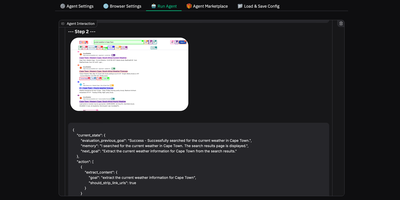
Browser Use Web UI lets you describe a web task in plain English and watch as an AI agent autonomously navigates pages, clicks buttons, fills forms, and extracts information without writing any automation code. Backed by over 16,000 GitHub stars, the Gradio-based interface supports 14+ LLM providers through a unified abstraction layer: OpenAI GPT, Anthropic Claude, Google Gemini, Azure OpenAI, DeepSeek, and local Ollama models are all configurable via dropdown menus without touching code or environment files. The BrowserUseAgent handles interactive single-task automation with step-by-step LLM decision-making and vision-based page understanding, while the DeepResearchAgent orchestrates multi-step research workflows using Langgraph state machines that spawn parallel browser instances with asyncio concurrency control. Custom browser support connects your existing Chrome profile to preserve logins, cookies, and sessions across agent runs, eliminating re-authentication overhead. Persistent browser sessions maintain complete interaction history between tasks for debugging and demonstration. The Docker deployment bundles Chrome, Playwright, and a VNC server in a single container, exposing the Gradio interface on port 7788 and a noVNC viewer on port 6080 for real-time observation of agent behavior. MCP integration via MultiServerMCPClient enables external tool access. Screen recording captures agent workflows as video for review and documentation. Running on a dedicated VPS on RepoCloud with guaranteed CPU, RAM, and SSD, full root SSH access, and a browser serial console. MIT licensed.
Kokoro FastAPI
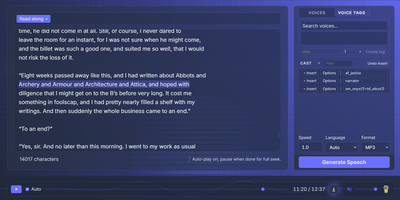
Kokoro-FastAPI turns text into natural-sounding speech across eight languages by serving the 82-million-parameter Kokoro-82M model through an OpenAI-compatible REST API, so any existing OpenAI SDK client can generate audio by just changing the base URL. With over 5,300 GitHub stars since December 2024, the fully Dockerized FastAPI server covers American English, British English, Spanish, French, Hindi, Italian, Japanese, Brazilian Portuguese, and Mandarin Chinese with language-specific phoneme processing. Inline voice mixing blends multiple profiles using weighted ratios like af_bella(2)+af_heart(1), automatically normalizing weights and caching combined voicepacks as PyTorch tensor files for reuse. Audio streams in real time over HTTP with configurable chunk sizes, or generates complete files in MP3, WAV, OPUS, FLAC, AAC, or PCM formats with speed control from 0.25x to 4.0x. Per-word timestamped captions with speaker-tagged voice labels enable subtitle generation for podcasts, audiobooks, and accessibility workflows. Pre-built Docker images support NVIDIA GPU acceleration via CUDA, experimental AMD GPU inference via ROCm, and CPU-only deployment on linux/amd64 and linux/arm64 architectures, with Apple Silicon MPS support available through direct UV execution. The integrated web interface at port 8880 provides browser-based speech generation, while the Swagger UI at /docs exposes the full API reference. Debug endpoints report system statistics for monitoring inference load. Running on a dedicated VPS on RepoCloud with guaranteed CPU, RAM, and SSD, full root SSH access, and a browser serial console. Apache 2.0 licensed.