Atomic
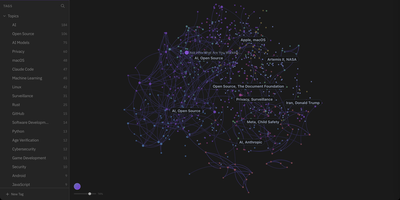
Atomic transforms collections of personal Markdown notes into an AI-augmented knowledge graph by breaking documents down into semantically linked conceptual units. Users capture thoughts, research excerpts, and web clippings as modular notes that the system automatically chunks, embeds, and categorizes with hierarchical tags. An interactive force-directed canvas maps out the entire knowledge base, positioning related ideas closer together based on embedding cosine similarity rather than manual folder hierarchies. Built-in vector search queries across text embeddings directly within SQLite, retrieving precise contextual snippets in response to natural language prompts. The automated wiki engine synthesizes disparate notes into comprehensive reference articles equipped with verifiable inline citations back to original source materials. Integrated conversational agents leverage retrieved knowledge context to answer research questions, surface contradictions across past entries, and draft structured daily briefings. External AI tools can read, search, and update stored knowledge through an embedded Model Context Protocol server endpoint. Running on a dedicated VPS on RepoCloud with guaranteed CPU, RAM, and SSD, full root SSH access, and a browser serial console. MIT licensed.
PsiTransfer
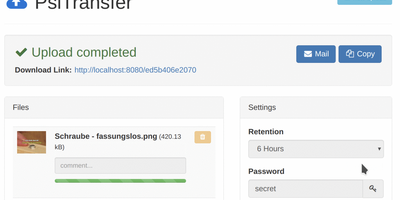
Upload files, get a share link, let it expire: PsiTransfer is a self-hosted WeTransfer with no accounts, no logins, and no third-party cloud with size caps and metadata harvesting. The engineering focus is large files over imperfect networks. Uploads use the tus.io resumable protocol, so a dropped connection on a multi-gigabyte video resumes exactly where it stopped once you're back online; downloads support HTTP range headers for the same resilience, and everything streams, so file size is bounded by your disk rather than memory. Files organize into upload buckets with retention you control: expire after a set time (up to weeks) or after a one-time download, with automatic cleanup when links lapse. Recipients need nothing installed - they open the link, preview files in modal views, and grab everything as a zip or tar.gz archive with one click. Buckets can be password-protected (AES-encrypted download lists), and security-through-obscurity is done properly: bucket URLs use hashed UUID tokens and stored filenames are replaced with UUIDs. An optional admin page (enabled by setting an admin password) lists bucket information and storage. The Vue.js frontend ships under 100 KB gzipped and is fully responsive. Honest caveat from the author: no end-to-end payload encryption yet. BSD-licensed, Docker-ready.
TRIP
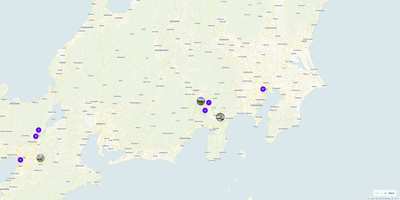
Plan multi-day expeditions, map custom waypoints, and coordinate shared group travel itineraries with TRIP, a private self-hosted journey management platform free from commercial tracking. Travelers can drop custom pins across global topographic or satellite maps, tagging locations with categories, visit durations, cost estimates, accessibility notes, and pet-friendly attributes. The visual trip builder organizes individual stops into ordered daily schedules, helping you calculate travel intervals and rearrange destination sequences using intuitive drag-and-drop tools. You can attach reference photos, booking confirmations, external links, and packing checklists directly to each itinerary milestone. Shared workspace controls enable travel companions to collaborate on upcoming road trips, leave comments on specific attractions, and coordinate shared responsibilities in real time. Dynamic filtering lets you isolate culinary destinations, outdoor hikes, or cultural landmarks by budget and travel style. Offline caching ensures your navigational routes and saved coordinates remain accessible in remote backcountry areas with spotty cellular coverage. Running on a dedicated VPS on RepoCloud with guaranteed CPU, RAM, and SSD, full root SSH access, and a browser serial console. MIT licensed.
Vigil
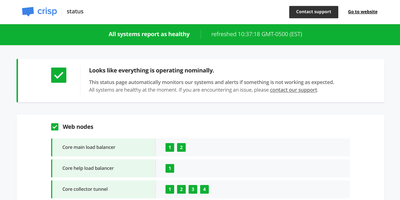
Vigil monitors your entire distributed infrastructure and generates a public status page from a single Rust binary small enough to run on a Raspberry Pi, consuming minimal CPU and memory while providing crash-free reliability. Four distinct monitoring modes cover every topology: poll probes check HTTP, TCP, SSH, and ICMP endpoints for reachability with configurable intervals and thresholds; push probes receive health reports from Vigil Reporter libraries embedded in your application code across Node.js, Python, Golang, Rust, TypeScript, Dart, and C#; local probes delegate monitoring to Vigil Local slave daemons running behind firewalls on separate LANs; and script probes execute custom shell commands for specialized health checks. Each monitored service transitions through healthy, sick, and dead states based on consecutive probe failures, with configurable thresholds controlling state transition sensitivity. When services change state, Vigil dispatches notifications through twelve alert channels including Slack, Email, Twilio SMS, Telegram, Pushover, Gotify, XMPP, Matrix, Zulip, Cisco Webex, and generic webhooks. The generated status page displays service groups organized by category with real-time replica status, system load metrics from reporter probes, and a maintenance announcement system for communicating planned downtime through the Manager HTTP API. Configuration uses a single TOML file defining all probes, services, and notification channels with no database dependency. Docker deployment pulls the official image with volume-mounted configuration. Running on a dedicated VPS on RepoCloud with guaranteed CPU, RAM, and SSD, full root SSH access, and a browser serial console. MPL-2.0 licensed.
Animockup
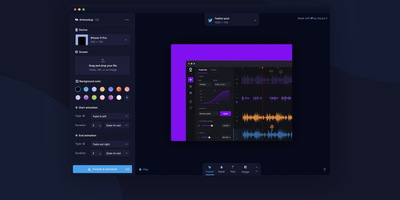
Product Hunt's Maker of the Year: Animockup delivers an alternative to expensive motion graphics tools for creating animated product teaser videos entirely in the browser. The FabricJS canvas engine provides a fully interactive editing surface where you import product videos or screenshots, place them inside device mockups ranging from iPhones and MacBooks to browser windows and smartwatches, and customize everything from background gradients to overlay text positioning. Anime.js powers the animation system with configurable start and end transitions, easing curves, and duration controls that produce smooth entrance and exit effects without timeline editors or keyframe knowledge. The built-in FFMPEG.wasm pipeline handles all video processing client-side — no server-side rendering required — exporting finished teasers to WebM, MP4, or GIF at custom framerates and resolutions up to 4K. The crop and reposition tool lets you precisely fit product footage into any device screen regardless of aspect ratio differences. Twenty-plus device frames cover phones, tablets, laptops, desktops, watches, and generic browser windows for maximum versatility. Firebase authentication handles user sessions while the optional Paddle integration manages subscriptions — or remove both for a fully free deployment. Self-hosting requires only a static web server with optional PHP for the payment webhook endpoint. Running on a dedicated VPS on RepoCloud with guaranteed CPU, RAM, and SSD, full root SSH access, and a browser serial console. MIT licensed.
Paca
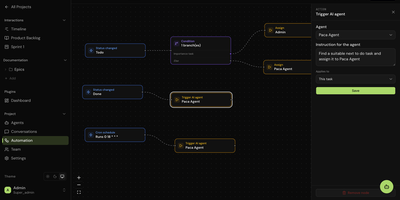
Paca is a self-hosted project management platform and Scrumban workspace where autonomous artificial intelligence agents collaborate with human software engineers as first-class Scrum teammates instead of external chat assistants. Engineering teams manage sprints, backlogs, and task lifecycles through a shared real-time board powered by Socket.IO where both humans and agents pick up assignments and post progress updates. A native Model Context Protocol server connects external coding assistants such as Claude Desktop and Claude Code directly into projects, tasks, and sprint data without custom scraping scripts. Distributed agents execute in isolated runtime sandboxes powered by the OpenHands software development kit, co-authoring behavior-driven development Gherkin scenarios with product owners and maintaining living system design documents. Visual event-driven automation builders compose multi-branch trigger, condition, and action pipelines that evaluate task dependency gates and cron schedules. A sandboxed WebAssembly plugin runtime allows developers to write custom backend logic and custom board views using Go or Rust. Running on a dedicated VPS on RepoCloud with guaranteed CPU, RAM, and SSD, full root SSH access, and a browser serial console. Apache 2.0 licensed.
Lingva Translate
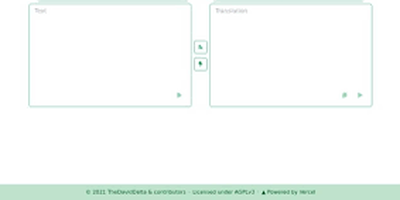
What Nitter was to Twitter and Invidious is to YouTube, Lingva Translate is to Google Translate: a privacy front-end delivering the service's full capability while cutting Google out of the loop between you and your text. Built on Next.js with TypeScript and Chakra UI, it uses the purpose-built Lingva Scraper to fetch translations from Google Translate without your browser ever touching a Google-related service - no cookies, no tracking, no account, while retaining what makes Google Translate hard to give up: 100+ languages with the translation quality of Google's production models, unlike offline engines that trade privacy for accuracy. The clean interface covers automatic source-language detection, text-to-speech audio playback for pronunciations, definitions and examples, and light/dark themes. For developers, every instance doubles as a translation API: a RESTful endpoint at /api/v1/:source/:target/:query returns JSON translations, an audio endpoint serves TTS buffers, and a full GraphQL API at /api/graphql exposes translations, audio, and language lists for richer integrations - all unmetered on your own instance. Deployment is a single stateless container with one environment variable for the site domain; defaults for theme and language pair are configurable. GPL-licensed, and popular as the translation backend for privacy-respecting apps.
dyrector.io
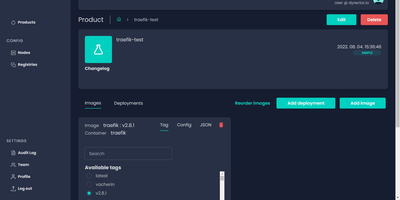
dyrector.io gives teams a visual web interface for deploying and managing containerized applications across Docker, Kubernetes, and Podman environments, replacing repetitive CLI commands and YAML editing with point-and-click configuration. Lightweight Go agents installed on target infrastructure communicate with the central TypeScript platform, enabling deployments to AWS, GCP, Azure, and on-premises servers without requiring infrastructure migration. Unified configuration screens eliminate redundant YAML editing across environments with support for all three container runtimes. Version management lets teams configure OCI-compatible container images once and deploy them as versioned releases with auto-generated changelogs and release notes. Multi-instance deployment enables simultaneous rollouts to multiple nodes with environment-specific configuration overrides, secret management, and instant test environment provisioning from any branch. The fine-grained RBAC system controls user access at project and environment levels, while audit logging tracks every deployment action. Registry integrations support Docker Hub, GitLab, GitHub, Google, and Azure container registries for image sourcing. ChatOps notifications integrate with Slack, Discord, and Microsoft Teams for deployment status alerts. Scheduled releases and workflow support enable automated deployment pipelines triggered by CI events via the REST API with JWT authentication. Running on a dedicated VPS on RepoCloud with guaranteed CPU, RAM, and SSD, full root SSH access, and a browser serial console. Apache 2.0 licensed.
BeaverHabits
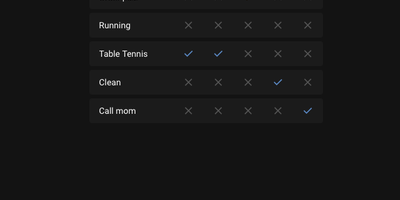
No targets, no gamification spiral, no motivational nagging: Beaver Habit Tracker is a self-hosted habit tracker deliberately built without "Goals". The core loop is honest: add habits, check them off each day, watch streaks accumulate on a calendar view. Its design follows behavioral-science basics - make it obvious (visual streak cues), make it attractive (progress is the motivator), make it satisfying (tracking becomes its own reward). Beyond the daily checklist it supports per-day notes intelligently grouped per habit, periodic habits, habit categories and tags, drag-to-reorder (manual or automatic), dark mode, and detailed streak and frequency views. Data lives where you choose: a single SQLite database or flat JSON files on a mounted volume, with JSON export and import for full portability. A REST API opens automation - community integrations already cover Stream Deck buttons, Home Assistant triggers, and CalDAV. The Python app ships as one Docker container with no external dependencies; environment variables tune everything from first day of week and index-page columns to iOS standalone PWA mode, and single-user setups can bypass the login entirely with TRUSTED_LOCAL_EMAIL. BSD-3-Clause licensed with no commercial restrictions - a well-executed single-purpose tool whose mobile PWA works anywhere a browser does.
Aptabase
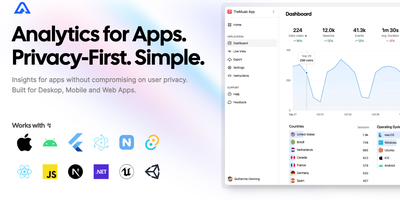
Web analytics tools ignore native mobile, desktop, and game apps; Aptabase was built for exactly those. If Firebase Analytics would force a privacy-policy footnote you don't want to write, this is the alternative - session-based metrics with no cookies, no IDFA or GAID, no device fingerprinting, and a daily-rotated salt that makes cross-day re-identification mathematically impossible. That design means GDPR, CCPA, and PECR compliance out of the box and "Data Not Collected" App Store privacy labels without ATT prompts. The SDK coverage is the widest in its category: eleven first-party libraries spanning Swift, Kotlin, Flutter, React Native, Tauri, Electron, .NET MAUI, NativeScript, Unity, Unreal Engine, and JavaScript for web - each MIT-licensed, following platform conventions, and accepting a custom host parameter that points at your instance. Integration is minutes: initialize with an app key, call trackEvent with optional properties, and the dashboard shows sessions, events, app versions, OS breakdowns, and country-level geography. The self-hosted stack is a .NET server over PostgreSQL for metadata and ClickHouse for high-volume event ingestion, giving cloud-parity features under an AGPL license. For indie iOS/Android apps, Electron and Tauri tools, and Unity or Unreal games, it replaces Firebase without the Google entanglement.
Portabase
Portabase takes a zero-trust approach to database backups: lightweight Rust/Tokio agents deploy next to each database, encrypt dumps with AES-GCM before data ever leaves the host, and poll the Next.js control plane outbound every five seconds requiring zero inbound firewall rules. This architecture contains blast radius if the dashboard is compromised while supporting ten engines with stable backup and restore: PostgreSQL 12 through 18, MySQL 5.7 through 9, MariaDB 10 and 11, MongoDB 4 through 8, SQLite 3.x, Redis 2.8+, Valkey 7.2+, Firebird 3.0 through 5.0, Microsoft SQL Server 2017 through 2022 including Azure SQL, and Docker volumes on Engine 20.10+. Encrypted backups store on configurable backends including local filesystems, any S3-compatible provider (AWS, MinIO, RustFS), Google Cloud Storage, and Azure Blob Storage. Cron-based scheduling with Grandfather-Father-Son retention policies automates backup lifecycle management, while on-demand restore targets any compatible server for cross-environment recovery. The CLI installs agents with a single command and auto-updates when new versions ship. A RESTful API with MCP server integration enables automation from CI/CD pipelines and AI agent workflows. Developed by a non-profit under Apache-2.0. 1,270+ stars and 174 releases since October 2024. Running on a dedicated VPS on RepoCloud with guaranteed CPU, RAM, and SSD, full root SSH access, and a browser serial console.
TeamPass
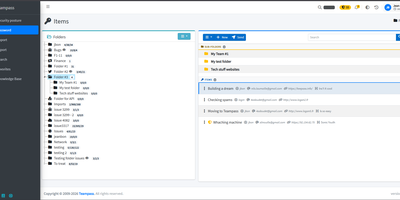
TeamPass is a dedicated on-premise password manager built specifically for teams that need collaborative credential sharing with fine-grained access controls. Role-based access control defines user permissions through hierarchical folder trees where each folder and item can be independently set to write, read, or no access against assigned roles, enabling organizations to segment credentials across departments without exposing sensitive data. Passwords are encrypted in the database using Defuse PHP Encryption with per-installation unique saltkeys, while two-factor authentication supports configurable RFC 6238 TOTP profiles with custom digits, period, and algorithm settings alongside Duo Security and Yubico hardware key integration. LDAP and Active Directory native integration enables enterprise SSO with automatic user provisioning. The Security Posture Dashboard surfaces weak, reused, breached, overdue, no-expiry, widely-shared, and unreadable credentials through indicator cards that filter and deep-link directly to items. Secure Send creates expiring, view-count-limited one-time links optionally protected by recipient passphrases for sharing credentials with external users. Import from Bitwarden, LastPass, 1Password, and KeePassXC through a unified source selector, with export to encrypted offline files. Email notifications, password expiration policies, custom fields, and attachment support round out item management. Running on a dedicated VPS on RepoCloud with guaranteed CPU, RAM, and SSD, full root SSH access, and a browser serial console. GPL-3.0 licensed.
Talkyard
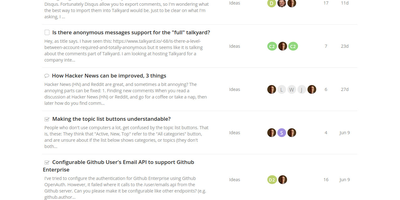
Talkyard combines five discussion formats in one platform: StackOverflow-style Q&A with accepted answers, Reddit-like upvote sorting for ideas, threaded forums, real-time chat channels, and embeddable blog comments. Running separate tools for each conversation type fragments community knowledge across disconnected systems, but Talkyard keeps it all searchable in one place. Question askers mark accepted answers, and community voting surfaces the best solutions for future visitors. Idea topics sort by upvotes for crowdsourced feedback prioritization and product decisions. Chat channels handle real-time day-to-day conversation, while forum threads preserve important discussions that need to remain findable months later. The embedding capability goes beyond blog comments: entire Talkyard forums can live inside iframes on your existing website with automatic deep-linking and iframe auto-resizing, adding community discussion to any page without rebuilding your site. Docker Compose containers run with dropped capabilities, no-new-privileges enforcement, non-root processes, health checks, and automatic log rotation. Multi-site hosting serves multiple communities from one installation with isolated databases and separate domains. Automated upgrades pull new images and restart services without intervention. ElasticSearch indexes every discussion format for instant full-text search. The Scala backend with TypeScript frontend stores data in PostgreSQL with automatic Let's Encrypt HTTPS. Runs on a RepoCloud VPS with guaranteed CPU, RAM, SSD, root SSH, and browser console. AGPL licensed.
Dialoqbase
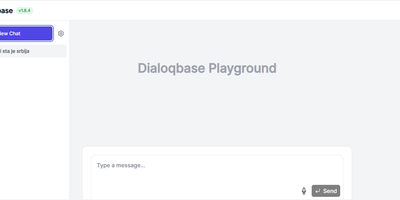
Retrieval-augmented chatbots on your own knowledge base - that is the whole mission of Dialoqbase, an open-source bot-building platform. Feed it content through a broad set of data loaders - web pages and full crawls, sitemaps, PDFs, DOCX, CSV, plain text, GitHub repositories, YouTube videos, and MP3/MP4 audio - and it handles the whole RAG pipeline in one self-contained app: chunking, embedding, vector storage, and LLM querying. The distinguishing architecture choice is PostgreSQL with pgvector for embedding storage and similarity search, which removes the separate vector-database dependency, and Redis-backed Bull queues for ingesting large documents without blocking the API. Model choice is wide open: OpenAI, Anthropic Claude, Google Gemini, Cohere, Fireworks, Hugging Face, local models via Ollama, and any OpenAI-compatible endpoint, with an equally broad list of embedding providers. Finished bots embed on any website with customizable styling or deploy to Telegram, Discord, and WhatsApp, and an API creates and manages bots programmatically. Multi-user support adds registration limits and per-user bot quotas. MIT-licensed and free for commercial use.
Relaticle
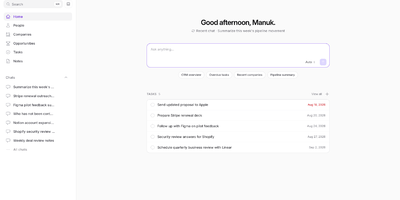
Relaticle delivers the first CRM built from the ground up for both human operators and AI agents — a self-hosted platform where Claude, GPT, Gemini, or any custom model connects through a production-grade MCP server exposing 30 tools for full CRUD operations across companies, people, opportunities, tasks, and notes without a single line of integration code. The 22 custom field types include text, email, phone, currency, date, select, multiselect, entity relationships, conditional visibility rules, and per-field encryption — all configurable through the UI without database migrations or code changes. Multi-team isolation enforces data boundaries through a 5-layer authorization system with team-scoped workspaces, API tokens, and granular permissions. The JSON:API REST surface provides Spatie QueryBuilder filtering, sorting, and pagination with schema discovery endpoints that let agents introspect your data model at runtime. A built-in AI chat connects directly to CRM data for natural language queries, while the external MCP server gives any compatible agent the same 30-tool access. Docker Compose deployment runs five containers — app (nginx + PHP-FPM), Horizon queue worker, scheduler, PostgreSQL 17, and Redis 7 — with automatic migrations on startup and demo data seeding for new teams. Running on a dedicated VPS on RepoCloud with guaranteed CPU, RAM, and SSD, full root SSH access, and a browser serial console. AGPL-3.0 licensed.
ServerKit
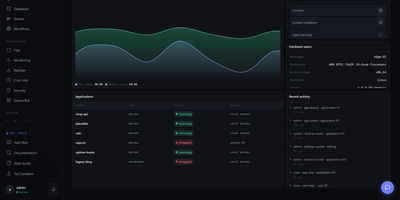
ServerKit delivers a server control panel that fits on a small VPS while managing everything from Docker containers to mail servers. The Python/Flask backend exposes 1,519 REST endpoints across 107 blueprints with full OpenAPI documentation at /api/v1/docs, while the React frontend spans 65 screens in a 1.75MB gzipped bundle served entirely from your own infrastructure. Docker management includes full container lifecycle control, Docker Compose project orchestration, real-time log streaming, and terminal access. Database panels cover MySQL/MariaDB and PostgreSQL with user management, browser-based query consoles, and automated backups to S3, Backblaze B2, or local storage. Nginx virtual host management automates Let's Encrypt certificate provisioning with hardened TLS 1.2+ configurations and Cloudflare-aware setups. The Go-based cross-platform agent enables multi-server fleet management with HMAC-SHA256 authentication over a WebSocket gateway, supporting Linux, Windows, and macOS across amd64 and ARM64 architectures. Fleet monitoring provides cross-server heatmaps, metric comparison charts, alert thresholds, anomaly detection, and capacity forecasting. A built-in marketplace distributes 106 one-click application templates using a declarative YAML schema with Docker Compose stacks. The extension system allows community plugins for Kubernetes management, Redis browsers, and WordPress site orchestration. Running on a dedicated VPS on RepoCloud with guaranteed CPU, RAM, and SSD, full root SSH access, and a browser serial console. MIT licensed.
Bracket
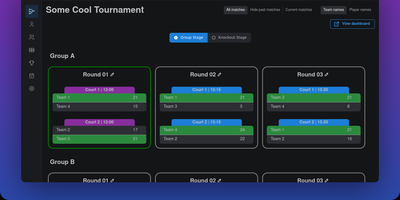
Organizers running sports leagues, gaming tournaments, and community athletics can deploy Bracket as an open-source competition control hub that coordinates multi-stage events without recurring SaaS subscription fees. Competition directors can configure multi-tier tournament topologies combining single elimination, double elimination, round-robin pools, and dynamic Swiss format brackets within a unified event schedule. An interactive calendar grid enables operators to drag and drop fixtures between designated courts, assign start times, and balance player recovery intervals across multiple playing areas. Public dashboard displays generate real-time match outcomes, court assignments, and standings boards that spectators can monitor on mobile devices or overhead venue monitors with customized team logos. Club administrators can manage multiple regional athletic organizations, register rosters through bulk CSV spreadsheet imports, and coordinate simultaneous divisions spanning amateur and championship flights. Integrated OpenAPI REST endpoints allow external scoring overlays, live stream graphic generators, and automated result bots to query match statuses or submit verified referee scorecards programmatically. Running on a dedicated VPS on RepoCloud with guaranteed CPU, RAM, and SSD, full root SSH access, and a browser serial console. AGPL-3.0 licensed.
Whatomate
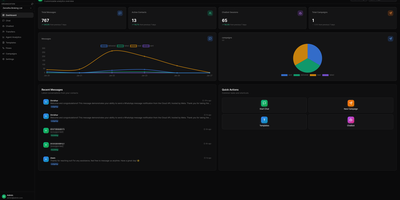
A complete WhatsApp Business Platform covering messaging, chatbot automation, and voice calling with IVR — a combination most self-hosted projects never attempt. The Fastglue/fasthttp backend processes WhatsApp Cloud API webhooks through PostgreSQL and Redis into a real-time WebSocket layer powering instant chat updates across a Vue 3 frontend built with shadcn-vue and TailwindCSS. Chatbot automation supports keyword triggers, multi-step conversation flows with branching logic, AI-powered responses from OpenAI, Anthropic, or Google models, knowledge base integration via vector stores, and seamless handoff to human agents when the bot gets stuck. The visual IVR builder uses a drag-and-drop node canvas where you wire greeting prompts, DTMF menu capture, HTTP callbacks to external APIs mid-call, business-hours routing by IANA timezone, agent team transfers with hold music, and reusable sub-flows. Every call recording streams encrypted to your S3-compatible bucket with retention you control. Multi-tenant architecture isolates organizations with separate data, roles, and API keys while a unified inbox presents both chat and call conversations to agents in a single dashboard. Meta-approved template management, bulk campaign messaging, analytics tracking, and a full REST API round out the platform. Deploy via Docker Compose with Postgres and Redis included. Running on a dedicated VPS on RepoCloud with guaranteed CPU, RAM, and SSD, full root SSH access, and a browser serial console. AGPL v3 licensed.