JT-IPAM
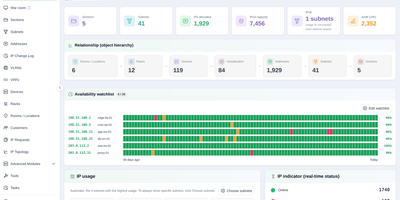
Spreadsheets and sticky notes stop scaling the day your network grows past a rack or two, so JT-IPAM keeps every address, subnet, and device in one searchable system of record. Track subnets and individual IPs with their hostnames, MAC addresses, and owners, then reconcile what you documented against what scan agents actually find through ICMP, ARP, reverse DNS, and SNMP collection from routers and switches. Connect the DNS servers you already run, from PowerDNS and BIND 9 to Windows DNS and Technitium, and flag records that have no matching address in IPAM. Pull devices and virtual machines in from LibreNMS, Zabbix, Proxmox VE, ESXi, Hyper-V, and OpenStack so monitoring and address records stop drifting apart. Draw floor plans and rack elevations, trace a cable across multiple hops, and open an SSH terminal, SFTP browser, or RDP desktop to a device straight from its address page. Route new address requests through configurable multi-stage approval workflows, distribute certificates to web servers and firewalls from central encrypted storage, and keep a full audit trail of every change and console session. Running on a dedicated VPS on RepoCloud with guaranteed CPU, RAM, and SSD, full root SSH access, and a browser serial console. AGPL-3.0 licensed.
Waxum
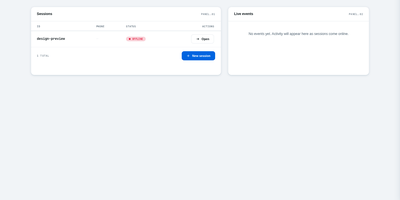
WhatsApp is where your customers already are, and Waxum is the self-hosted gateway that lets your own software talk to them there without renting a per-message platform. One REST API fronts two providers at once: multi-device sessions paired by QR code or pairing code, and Meta's official Cloud API, sharing the same message routes and webhook events. Send text, media, locations, contact cards, polls, reactions, and broadcast lists, schedule messages for later, or run paced bulk blasts with deduplication, retries, and a dead-letter queue when a send fails. Voice and video calls ring, play audio, speak text in hundreds of voices, record the peer side, and stream media over WebSocket, while groups, contacts, blocking, privacy settings, and presence are all manageable per session. Signed webhooks with event filters and circuit breakers push receipts and replies into your app, and a failed delivery can be replayed from the queue instead of lost. The built-in ops console shows your whole session fleet, and each session opens a playground covering dozens of endpoints, so you can test a send from the browser before writing code. Sessions export and import between instances as zip files, and Prometheus metrics with health probes keep the fleet observable. Running on a dedicated VPS on RepoCloud with guaranteed CPU, RAM, and SSD, full root SSH access, and a browser serial console. MIT licensed.

Nodyx
Nodyx puts forum threads, real-time chat channels, peer-to-peer voice calls, collaborative whiteboards, and a drag-and-drop homepage builder behind one installation script on hardware you control. Create categories and threaded discussions that search engines index, then switch to Socket.IO-powered chat rooms where replies, pins, link previews, and @mentions update instantly. Voice channels connect participants through WebRTC mesh networking, keeping audio between peers without routing through third-party servers; a Rust-based STUN/TURN relay handles restrictive NATs so home-server deployments work without port forwarding. The NodyxCanvas layer adds CRDT-synchronized collaborative drawing with 11 tools, voice-aware cursors, and board-scoped chat, all persisted to PostgreSQL snapshots. Build your community's landing page with a visual editor that places widgets across 11 layout zones, then extend functionality by dropping third-party widget archives into the admin panel or authoring your own with the plain-JavaScript Widget SDK. Private conversations stay end-to-end encrypted with ECDH P-256 key exchange and AES-256-GCM ciphers where the private key never leaves the browser, and the OctoGuard module automates moderation with five matcher types plus configurable actions from muting to banning. For streamers, a native Streamer Hub bridges Twitch chat bidirectionally, provides a drag-and-drop soundboard, generates OBS browser-source overlays, and offers a mobile Stream Deck. Instances discover each other through a gossip protocol, forming a decentralized network without central coordination. Running on a dedicated VPS on RepoCloud with guaranteed CPU, RAM, and SSD, full root SSH access, and a browser serial console. AGPL-3.0 licensed.
Massing
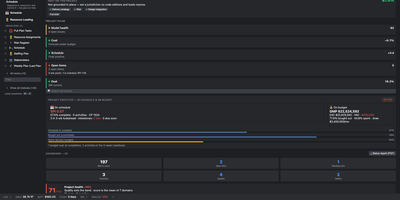
A building project usually scatters across a dozen disconnected tools, and Massing pulls the whole lifecycle into one browser workspace organized as seven rooms: Deal, Design, Planning, Schedule, Cost, Work, and Operate. Generate massing options from a zoning envelope, author the model, and produce permit-ready drawing sets with plans, sections, elevations, and schedules exported as SVG, PDF, or DXF on ARCH-D sheets, plus a MasterFormat specification manual. An IBC code pre-check flags problems before submission. The general contractor portal spans 139 modules for RFIs, submittals, change orders, G702 and G703 pay applications, a critical path schedule, safety tracking with TRIR, and COBie closeout. A development proforma handles sources and uses, XIRR, NPV, and joint venture waterfalls. A vitals strip keeps float, health, and cost per square foot in view, and a next best action banner points to the most urgent item for whichever role you pick, for example general contractor. A CAD command line speeds drafting, and an AI command bar and an MCP server connect assistants to the project. Running on a dedicated VPS on RepoCloud with guaranteed CPU, RAM, and SSD, full root SSH access, and a browser serial console. MIT licensed.
Polaris Control Plane
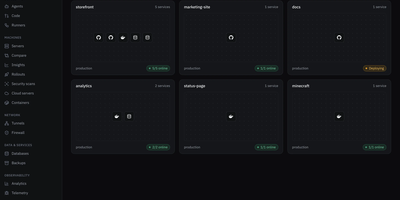
Polaris puts app deploys, file storage, team chat, tasks, and a password vault behind one login on a server you control. Deploy from a Git repository or an image with databases, volumes, environment variables, logs, a terminal, and a domain, published through your own domain, a Cloudflare tunnel, or DuckDNS. Enroll more machines over SSH with one generated command, then watch their containers and metrics and schedule backups with restore. Drive spans local disks, SFTP, S3-compatible storage, SMB, NFS, Google Drive, OneDrive, and Dropbox, with password-protected public links, expiry, and drop points for people without an account. Vault works with the Bitwarden apps and extensions and encrypts in the browser, so the server never sees your master password. Chat brings channels, threads, direct messages, voice and video calls, screen sharing, and a soundboard, while Tasks adds lists, boards, sprints, goals, and time tracking, and can hand work to coding agents over MCP. Calendar syncs both ways with Google, Microsoft 365, and CalDAV and offers booking pages. Game servers run Minecraft, ARK, and FiveM, a firewall blocks countries, networks, and bots, and one-click Marketplace installs add more apps. The interface comes in English and Spanish. Running on a dedicated VPS on RepoCloud with guaranteed CPU, RAM, and SSD, full root SSH access, and a browser serial console. AGPL-3.0 licensed.
TidyQuest
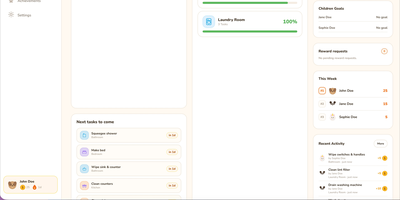
Whoever vacuums the living room this week should not be decided by whoever loses the argument, so TidyQuest turns household chores into quests with health bars, coins, and a family leaderboard. Every chore gets a health indicator that drains as its due date approaches, which makes overdue cleaning visible at a glance instead of festering in a group chat. Completing tasks pays coins into a personal wallet, builds daily and weekly streaks, and unlocks twelve milestone achievements from first chore to a thirty day run. Coins buy entries from a reward catalog your household defines, whether that is picking the Friday movie, extra game time, or sleeping in, and parents approve each redemption before it counts. Rooms organize work around the eight built-in spaces, from kitchen and bathroom to garage and garden, seeded with more than sixty predefined chores at realistic intervals. Assignment modes decide how credit lands: the first finisher takes everything, assignees split coins equally, or custom percentages reward whoever does the heavier share, while a strict mode requires admin approval before completions count. Reminders reach phones through web push, Telegram, ntfy, or Home Assistant, and vacation mode pauses decay for anyone away. A calmer couple mode strips the game layer away entirely, leaving plain shared tracking for households that just want the list. Running on a dedicated VPS on RepoCloud with guaranteed CPU, RAM, and SSD, full root SSH access, and a browser serial console. AGPL-3.0 licensed.
SoftJL
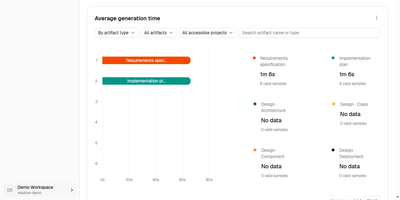
SoftJL turns a system description into the UML diagrams, test cases, and Word specifications a software project is supposed to produce, and keeps every artifact traceable back to the requirement it came from. Describe your system in chat and confirm the extracted requirement rules, then work through feasibility analysis with system context, business and system flows, and implementation options weighed by cost, benefit, and risk. From the confirmed rules it builds requirement and design models: functional structure, use cases, domain concepts, architecture, design classes, database and deployment diagrams, all editable as PlantUML with SVG export. Tests follow the same thread, with normal, exceptional, and boundary cases mapped to requirement rules in coverage and traceability matrices that show exactly which requirements lack design or test support before you submit. When a requirement changes, dependencies and update status point at the models, tests, and documents that need review, instead of leaving you to rediscover them by hand. Specifications generate from the saved models as versioned, editable DOCX files, a feasibility report, a requirements specification, and a design description, ready to compare against the diagrams and revise. An optional read-only MCP endpoint lets a coding agent read your designs and acceptance criteria, and the whole workspace runs on your own OpenAI-compatible model service. Running on a dedicated VPS on RepoCloud with guaranteed CPU, RAM, and SSD, full root SSH access, and a browser serial console. Apache-2.0 licensed.
Wildbox
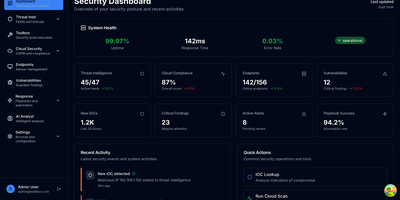
Enterprise security stacks assume an enterprise budget; Wildbox assumes a server you already own. It runs your whole security operation as a set of cooperating services behind a single HTTPS gateway: threat intelligence collectors pull indicators from seven public feeds on a schedule, starting with abuse.ch's Feodo Tracker, and every indicator is searchable in one place. Fifty-two security tools sit behind one API, covering DNS, TLS, email security, headers, and port analysis. The cloud posture service runs 22 configuration checks against your live AWS accounts and keeps each scan's report, while the vulnerability service inventories your assets, prioritizes findings by risk, and tracks them through remediation with SLA checks and alert rules. When something needs doing, YAML playbooks execute response workflows as background jobs, and the agents service writes Claude-generated threat-enrichment reports for suspicious indicators when you give it an API key. An osquery-based sensor streams endpoint telemetry from your hosts into the platform, kept separate per team. Users, teams, roles, and scoped API keys live in the identity service, and the backends accept nothing that did not arrive through the gateway, so your security data never leaves hardware you control. Optional Compose profiles add n8n automation and Prometheus monitoring. Running on a dedicated VPS on RepoCloud with guaranteed CPU, RAM, and SSD, full root SSH access, and a browser serial console. MIT licensed.
ShowAI
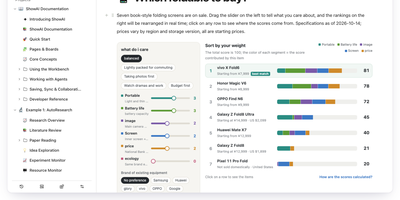
Your coding agent answers a question, and instead of a wall of Markdown you get a page you can actually use. ShowAI turns replies into interactive pages built from text, tables, charts, flow diagrams, sliders, and boards, so you can drag a weight, compare options, or step through an idea and watch the result change. Every page is saved as versioned files in a local project, with undo, retained drafts, and conflict protection, and the agent reads your edits before it continues. Select any text, cell, or board object to ask the agent to expand, reorganize, or visualize it, and run several conversations on one project in parallel. When a needed component is missing, the agent builds it, and pages that work can be distilled into templates. Export a page as standalone HTML, an inline fragment, or a static site. Connect a self-hosted ShowAI Server for projects shared by administrators, editors, and viewers, with account login and device management. Running on a dedicated VPS on RepoCloud with guaranteed CPU, RAM, and SSD, full root SSH access, and a browser serial console. MIT licensed.
Reconner
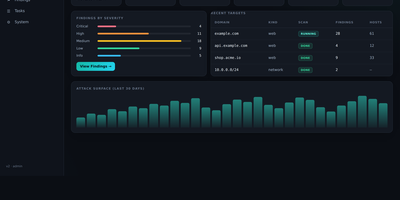
Hunting for the hole is only half the job, because a scanner alert nobody believes wastes more time than the bug itself. Add a domain, CIDR, or bug-bounty scope and Reconner builds the map first: passive and active subdomain enumeration, live HTTP probing and fingerprinting, JavaScript analysis that digs endpoints, secrets, and API keys out of bundles, plus parameter and hidden-param discovery. Then it attacks what it mapped with a context-aware engine covering reflected, stored, and DOM XSS, SQL, NoSQL, SSRF, IDOR, LFI, SSTI, XXE, injection, and open redirects, and every candidate has to survive differential, out-of-band, or control-based proof, re-verified before it is ever reported. Blind issues are not dropped either: OAST callbacks catch out-of-band SSRF, RCE, SQLi, and SSTI that never respond inline. Networks get the same treatment, with port scanning, service detection, network-CVE checks, and IP-camera auditing. Findings land in a live dashboard streamed over WebSocket, with an attack-path view, coverage ledger, monitoring diffs, and HTML, Markdown, and PDF reports, while Telegram can alert you and even start, stop, or resume scans remotely. Run it only against assets you own or are authorized to test; behind a VPN and TLS it becomes your private proving ground. Running on a dedicated VPS on RepoCloud with guaranteed CPU, RAM, and SSD, full root SSH access, and a browser serial console. MIT licensed.
Proval
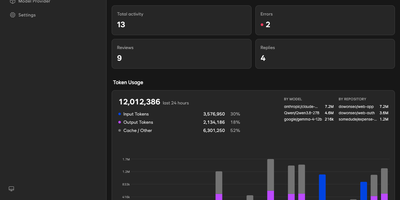
Proval is a self-hosted AI code review agent that reads every pull request on your GitLab, Forgejo, or GitHub server and posts a consolidated, severity-grouped review with inline comments, using a model you run yourself. When a pull request gets a meaningful push, a planning agent groups changed files into review units and dispatches specialist sub-agents in parallel, each exploring the codebase so cross-file issues surface. A writing agent merges their findings into one review, with comments on the affected lines, including multi-line ranges. Reply to any Proval comment and it reads the thread context and answers, and it works on issues too, greeting new ones and answering follow-ups on every message or only when mentioned. Choose per repository whether reviews run on first push only, every push, or not at all, skipping drafts until they are marked ready. Every review, reply, and issue comment is logged with its token usage, so each model's cost shows in the dashboard instead of hiding in an API bill. Your code is never stored; review context goes only to the LLM endpoint you configure, whether that is a cloud API or a local Ollama or llama.cpp server on your own network. Connect GitLab or Forgejo with an access token and webhooks, or GitHub through a GitHub App; Gitea and Codeberg use the same Forgejo-compatible path. Running on a dedicated VPS on RepoCloud with guaranteed CPU, RAM, and SSD, full root SSH access, and a browser serial console. AGPL-3.0 licensed.
Usulnet
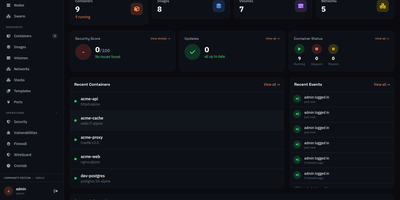
Usulnet packs container management, Trivy security scanning, Nginx reverse proxy, scheduled backups, WireGuard VPN, firewall rules, and multi-node orchestration into a single 70MB Go binary with zero external runtime dependencies. Every module ships in one download with no paid tiers, no telemetry, and no edition gating. Container lifecycle management covers creation, start, stop, restart, pause, kill, and removal with bulk operations, real-time resource statistics, filesystem browsing, and settings editing. Trivy integration scans images and running containers for CVEs with severity scoring, generates SBOMs, and validates CIS benchmarks. The multi-node architecture supports standalone, master, or agent modes where agents connect over NATS JetStream with mTLS encryption, enabling remote Docker host management from a central dashboard. Reverse proxy configuration handles Nginx with automatic Let's Encrypt certificates, TCP/UDP stream proxying, access lists, and dead host detection. Backup operations capture container volumes and Compose stacks on configurable schedules with retention policies and full restore capabilities. A built-in application catalog provides 60+ one-click templates for common services. JWT license validation uses an RSA-4096 public key embedded in the binary, requiring no call-home and working entirely offline. For teams tired of maintaining separate tools for each infrastructure concern, Usulnet collapses the entire stack into a single point of management with Docker Compose deployment alongside PostgreSQL, Redis, and NATS.
PNLCS
Hosting companies sell, invoice, provision, and support hosting, domains, SSL certificates, and VPS servers from PNLCS, a free self-hosted billing platform with one client portal at the center. Customers browse your catalog, configure services, apply coupons, and check out, and the moment an order is paid a server module creates the account or machine on Panelica, cPanel, Plesk, DirectAdmin, HestiaCP, Proxmox VE, or Vultr. Renewals then run themselves: invoices are generated ahead of the due date, stored cards are charged with retries, reminders and late fees follow, and unpaid services suspend automatically and restore themselves once payment lands. Domain registration, transfers, renewals, WHOIS and EPP codes, and SSL issuance run through the same checkout, while customers manage their actual hosting from the portal itself, including files, mailboxes, databases, FTP accounts, subdomains, DNS records, cron jobs, and backups. Eight payment gateways share one engine, so partial payments, refunds, and credit balances behave the same everywhere. Support tickets route by department with priorities and attachments, a searchable knowledge base deflects repeat questions, and affiliates track referrals and commissions. Operators get revenue dashboards, client management with impersonation, bulk invoicing and mail, and twenty-seven reports covering income, MRR, churn, domains, and tax, all in thirty languages and sixteen themes. Running on a dedicated VPS on RepoCloud with guaranteed CPU, RAM, and SSD, full root SSH access, and a browser serial console. MIT licensed.
PingCRM
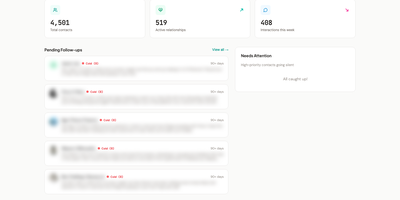
PingCRM is a personal relationship manager that watches your conversations across Gmail, Telegram, Twitter/X, LinkedIn, and WhatsApp and tells you who you are about to lose touch with. Connect those accounts, and every email, DM, mention, and thread lands on one chronological timeline for each person you know. Each relationship carries a transparent score built from reciprocity, recency, frequency, and breadth, so the dashboard can point at exactly who is going cold and show its working. When someone changes jobs, updates a bio, or hits a birthday, life event detection surfaces it while it is still a good reason to write. The same person hiding behind a work email, a handle, and a profile gets merged into one contact through identity resolution, and the suggestion inbox drafts a contextual follow-up for your review, never sending anything on its own. Browse contacts on a map, watch organizations and their people together, filter a notification feed down to what you missed, and ask questions of the whole graph through the built-in MCP server from your AI client. Running on a dedicated VPS on RepoCloud with guaranteed CPU, RAM, and SSD, full root SSH access, and a browser serial console. AGPL-3.0 licensed.
Malloy Publisher
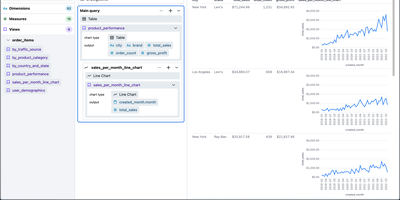
Analytics teams, and increasingly the AI agents working beside them, get one shared definition of the business from Malloy Publisher instead of a pile of SQL queries that each compute revenue slightly differently. You model what your data means once: the sources, the joins, the measures, and who may see what. Agents then compose queries against that model over MCP, so there is no wrong join, no invented column, and no fan-out that double-counts while looking plausible, and the same question returns the same numbers tomorrow. Applications and BI tools reach the same model over REST, and unattended agents use the same governed path instead of scraping raw tables. Reports declared in Malloy read top to bottom or lay out as tile grids you can build by dragging, no-build HTML data apps ship inside the package, and the built-in Console lets anyone browse environments, packages, models, and results without writing code. Access rules decide who may query and which rows they see, discovery curation decides what is even visible, and a single annotation materializes an expensive source or pre-aggregates it on a schedule. Local files work through built-in DuckDB, while BigQuery, Snowflake, Postgres, Databricks, and others connect when the data already lives there. Running on a dedicated VPS on RepoCloud with guaranteed CPU, RAM, and SSD, full root SSH access, and a browser serial console. MIT licensed.
Oxigen
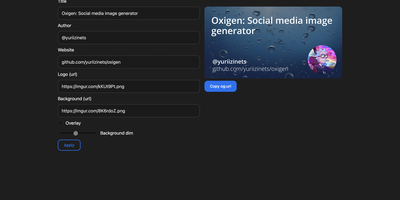
The social preview cards shown when links hit Twitter, LinkedIn, Slack, or Discord, generated on the fly: Oxigen is a small Go service for dynamic Open Graph images, no designer required per page. Instead of exporting static images per page, you compose a card once and drive it with parameters: title, author, website, logo, background image, and background dimming all arrive as URL query arguments, so your og:image meta tag simply points at the Oxigen endpoint with the page's own values substituted in. Every blog post, product page, and doc gets a branded, correctly sized preview generated on the fly. A built-in web UI covers interactive composition - tweak the text and imagery, watch the preview update, copy the resulting URL - while the same rendering path serves programmatic API use from static site generators, CMS templates, or build pipelines. Rendering is pure Go using the gg 2D graphics library, freetype fonts, and the imaging package, built on the kyoto framework by that project's author. Deployment is one stateless container on port 80 with no database and no external dependencies, so instances scale and restart freely.
Aizen
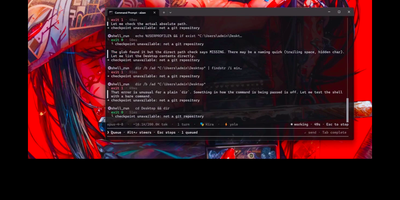
Aizen is a coding agent that actually lives on your server: one small binary you can message from your phone, which fixes code, runs the tests, and reports back before you are anywhere near a keyboard. Leave it running on the box and drive it from Telegram or Discord, approving risky edits with a tap while it works behind NAT with no inbound port to expose. In the terminal it is a single chat and agent loop with a live heads-up display of model, tokens, and context, reading files in parallel, editing symbolically through the language server, and running your shell under an approval layer with a hard floor that refuses catastrophic commands even on auto-approve. It does not get to claim done early: a verify gate runs your typecheck and test suite and sends it back to fix what it broke, git-backed checkpoints let you rewind a bad turn, and seven capability-scoped sub-agents can fan out across finding, planning, building, reviewing, testing, research, and recall when a job wants a team. Point it at any OpenAI-compatible endpoint, from hosted models to your own local server, extend it with MCP servers and slash-command macros, and let the sandbox keep every child process away from your API keys with the network denied by default. Running on a dedicated VPS on RepoCloud with guaranteed CPU, RAM, and SSD, full root SSH access, and a browser serial console. Apache-2.0 licensed.
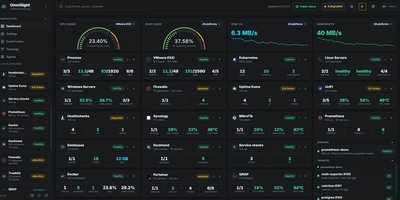
OmniSight
OmniSight ends the homelab ritual of a dozen admin panels open in a dozen tabs, each with its own login and its own idea of what healthy looks like. It folds all of them into one page that answers the only question you actually have: is everything fine? Watch Proxmox nodes with their VMs, containers, backup status, and Ceph health next to VMware hosts and datastores, Linux and Windows servers, and Kubernetes pods with live log viewing. Add Docker hosts and see container status, ports, resource use, and image updates, check OPNsense firewalls, TrueNAS and QNAP storage, and PostgreSQL, MySQL, and MongoDB databases without leaving the dashboard. A small push agent installs with one copied command and self-registers within seconds, needing no inbound firewall rules, so machines behind NAT report in on their own. Follow relationships on the topology map, restart a service from the detail view, export a full backup, and publish a read-only public status page for anyone who asks how things are running. Running on a dedicated VPS on RepoCloud with guaranteed CPU, RAM, and SSD, full root SSH access, and a browser serial console. GPL-2.0 licensed.