Margin
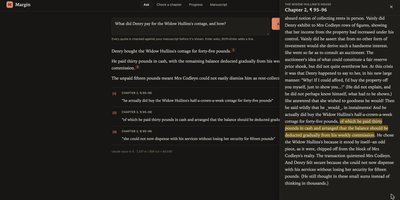
Long novels contradict themselves, and Margin is a self-hosted AI editor that reads the whole manuscript, catches the slips, and backs every answer with a quote from your own pages. Ask what color the inn door was in chapter 3 and each statement links to the passage that proves it. When the book is silent, Margin says so. Paste a new chapter, or pick a Google Docs tab, and every factual claim is checked against the rest of the book. Contradictions land side by side, your new line next to the earlier one. The worst-case cost shows first, and Margin asks before spending. A progress view charts words against your target and separates drafted chapters from outlines. It also counts words written this week and draws a chapter-length chart. A timeline lays scenes out in story order, each with the time words it rests on, and undated scenes wait under Not placed. A bible lists characters and places with quoted facts and the chapters that name them. Manuscripts load from Markdown, text, Word files, or a Google Doc with one tab per chapter. Re-ingesting reads only what changed. Margin never writes or rewrites prose. Every quote is checked word for word in code before it appears. Running on a dedicated VPS on RepoCloud with guaranteed CPU, RAM, and SSD, full root SSH access, and a browser serial console. MIT licensed.
GuardNous
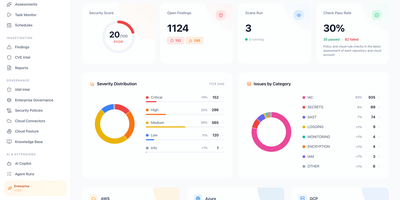
Point GuardNous at your repositories and AWS account, and your existing scanners feed one triaged list of findings that AI agents can fix only with a person's approval. Nine scanner adapters, from Semgrep and Trivy to Checkov and Gitleaks, share one format, and SARIF carries in results from any other tool. Triage, assignment, notes, and severity-based deadlines stay attached to findings across rescans. AWS connects through OIDC federation with no stored keys, and 44 rules check the account, show internet exposure, and offer five reversible fixes. Twenty agents with 72 tools answer questions from live data and run in the background within step and token budgets. A fix pull request, a cloud fix, or a Slack message runs only after a person approves the exact change. Bring your own model: OpenAI, Azure OpenAI, Anthropic, or a local Ollama. Six compliance frameworks, 21 built-in policies, SBOM export, and scheduled PDF reports cover governance. Tenants, seven roles, two-factor sign-in, and an audit trail keep teams separated and accountable. GitHub, GitLab, Bitbucket, and Azure DevOps connect to scan on push and open fix pull requests. Running on a dedicated VPS on RepoCloud with guaranteed CPU, RAM, and SSD, full root SSH access, and a browser serial console. Apache-2.0 licensed.
AgentTape
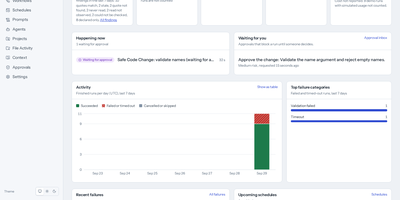
When a coding agent says the tests already cover a case, AgentTape checks the lines it cites against a recording of the run and shows a verdict beside them. The verdicts are Quote matches, Quote not found, Never read, Read not observed, and Stale, where the file changed after the read and both hashes are displayed. A finding with no citation reads Declared only. Matching is deterministic and no model judges anything: line endings, Unicode, and trailing spaces are normalized before each quote is compared. Confidence climbs a ladder from declared, to commands re-run, to a person's confirmation, and a second agent can challenge a finding, labeled as judgment. Today Claude Code findings are verified, while Codex CLI and any allowlisted command are recorded alongside them. Runs launched from the UI, CLI, API, a schedule, a webhook, or a workflow leave an ordered record of the prompt, commands, output, files read, and files changed. Any run can be replayed as recorded or forked with one variable changed, and the two are compared side by side. Workflows chain agent steps, commands, evaluation gates, and approval nodes that pause for a person, and evaluators check exit codes, diffs, regex, JSON schema, duration, and cost. Work happens in a separate Git worktree and commits locally only after approval. Running on a dedicated VPS on RepoCloud with guaranteed CPU, RAM, and SSD, full root SSH access, and a browser serial console. MIT licensed.
Signed.md
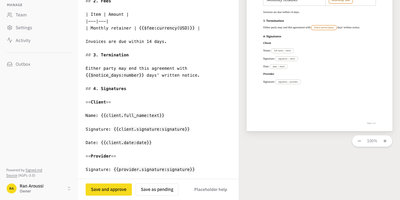
Built for people who ask an agent to do the paperwork, Signed.md has agents draft and send agreements while only humans approve templates and sign. Plain Markdown templates hold placeholders for text, numbers, currency, dates, choices, and signatures, and existing Word or PDF contracts can be imported. Sixteen MCP tools, REST endpoints with an OpenAPI spec, and webhooks give any agent a way to create, preview, and send documents. Guardrails sit in the server, not a prompt: templates an agent writes stay pending until an owner approves them, and changing one comma sends a draft back for another look. Template limits like a minimum fee or allowed notice periods are checked on every draft. Signers need no account or app; a link opens inline fields, a typed or drawn signature applied with one tap, and a progress panel. Signers can download an unsigned copy for their lawyer or decline with a reason. The last signature seals a PDF/A-2b file with a PAdES signature and RFC 3161 timestamps, plus a certificate page listing each signer's consent, times, IP address, and device. A ZIP evidence package, checkable offline by anyone, holds the signed Markdown, the PDF, a hash-chained log, and a signed manifest. Teams get four roles, folders, custom branding, and a record of what people and agents did. Running on a dedicated VPS on RepoCloud with guaranteed CPU, RAM, and SSD, full root SSH access, and a browser serial console. AGPL-3.0 licensed.
Olano
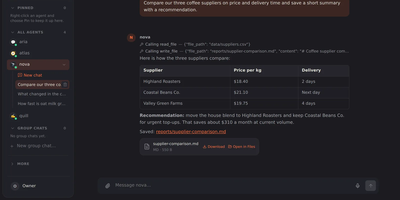
Olano turns one install into an office of AI agents, each with its own memory, workspace, tools and chat channels, all run from a web dashboard called Mission Control. Describe the agent you want to Agent Father in plain language, or edit a single config file, and it appears with its own schedule and permissions. Around 900 named tools across 88 toolkits cover Google Workspace, Microsoft 365, GitHub, Slack, Notion, Jira, Linear, HubSpot, Salesforce, Stripe and Shopify, alongside web search, a headless browser and SQL. People reach agents through 21 channels including Telegram, Discord, Slack, WhatsApp, Signal, Matrix, email and SMS, with approvals answered right in the chat. Each agent picks its own model from twenty providers, including Anthropic, OpenAI, Gemini, Bedrock and local Ollama. Memory persists in markdown files, a notes wiki with backlinks and searchable documents, while background workers write briefings and ideas into an approval queue. Cron schedules with time zones, a shared issue tracker, a calendar and an org chart keep work moving between humans and agents. Approval gates by tool category, PII and prompt-injection scanning, an encrypted vault and optional per-agent sandboxed shells behind an egress firewall keep each agent inside its lane. Agents speak MCP and A2A in both directions, and the dashboard installs as a phone app. Running on a dedicated VPS on RepoCloud with guaranteed CPU, RAM, and SSD, full root SSH access, and a browser serial console. MIT licensed.
Mulebox
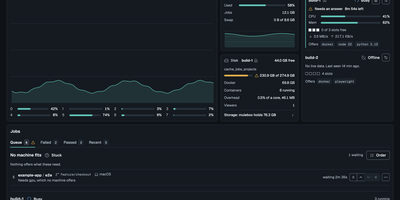
Send your AI coding agents' builds and tests to a Linux box instead of your laptop, and let them wait in one shared queue. An agent types mulebox check. Output and exit code come back as if the command ran locally. Your working copy travels as it is, committed or not. Only changed files move, and anything that looks like a secret stays home. Same files, same result: a repeat returns the earlier answer, and a second agent joins the job already running. Jobs run in private Compose services and ports that vanish when the job ends. Package caches and Playwright browsers stay warm. A pass must prove its tests ran. A long job asks its agent whether all is well instead of timing out. Detached jobs can be collected later with mulebox wait. GitHub Actions runners for private repositories queue in the same line, and results can post as commit statuses. Queue rules set levels per project or branch, with aging and fair turns. Lanes, stage waterfalls, and streaming logs update live on the dashboard. Pause, freeze, boost, reorder, or cancel any job. Agents ask for more disk, and you approve it from a strip on every page. Open the dashboard from your phone behind a password. Jobs travel over ssh to machines you own; no cloud service sits between. Running on a dedicated VPS on RepoCloud with guaranteed CPU, RAM, and SSD, full root SSH access, and a browser serial console. MIT licensed.
LapisLLM
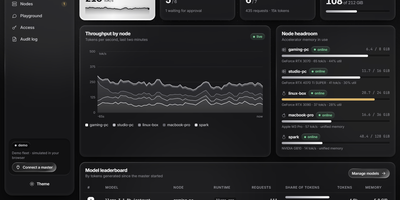
Behind one OpenAI-compatible endpoint, LapisLLM turns the old gaming PC, the work laptop, and the Apple Silicon Mac you already own into a single self-hosted model fleet. A master keeps the registry and routes every request to the right machine, and a small agent on each box runs llama.cpp, vLLM, or MLX and reports its GPU or unified memory. Clients need one base URL and one API key, pick models by name, and see which machine answered in an X-Lapis-Node header. Admission checks free memory minus a reserve before any model starts, first on the master and again on the agent, and a refusal states the numbers. Best-fit placement packs small models onto small machines so the big box stays free, and previews each decision before you commit. New machines stay pending until an admin types the fingerprint printed on that machine, and scoped API keys are shown exactly once. Self-healing brings back the models that should be running after a restart, one at a time per node, while models you stopped stay stopped. Drain a machine out of rotation without clients noticing, export the fleet to JSON without secrets, and scrape Prometheus metrics. The lapis demo command runs a real master with five simulated nodes, so the console can be explored without a GPU. Running on a dedicated VPS on RepoCloud with guaranteed CPU, RAM, and SSD, full root SSH access, and a browser serial console. MIT licensed.