Fireshare
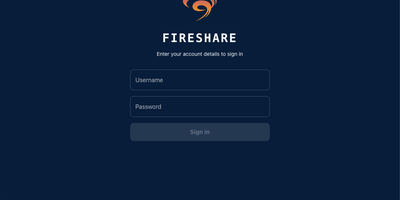
FireShare turns a folder of game captures on your server into a browsable library where every clip gets its own permanent link, ready to paste into Discord the moment something worth bragging about happens. Point it at the directories you already record to and it scans what is there: the file people watch is always your untouched original, in MP4, WebM, or MOV, never a recompressed stand-in. Privacy is set per file, public for the feed, link-only for friends, or behind a password, and whole folders can be shared as a single link. It also sorts the chaos for you, detecting the game in each capture and shelving hundreds of timestamped filenames under proper cover art you can search and browse. Trim the dead air off a clip before posting it, add a title, description, tags, and a custom thumbnail, and watch the view count climb. For screens that struggle with huge originals, optional transcoding adds adaptive lower qualities on CPU or an NVIDIA GPU, and HDR captures get tone-mapped to SDR instead of looking washed out. Friends can upload through the browser or by token from scripts, new public clips can announce themselves to Discord or an RSS reader, and accounts come with permissions, profiles, and two-factor sign-in. Running on a dedicated VPS on RepoCloud with guaranteed CPU, RAM, and SSD, full root SSH access, and a browser serial console. GPL-3.0 licensed.
YaCy
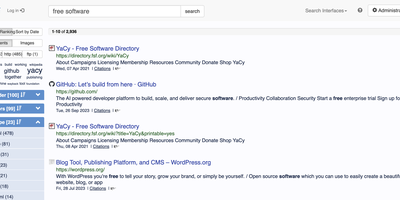
Search engines normally rent you answers from an index you cannot inspect; YaCy installs the entire machine on your server: the crawler, the index, the ranking, and the search page itself. Run it as a public web search portal with faceted results, topic clouds, and image search, or point the crawler at your intranet where a network scanner discovers HTTP, FTP, and file servers for a private enterprise search. Expert crawl jobs take start URLs, sitemaps, or link lists with depth limits, per-domain caps, and freshness rules, and the scheduler keeps re-crawling so results stay current. Peers exchange index data over a built-in peer-to-peer protocol, so a fresh installation can answer from the shared network index before its own crawl has seen much of the web. Private modes cut that connection for local-only answers computed on your hardware alone. The index browser walks stored hosts and draws link graphs of what the crawler found. Every page in the interface has an XML or JSON twin for automation, and the portal design tools restyle the result page for embedding in your own site. Running on a dedicated VPS on RepoCloud with guaranteed CPU, RAM, and SSD, full root SSH access, and a browser serial console. GPL-2.0 licensed.
Flare
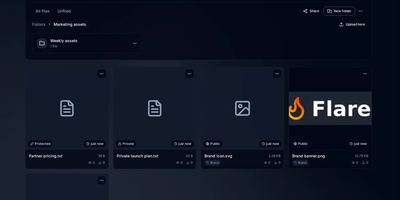
Screenshot, copy link, done: that is the loop Flare is built to make instant on your own server. Connect ShareX, Flameshot, KDE Spectacle, or a plain upload script once, and captures land in a vault you control instead of a third-party host that deletes them next month. Files live in folders with nested structure, bulk moves, automatic tagging rules, and one share link per folder, while previews handle images, video, PDFs, and syntax-highlighted code without downloading anything. Search digs through filenames, dates, and text extracted from images by OCR, so the screenshot from three weeks ago is findable by what it says. Password-protect a sensitive file, keep another private entirely, or publish it with a rich embed that unfurls properly wherever you paste the link. An appearance studio restyles branding, color palettes, and share page layouts, upload profiles carry reusable defaults between browser and screenshot tools, and the extras round out the kit: a URL shortener with click tracking, a pastebin, storage quotas, invite links, and tokens with signed webhooks for your own integrations. Running on a dedicated VPS on RepoCloud with guaranteed CPU, RAM, and SSD, full root SSH access, and a browser serial console. MIT licensed.
Cliparr
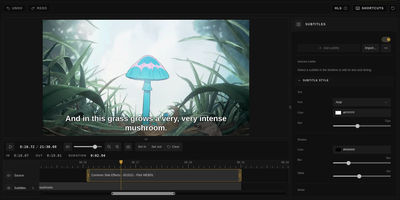
You are halfway through a film when a scene begs to be shared, and Cliparr is the self-hosted clip maker that turns moments from your Plex, Jellyfin, or local video library into shareable clips without opening a full video editor. Connect a media server and Cliparr follows live playback sessions automatically, so the scene you are watching is already loaded when you decide to keep it. Local video files open directly in the browser without being uploaded anywhere first. Mark the range, fine tune the start and end, then crop the frame freely or to a fixed aspect ratio with mouse or touch controls, which makes vertical clips for phones as easy as widescreen ones. Exports run entirely in your browser as video, audio only files, or GIFs, so the server never turns into a render box and the clip lands on the device you are using. Source details, artwork, and clip timing travel inside supported containers, keeping the exported file labelled with where it came from. Captions are a first class step: write your own subtitles, import an existing file, style the text, and burn it into the picture before export. Editor keyboard shortcuts, access control, and reverse proxy support round out a tool that fits into an existing media setup instead of replacing it. Running on a dedicated VPS on RepoCloud with guaranteed CPU, RAM, and SSD, full root SSH access, and a browser serial console. MIT licensed.
TestPilot
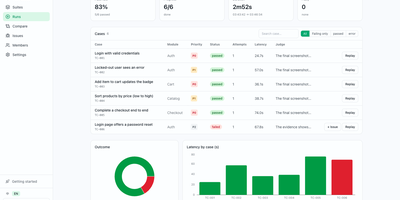
Why keep patching brittle selector scripts when TestPilot lets a browser agent run plain-English cases in real Chrome and an LLM judge rule pass or fail with a written reason? Cases read like a brief to a colleague (log in as the reviewer, approve the first pending entry, confirm it reads Approved) and the agent finds the clicks. Group them by module and tag, and move suites in and out through Excel. A video, a screenshot of every step, and a replayable action history come out of each case. The judge weighs that evidence against the expected outcome and leans toward failed when proof is thin, so a green run means something. Runs share a global browser budget, report live progress, offer run comparison, and can repeat only the failed or only the errored cases. Test and staging environments plus login accounts with roles let cases start signed in, using saved cookies and browser storage. Failures become issues on a built-in Kanban board with opt-in two-way GitLab sync, and an opt-in Feishu bot starts runs from a group chat. Judge and agent run on any OpenAI-style endpoint, the agent may use a local vision model, and settings swap models without a redeploy. Teams share one workspace or assign per-project owner, editor, and viewer roles. The interface comes in English and Simplified Chinese. Running on a dedicated VPS on RepoCloud with guaranteed CPU, RAM, and SSD, full root SSH access, and a browser serial console. MIT licensed.