Misskey
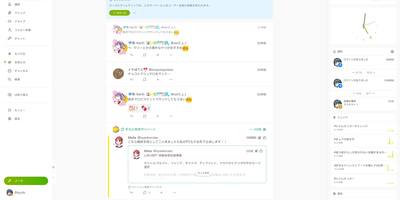
With 11,000+ GitHub stars and over 1,291 releases since 2016, Misskey is the most feature-rich open-source microblogging platform in the Fediverse — federation-first social networking with capabilities that go far beyond simple status updates. The TypeScript and Vue 3 frontend delivers a highly customizable interface with drag-and-drop widget layouts, switchable themes, per-user custom CSS, and AiScript-powered plugins that transform every instance into a unique social experience. ActivityPub federation enables seamless interaction with Mastodon, Pixelfed, PeerTube, and any ActivityPub-compatible platform across the decentralized network. Emoji reactions let users respond with custom instance emojis instead of simple likes, while Misskey Flavored Markdown adds animated text effects, sparkle decorations, and rich formatting to posts. The built-in Drive provides personal cloud file management with folder organization for images, videos, and audio — eliminating the need for external storage services. Antennas create custom filtered timelines based on keywords, users, or criteria for monitoring specific topics. Channels offer topic-specific feeds separate from the main timeline. Pages enable users to build personal websites directly within their instance. Clips save and organize posts into curated collections. The Node.js backend scales with PostgreSQL for persistence, Redis for caching, and optional S3-compatible storage for media. Docker Compose deployment provisions the complete stack including the database and cache in under 15 minutes. Running on a dedicated VPS on RepoCloud with guaranteed CPU, RAM, and SSD, full root SSH access, and a browser serial console. AGPL-3.0 licensed.

Ech0
Ech0 is a self-hosted personal microblog that gives you a public timeline of short posts, links, and media on your own domain, with no ads, algorithms, or subscription in the way. Write in a Markdown editor with live preview, organize posts with tags, and let links and GitHub projects unfurl into rich cards while Bilibili and YouTube videos play inline. Attach images, audio, and video to any post, browse them in an inline gallery with built-in players, and manage uploads in a visual file manager. Visitors can like, share, and comment, you moderate from the panel with captcha protection, and RSS lets readers follow without an account. Sign in with passkeys, OAuth2, or OIDC, issue scoped access tokens, and run extra accounts under Owner, Admin, and regular roles. Media can sit on local disk or any S3-compatible bucket, and snapshots, scheduled backups, and portable capsules move the whole timeline to another instance or compile it into a static site. Ech0 Copilot recaps recent posts in one click and lets you chat with your own archive, while an MCP server, webhooks, and a documented API connect AI assistants and automations. Follow live logs in a web console, administer from a terminal UI or CLI, and install it as a PWA with dark mode and multiple languages. Running on a dedicated VPS on RepoCloud with guaranteed CPU, RAM, and SSD, full root SSH access, and a browser serial console. AGPL-3.0 licensed.
Bluesky PDS
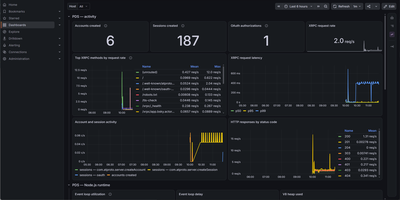
Bluesky PDS is the official Personal Data Server for hosting your own account on the AT Protocol network, so your posts, follows, and media live on infrastructure you control and still appear across the whole federated Bluesky social graph. An interactive installer sets up the container stack with the Caddy web server handling HTTPS for your domain and wildcard subdomains, creating the data directory, generating secrets, and registering the service with the network's identity directory. You create accounts directly or by invite code, sign in from the standard Bluesky web, iPhone, and Android apps by pointing them at your server address, and brand the sign-in, sign-up, and account screens with your own service name, logo, colors, and background images. Email verification and password resets go through your SMTP provider, rate limiting and blob upload limits are configurable, and the data directory holds everything needed to back up or migrate the instance to a new host later. Built-in tooling covers day-to-day operation: an admin command updates the service, automatic updates run through Watchtower, logs stream to Docker or a file, health and firehose WebSocket endpoints confirm the network can reach you, and an optional Prometheus and Grafana stack tracks accounts, sign-ins, and request latency. Account migration moves an existing identity onto your server when you are ready to leave a hosted provider. Running on a dedicated VPS on RepoCloud with guaranteed CPU, RAM, and SSD, full root SSH access, and a browser serial console. MIT and Apache-2.0 licensed.
Mbin
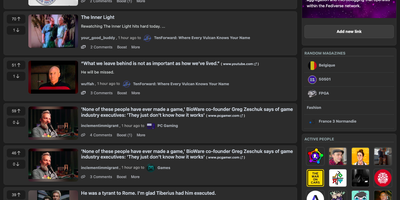
Mbin is a federated community platform that mixes magazine-based link aggregation and threaded discussion with short-form microblogging, so one self-hosted instance works as both a Reddit-style forum and a Mastodon-style social feed. Members create magazines around topics, then post links, articles, photos, and videos into them, vote submissions up or down, boost the best ones to their followers, and argue the details in threaded comment trees. The microblog stream sits beside the magazines for quick status posts, and a combined view blends both content types into a single feed you can sort by hot, new, active, or most commented. Because the whole platform speaks ActivityPub, your magazines and users federate with Mastodon, Lemmy, Pixelfed, Pleroma, and PeerTube, and follows, replies, and votes travel across instance boundaries in both directions. Magazine owners appoint moderators, pin threads, and handle reports, while instance admins control registration, federation allow and block lists, and which remote servers the instance talks to. Readers shape their own view with subscriptions to magazines, people, and tags, plus personal blocks for users, magazines, and entire instances. A documented REST API with OAuth 2.0 access lets mobile clients, bots, and integrations read and publish content, and Service-type accounts are supported for automated posters. Running on a dedicated VPS on RepoCloud with guaranteed CPU, RAM, and SSD, full root SSH access, and a browser serial console. AGPL-3.0 licensed.
Bloglite
Most blogging platforms demand a database server, a cache layer, and a healthy slice of RAM before you publish a single sentence; Bloglite runs a complete personal microblog in a few megabytes of memory. You write and edit posts directly in the web interface from a phone or a desktop browser, see the rendered result within seconds, and skip the commit, build, and deploy cycle that static site generators impose on every small update. Posts are written in Markdown with built-in syntax highlighting for code and rendered LaTeX for math expressions, so technical notes, recipes, snippets, and reading highlights all sit comfortably in the same public notebook. Upload images and files to embed them in posts, follow RSS feeds from inside the service, and retrieve anything later through the built-in search or an external search engine. Share posts through short numeric links or longer descriptive slug URLs, and keep ownership of everything: posts live in one SQLite database on your server, and automatic backups export the whole site to plain text files that can be downloaded through the API and committed to a Git repository on a schedule. Running on a dedicated VPS on RepoCloud with guaranteed CPU, RAM, and SSD, full root SSH access, and a browser serial console. MIT licensed.
GoToSocial
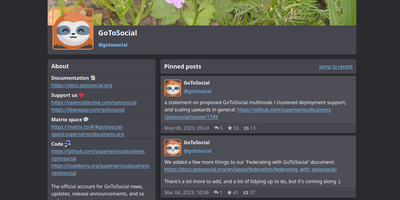
Mastodon serves single-user and small-community instances poorly; GoToSocial, an ActivityPub server written in Go, was built precisely for them. Where Mastodon demands Ruby, PostgreSQL, Redis, and Sidekiq, GoToSocial is one binary using roughly 250-350 MiB of RAM with SQLite as the default database (PostgreSQL optional) - it runs comfortably on a $5 VPS or a repurposed laptop. The deliberate design choice is having no built-in web client: the server exposes profile pages, a settings panel, and a faithful implementation of the Mastodon API, and you post through the client app you already like - Tusky on Android, Feditext on iOS, Pinafore or Phanpy in the browser. Federation is the point: your instance follows, boosts, and replies across Mastodon, Misskey, Pixelfed, and the rest of the Fediverse, with your identity anchored to your own domain. Safety is a stated focus, with granular per-post visibility and interaction controls, content warnings, custom emoji, hashtag following, domain allow/blocklists, and OIDC login support. Built-in Let's Encrypt provisioning simplifies the mandatory TLS. AGPL-3.0 licensed and in active beta, federating cleanly with the ecosystem's major servers.