Atomic
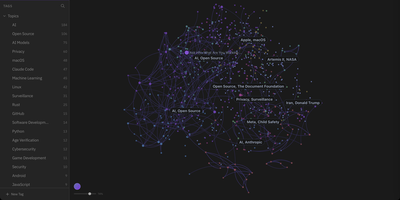
Atomic transforms collections of personal Markdown notes into an AI-augmented knowledge graph by breaking documents down into semantically linked conceptual units. Users capture thoughts, research excerpts, and web clippings as modular notes that the system automatically chunks, embeds, and categorizes with hierarchical tags. An interactive force-directed canvas maps out the entire knowledge base, positioning related ideas closer together based on embedding cosine similarity rather than manual folder hierarchies. Built-in vector search queries across text embeddings directly within SQLite, retrieving precise contextual snippets in response to natural language prompts. The automated wiki engine synthesizes disparate notes into comprehensive reference articles equipped with verifiable inline citations back to original source materials. Integrated conversational agents leverage retrieved knowledge context to answer research questions, surface contradictions across past entries, and draft structured daily briefings. External AI tools can read, search, and update stored knowledge through an embedded Model Context Protocol server endpoint. Running on a dedicated VPS on RepoCloud with guaranteed CPU, RAM, and SSD, full root SSH access, and a browser serial console. MIT licensed.
TestPilot
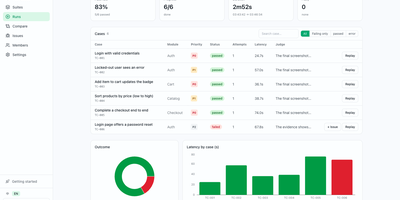
Why keep patching brittle selector scripts when TestPilot lets a browser agent run plain-English cases in real Chrome and an LLM judge rule pass or fail with a written reason? Cases read like a brief to a colleague (log in as the reviewer, approve the first pending entry, confirm it reads Approved) and the agent finds the clicks. Group them by module and tag, and move suites in and out through Excel. A video, a screenshot of every step, and a replayable action history come out of each case. The judge weighs that evidence against the expected outcome and leans toward failed when proof is thin, so a green run means something. Runs share a global browser budget, report live progress, offer run comparison, and can repeat only the failed or only the errored cases. Test and staging environments plus login accounts with roles let cases start signed in, using saved cookies and browser storage. Failures become issues on a built-in Kanban board with opt-in two-way GitLab sync, and an opt-in Feishu bot starts runs from a group chat. Judge and agent run on any OpenAI-style endpoint, the agent may use a local vision model, and settings swap models without a redeploy. Teams share one workspace or assign per-project owner, editor, and viewer roles. The interface comes in English and Simplified Chinese. Running on a dedicated VPS on RepoCloud with guaranteed CPU, RAM, and SSD, full root SSH access, and a browser serial console. MIT licensed.