OctoPrint
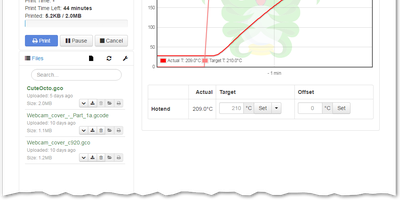
Over a million active instances make OctoPrint the standard web interface for consumer 3D printers - Gina Häußge's Python application, the center of the printing world since 2012. It talks to your printer over USB serial and turns every browser into a control panel: upload, organize, and start G-code prints; watch hotend and bed temperature graphs in real time; drive the print head manually; adjust feed rate, flow, and fan speed mid-print; and hit an emergency stop if things go wrong. The G-code visualizer renders the current layer in sync with the job, and a connected webcam adds a live feed plus automatic timelapse recording of every build. What keeps OctoPrint ahead is its plugin ecosystem - 300+ community plugins installable from the built-in manager. Highlights include Obico's AI spaghetti detection that pauses failed prints automatically, OctoEverywhere for tunnel-based remote access, Bed Level Visualizer's 3D mesh of your bed surface, PrintTimeGenius for accurate time estimates, Exclude Region to abandon one failed object mid-print while others continue, and Firmware Updater to flash Marlin or Klipper without SD-card shuffling. Event hooks fire notifications when prints finish or fail, and a full REST API supports slicer integration and custom automation. AGPL-licensed.
Mainsail
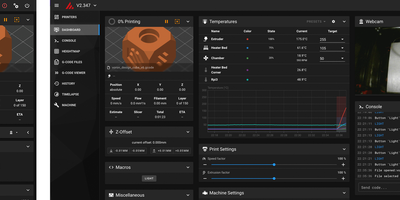
Controlling Klipper-powered 3D printers from a single browser workspace, Mainsail delivers a responsive web interface for monitoring print jobs, tuning kinematics, and managing multi-printer farms in real time. Makers and print farm operators monitor extruder and heated bed temperatures, fan speeds, and toolhead coordinates live on customizable dashboard layouts. An integrated file manager and syntax-highlighted editor let you upload G-Code directly from your slicer, organize print job queues, and modify Klipper configuration files (`printer.cfg`) without opening an SSH terminal. Interactive 3D visualizations render bed mesh heightmaps for first-layer leveling diagnostics alongside a real-time 3D G-Code toolpath viewer that tracks layer progress. Multi-webcam streaming, automated timelapse recording through `moonraker-timelapse`, Spoolman filament spool tracking, and mid-print object exclusion help salvage multi-part plates when a single model detaches. You can also organize parameterized Klipper macros, switch smart relays or Tasmota power plugs, and audit historical job success rates and filament consumption. Running on a dedicated VPS on RepoCloud with guaranteed CPU, RAM, and SSD, full root SSH access, and a browser serial console. GPL-3.0 licensed.