Pumpkin
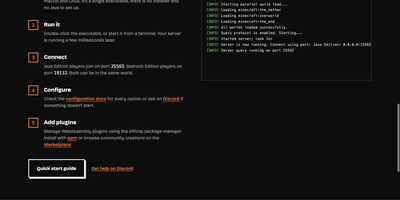
Why keep a Java runtime on the server just to host Minecraft, when Pumpkin runs from a single native executable and lets Java and Bedrock players share a world? Java Edition clients join on port 25565 and Bedrock clients on 19132, although Bedrock support is still marked work in progress. Builds exist for Windows, Linux, macOS, and Android. On launch, the console reports the worlds loaded and the server ready within milliseconds. Plugins are sandboxed WebAssembly modules that raise console permission prompts and pass signature checks, and authors can write them in Rust, Kotlin, Python, Go, C#, C/C++, D, Zig, or TypeScript. The ppm package manager searches and installs community plugins from the Pumpkin Market, and PatchBukkit loads some Bukkit and Paper plugins, with expected gaps. One pumpkin.toml file holds ports, MOTD, view distance, whitelist, authentication, compression, PvP, chat, resource packs, and world options, while chunks save in Anvil, Linear, or the native Pump format. Velocity and BungeeCord forwarding fit proxy networks, and the Query protocol plus Minecraft Server Management Protocol cover monitoring and remote administration. A public parity tracker lists every vanilla block, entity, item, and command as implemented, partial, or planned, so gaps are easy to spot before a world moves. Today it suits private survival worlds, test servers, and plugin development. It is early software, so the project advises backups. Running on a dedicated VPS on RepoCloud with guaranteed CPU, RAM, and SSD, full root SSH access, and a browser serial console. GPL-3.0 licensed.
Deploy