EdenText
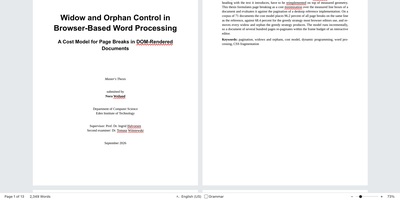
EdenText is a full word processor, from quick notes to full-length books, that opens the docx and odt files you already have and keeps them looking the way Word or LibreOffice made them. Pages are real pages: A4 or Letter sizes, margins, headers and footers, footnotes, columns, and watermarks, with mirrored margins and chapters opening on the right-hand page when you are laying out a book. Paragraph, character, table, and list styles cascade with inheritance and chapter numbering, and tables sort rows and compute spreadsheet-style formulas. The academic toolbox is complete: table of contents, captions, cross-references, citations with bibliography, an alphabetical index, and LaTeX formulas. Reviewing works the way editors expect, with tracked changes, threaded comments in margin balloons, printable markup, spell checking in eight languages, and grammar checking for English. An optional AI assistant answers questions about the document and proposes edits as tracked changes through your own model provider. Nothing waits on a server: documents autosave in the browser, the app installs and works offline, and your words never leave the machine. Running on a dedicated VPS on RepoCloud with guaranteed CPU, RAM, and SSD, full root SSH access, and a browser serial console. AGPL-3.0 licensed.
Etherpad
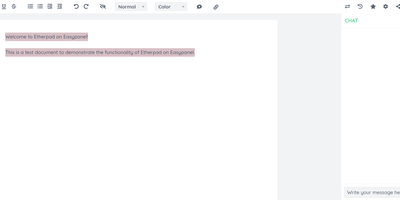
In continuous open-source development since 2009, Etherpad is the original really-real-time collaborative editor - used by Wikimedia, governments, EU public-sector institutions, and tens of thousands of self-hosters. Its core idea is visible authorship: every keystroke is attributed with author colors, every revision preserved, and the timeslider lets you scrub through a document's entire history character by character. Multiple people type into the same pad and see each other's changes instantly - it scales to thousands of simultaneous editors per pad. The base install is deliberately lightweight; capability comes from roughly 290 plugins installable from the admin web UI: comments, images, tables, drawing, video chat via WebRTC, math rendering, code highlighting, and authentication via OAuth, LDAP, or OpenID. AI is pointedly a plugin, not a default - you choose the model and infrastructure, or never turn it on. There is no telemetry. For integrators, an HTTP API (with OpenAPI definitions at /api/openapi.json) manages pads, users, and groups for embedding in your own applications, and the ueberDB abstraction layer supports PostgreSQL, MySQL, Redis, MongoDB, and SQLite backends. Full data export is built in, the format is open, it is translated into 105 languages, and it runs on anything from a Raspberry Pi to a server farm. Apache 2.0 licensed, Node.js based.