Part-DB
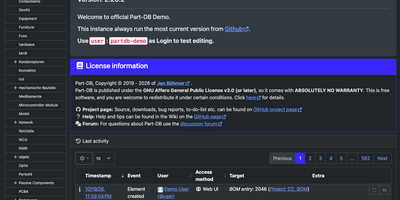
Across electronics labs, hardware startups, and university makerspaces, Part-DB indexes thousands of resistors, microcontrollers, and SMD reels with datasheets, storage locations, and live supplier pricing. Each component record tracks categories, footprints, manufacturers, multi-currency order histories, electrical tolerances, and custom tags for instant parametric search. New shipments populate part attributes, product photos, and PDF datasheets directly from Octopart, DigiKey, Mouser, Farnell, LCSC, or TME, alongside AI-assisted extraction from uploaded datasheets. Print custom barcode labels on demand. Scan internal IDs, GTIN codes, or distributor DataMatrix labels with a webcam or USB scanner to jump straight to any bin. Hardware engineers import KiCad bills of materials into project workspaces to calculate buildable board quantities and deduct stock in one step. Schematic designers can even connect Part-DB as a native KiCad 8 HTTP library source to place verified lab components with pre-linked footprints directly inside their EDA editor. Fine-grained group permissions, SAML single sign-on, WebAuthn two-factor authentication, and a versioned audit log with rollback protect shared inventories. Running on a dedicated VPS on RepoCloud with guaranteed CPU, RAM, and SSD, full root SSH access, and a browser serial console. AGPL-3.0 licensed.
OpenSlides
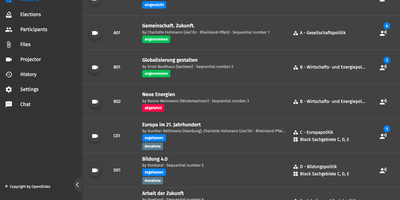
If an assembly needs motions, amendments, speaker lists, and secret ballots on one shared screen, OpenSlides is the open-source web application that runs them. Before the meeting, administrators set up committees and meetings, import participants from CSV or connect a SAML identity provider for single sign-on, email invitations with login data, and sort people into groups with freely defined rights. Members file motions in an HTML editor, attach documents, gather supporters, and send them through customizable workflows with automatic numbering by category, and amendments and change recommendations attach to specific line numbers. Motions can be forwarded to other meetings. During the session the agenda reorders by drag and drop, and every item, motion, or election gets its own speaker list with countdowns, points of order, and recorded speaking time. Votes are open, secret, or nominal and run live for present participants in voting groups, with proxy delegation, vote weighting, multiple rounds, and Yes/No/Abstain options per candidate or list. Results appear against a chosen reference value on projectors, in PDF exports, or as individual tallies. Several projectors can show the current item, a lower third for the active speaker, and live results, and Autopilot guides participants through whatever is happening. A video livestream brings in remote attendees. Afterward, motions export to PDF, CSV, or XLSX. Running on a dedicated VPS on RepoCloud with guaranteed CPU, RAM, and SSD, full root SSH access, and a browser serial console. MIT licensed.