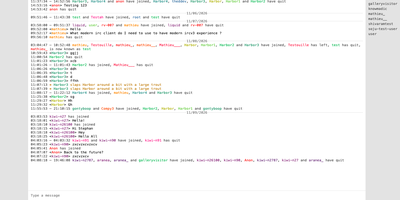
Ergo
IRC never died, it just waited for a server that behaves like people chat now: Ergo runs your own IRC network where nobody loses the thread when a laptop closes. The server remembers channel and direct message history and replays what you missed when you reconnect, and your nickname stays present around the clock like a bouncer, so conversations keep their context. Connect your phone, desktop, and terminal clients to the same nickname at once and each one stays in sync. NickServ accounts, ChanServ channel registration, and HostServ vanity hosts are built in rather than bolted on, and SASL, client certificates, and bcrypt hashed passwords keep sign-in sane. Modern IRCv3 capabilities power typing notifications, message replies, and rich history requests for clients that support them, and UTF-8 nicknames and channel names work when you want them. Operators get a unified ban system, connection limits, IP cloaking, LDAP integration, and a YAML configuration that reloads live with a rehash, certificates included. One small binary or container is the whole network, equally at home for a friend group, an open source project, or a company that still loves plain text chat. Running on a dedicated VPS on RepoCloud with guaranteed CPU, RAM, and SSD, full root SSH access, and a browser serial console. MIT licensed.
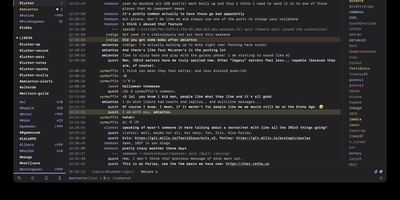
Lurker
Lurker keeps you present in every IRC channel you care about, holding your connections open around the clock and recording everything said so a retro, searchable web client can hand it all back whenever you return. Invite your friends and each person gets their own set of networks under one roof, while admins decide which networks members may join and which channels newcomers are pointed at. Nothing said while you were away is lost: the full history is searchable by nick, channel or network, and clicking a result jumps straight to that moment, whether it happened an hour or a year ago. The everyday annoyances are handled too, with drafts that follow you between devices, a highlight and ignore system that cuts noise, bookmarks and private notes on users, reactions, replies, and image uploads that are optimized, stripped of metadata and stored on your own disk or S3. If you prefer your old client, the built-in bouncer speaks the soju and ZNC dialects with SASL, network discovery, on-demand scrollback and read markers that stay in sync everywhere, and DCC file transfers with an XDCC queue still work. Optional companion containers generate inline link previews in isolation and keep your IRC connections alive across restarts of the main service. Running on a dedicated VPS on RepoCloud with guaranteed CPU, RAM, and SSD, full root SSH access, and a browser serial console. MPL-2.0 licensed.
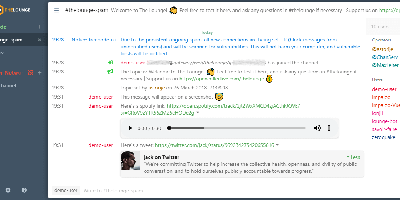
The Lounge
"Forget about bouncers" became a real sentence because of The Lounge: a Node.js web IRC client that holds persistent connections to your networks 24/7, logging everything while you sleep, so closing the browser tab never means missing a message or losing your place in a channel. Open it again from any device - desktop, phone, tablet - and you resume exactly where you left off, with full history synchronized. Because it combines bouncer and client in one process, the experience feels like a modern chat app rather than 1990s infrastructure: push notifications for highlights and private messages (with self-generated VAPID keys, so even Web Push needs no third-party service), automatic link previews, inline file and image uploads, and full IRCv3 protocol support. It installs as a progressive web app from any modern browser, so phones get a native-feel client without an app store. Multi-user support means one instance serves your whole team or community, each user with their own networks and history, and LDAP integration ties into existing authentication. A public mode alternatively serves as an open, registration-free web chat for events or support channels. MIT-licensed, born as a fork of Shout, and a fixture of self-hosting stacks since.