Opengist
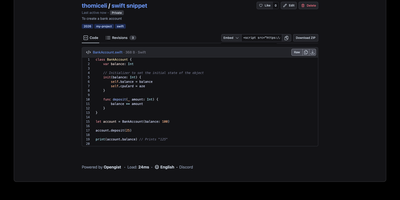
Every code snippet in Opengist lives inside a real Git repository that you can initialize, clone, pull, and push over HTTP or SSH while browsing syntax-highlighted files, revision diffs, and Markdown documents through a self-hosted web interface that replaces GitHub Gist. Create public, unlisted, or private multi-file gists directly from your browser, terminal Git client, or the OpenAPI-documented REST API v1 using personal access tokens. Rich rendering displays source code across hundreds of languages alongside Markdown documents with Mermaid diagrams, LaTeX math, CSV tables, images, and downloadable ZIP archives. Full-text code and metadata search powered by Bleve or Meilisearch lets teams locate snippets by content, filename, extension, language, user, or topic tags in milliseconds. Users can star, fork, archive, and embed snippets into external websites via JavaScript widgets or fetch raw files and structured JSON payloads. Enterprise authentication supports GitHub, GitLab, Gitea, OpenID Connect, and LDAP directories, reinforced by TOTP two-factor authentication and WebAuthn passkeys, while administrators control anonymous access and monitor Prometheus metrics. Running on a dedicated VPS on RepoCloud with guaranteed CPU, RAM, and SSD, full root SSH access, and a browser serial console. AGPL-3.0 licensed.
Pastefy
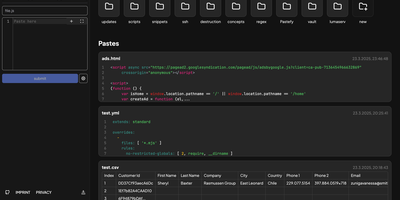
Pastefy gives developers a self-hosted pastebin and GitHub Gist workspace where multi-file code snippets, Mermaid architecture diagrams, and terminal recordings can be shared in a single click or cURL command. Its multi-tab editor highlights syntax across more than 200 programming languages so you can bundle scripts, configuration files, and documentation inside one URL. Markdown notes render cleanly. SVG graphics, CSV tables, GeoJSON maps, unified diffs, calendar events, regex testers, and Asciinema `.cast` terminal sessions all preview interactively in the browser. Sensitive snippets stay locked behind client-side AES password encryption, automatic expiration timers, and public, unlisted, or private visibility controls. Authenticated users organize pastes into nested folders, fork community snippets, generate QR codes or styled code screenshots, and embed interactive viewers into external docs. Command-line users pipe output directly via `curl -F [email protected]`, manage pastes from VS Code or Raycast extensions, and automate workflows through the REST API v2 with official JavaScript, Java, and Go SDKs. Single sign-on supports GitHub, Google, Discord, Twitch, and custom OpenID Connect providers. Running on a dedicated VPS on RepoCloud with guaranteed CPU, RAM, and SSD, full root SSH access, and a browser serial console. MIT licensed.
PrivateBin
PrivateBin shares text and files with true zero-knowledge encryption: the server stores only ciphertext it cannot decrypt because the key exists exclusively in the URL fragment that never reaches the server. With over 8,400 GitHub stars and 500,000+ Docker pulls, it has become the standard for privacy-respecting paste sharing where not even the hosting operator can read stored content. All encryption uses 256-bit AES in Galois Counter mode performed entirely client-side in the browser. Burn-after-reading mode destroys pastes on first view, while configurable expiration timers automatically purge content after periods ranging from five minutes to forever. Optional password protection adds a second encryption layer requiring recipients to enter a passphrase before decryption occurs. Discussion threads enable anonymous or nickname-based commenting on pastes with IP-based identicon avatars for visual identity. Markdown rendering with live preview formats pastes as styled HTML, and syntax highlighting through prettify.js supports dozens of programming languages across four color themes. File upload support enables sharing images, PDFs, and media files with in-browser preview. QR code generation converts paste URLs for mobile device transfer. Customizable templates include Bootstrap 5, classic Bootstrap CSS, and Darkstrap themes. Storage backends support filesystem, MySQL, PostgreSQL, SQLite, Amazon S3, and Google Cloud Storage. Deploy via Docker with the privatebin/nginx-fpm-alpine image on port 8080. Running on a dedicated VPS on RepoCloud with guaranteed CPU, RAM, and SSD, full root SSH access, and a browser serial console. zlib licensed.
Chiyogami
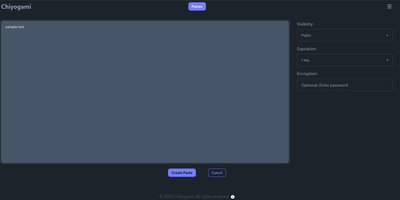
Chiyogami is a pastebin you host yourself for sharing code, logs, notes, and text snippets through short links that expire on your terms. Paste into the web editor and the content comes back formatted, with syntax highlighting for code and rendered Markdown for prose, so a stack trace or a runbook reads the way it was written. Anything sensitive can be encrypted in the browser before it leaves your machine, and the server never stores the password, which makes an encrypted paste safe to pass through chat or email. Every paste carries a configurable lifetime, from minutes to never, and visibility choices keep a snippet public, unlisted, or private behind an unguessable address. Registered users manage their own pastes from an account, and anonymous quick pastes stay available for one-off sharing. The public paste list supports search, so a team instance doubles as a small shared snippet library. Developers can skip the browser entirely: one curl command creates a paste from a file or a JSON body, and the API returns a short title that fetches the content later. Sharing extends to QR codes for moving text onto a phone, and built-in rate limiting throttles spam and abuse before it fills the database. Running on a dedicated VPS on RepoCloud with guaranteed CPU, RAM, and SSD, full root SSH access, and a browser serial console. BSD-3-Clause licensed.
dpaste
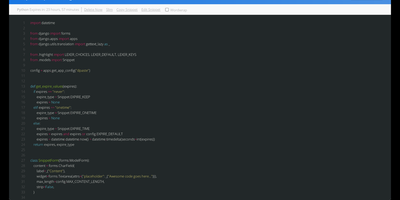
dpaste is a self-hosted pastebin that turns code snippets, log excerpts, and config files into short highlighted links with expiry and access rules you control. Paste code, stack traces, or plain notes, pick the language, and highlighting makes the result readable at a glance in the browser. Set the paste to expire in an hour, a week, a month, or never, or make it a one-time snippet that deletes itself after it has been viewed. Every paste offers a raw view for clean copying and terminal friendly reading, and random short slugs keep links tidy in tickets and commit messages. Scripts post through the API with a single request, so deploy tooling and CI jobs can publish their output where humans can read it. Run it standalone for the team, or fold it into an existing Django project as an app, and tune slug length, default language, maximum size, and expiry choices to your habits. Nobody has to wonder which public paste site a sensitive debug log landed on, because the bin answering the link is yours. Running on a dedicated VPS on RepoCloud with guaranteed CPU, RAM, and SSD, full root SSH access, and a browser serial console. MIT licensed.