colibri
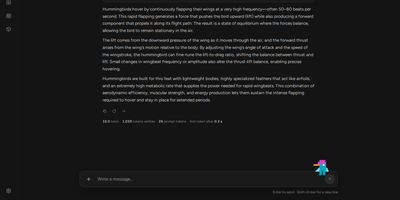
colibri lets you run huge open language models, including ones with hundreds of billions of parameters, on the computer you already own by keeping only the parts a model needs for each token in fast memory. Thirteen engines cover chat models such as GLM-5.2, DeepSeek V4 Flash, Qwen3.6, Kimi K3, and Mistral-Large-4, the Qwen-Image-2.1 picture generator, and small decision models. A one-step setup checks your RAM, disk, and graphics card, recommends a model that fits, downloads it with resume, and opens the dashboard. It runs on the CPU alone, on any Vulkan GPU, on NVIDIA cards through CUDA, and on Apple Silicon through Metal for several engines, and it reads published GGUF files as they are. One server speaks the OpenAI and Anthropic APIs, so Claude Code, coding CLIs, and SDKs connect with a base URL, and it adds tool calling, image and document input, and up to 16 simultaneous conversations. The browser dashboard has a chat with folded reasoning, an expert map, a live monitor, a profiling page, and a System One page that returns a probability for every allowed answer. A built-in MCP server lets an AI assistant detect hardware, install, start, and stop colibri. Running on a dedicated VPS on RepoCloud with guaranteed CPU, RAM, and SSD, full root SSH access, and a browser serial console. Apache-2.0 licensed.
Mesh LLM
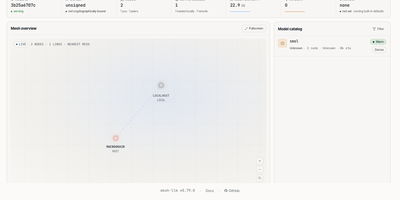
Spare GPUs and memory scattered across many machines become one OpenAI-compatible API for running open models on hardware you already own. Mesh LLM merges a home lab, an office, or a group of friends into a single pool, so existing chat apps and coding agents work unchanged. Start a node, add more later, and the mesh chooses between running a model locally, routing to a peer, or splitting it across several machines when it is too large for one box. Requests are routed by the model name, a virtual model called mesh picks a compatible one for you, and traffic between nodes travels over encrypted QUIC. Private meshes join by invite token and public ones can be discovered, with an API-only client mode for machines that host nothing. A web console shows the node map, model catalog, connected peers, chat with streaming replies, request logs, and a configuration editor. Goose, OpenCode, Claude Code, and Pi launch with one command and use the mesh as their provider, and plugins add extra backends. Releases cover Linux, macOS, and Windows with CPU, CUDA, ROCm, Vulkan, and Metal runtimes, and a headless flag keeps servers tidy. Running on a dedicated VPS on RepoCloud with guaranteed CPU, RAM, and SSD, full root SSH access, and a browser serial console. Apache-2.0 licensed.