Pipewright
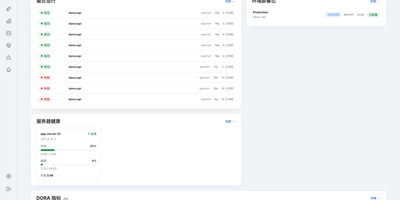
Draw a pipeline, push code, and watch it build, deploy, and roll back on its own: Pipewright is a self-hosted CI/CD platform delivered as one static binary. Pipelines are drawn on a two-level canvas of stages and jobs, then run with matrix builds, sidecar databases for tests, manual approval gates, and typed parameters validated at trigger time. The pipeline can also live in the repository as a per-branch .pipewright.yml file, and triggers cover webhooks, schedules, branch to environment mapping, and chained pipelines. Builds run isolated inside containers with cached dependencies and a content-addressed artifact store, and JUnit and Cobertura reports feed quality gates that stop bad code before deployment. Deployment is agentless over SSH: health checks gate a zero-downtime cutover, failures roll back on their own, and environments track their active version with one-click rollback and promotion toward production. Deployed services receive HTTPS domains through a managed Caddy proxy with automatic certificates, path routing, and load balancing, and each pull request gets a throwaway preview address with its own certificate. The operations side watches host CPU, memory, and disk, manages containers and networks across servers, and opens terminals in the browser. Notifications route by event to Slack, email, WeCom, DingTalk, Lark, or a webhook, approvals arrive as signed links, and the four DORA metrics are computed out of the box. Running on a dedicated VPS on RepoCloud with guaranteed CPU, RAM, and SSD, full root SSH access, and a browser serial console. MIT licensed.
WoodPecker CI
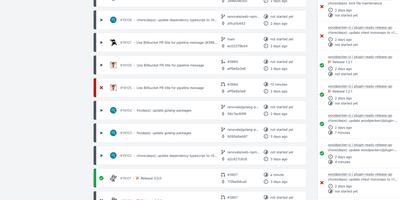
With 7,300+ GitHub stars and active releases through version 3.17, Woodpecker CI is the community-driven fork of Drone CI that kept the entire platform open source under Apache 2.0 — delivering a lightweight, container-native CI/CD engine that runs on minimal resources while providing enterprise-grade pipeline automation. Every pipeline step executes in an isolated Docker container, ensuring reproducible builds with zero host contamination and clean teardown after each run. Define workflows in simple YAML configuration files with step dependencies, conditional execution via when filters, service containers for databases and caches, and matrix builds that test across multiple language versions, platforms, or database engines simultaneously. Deep forge integration connects to GitHub, GitLab, Gitea, Forgejo, and Bitbucket via OAuth and webhooks, triggering pipelines on push, pull request, tag, deployment, and cron events. The plugin ecosystem inherits compatibility with the Drone plugin library — over 100 plugins for Docker builds, S3 uploads, SSH deployment, Slack and Telegram notifications, Helm deployments, and more. The server-agent architecture separates the web UI, API, and scheduler from pipeline execution, enabling horizontal scaling by adding agents across multiple machines or architectures including ARM. Secrets management supports global, organization, and repository-level scopes with approval workflows for forked repository pipelines. The admin web UI provides user management, agent monitoring, and queue control. Docker Compose deployment provisions the complete stack in under five minutes. Running on a dedicated VPS on RepoCloud with guaranteed CPU, RAM, and SSD, full root SSH access, and a browser serial console. Apache 2.0 licensed.
Concourse
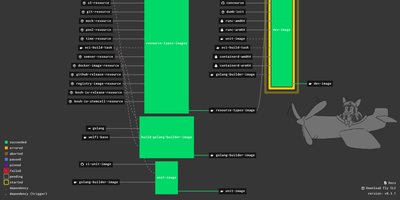
When a commit lands, a timer fires, or a pull request opens, Concourse runs the matching jobs in fresh containers and draws the entire CI/CD pipeline as a live graph you can read at a glance. Pipelines are plain YAML files that tie resources such as git repositories, registries, and buckets to jobs made of get, put, and task steps, so the same file behaves the same on every installation. Resources are checked continuously for new versions, webhooks can request an immediate check, and a version can be pinned when something needs to stay put. The dashboard lists every pipeline by team with status colors, a filter box, favorites, and a high-density view, while build pages stream colored logs and let you rerun a build with the exact same inputs. The fly command line sets pipelines, runs one-off tasks against local files from your laptop, and opens a shell inside the container of a failed step. A set_pipeline step lets pipelines configure other pipelines, and instance vars create a family of related pipelines, such as one per pull request. Teams keep projects separate and can be tied to a GitHub organization, credentials arrive at run time from Vault, CredHub, AWS, or Kubernetes, and policy rules can block disallowed images. Running on a dedicated VPS on RepoCloud with guaranteed CPU, RAM, and SSD, full root SSH access, and a browser serial console. Apache-2.0 licensed.
Dagger
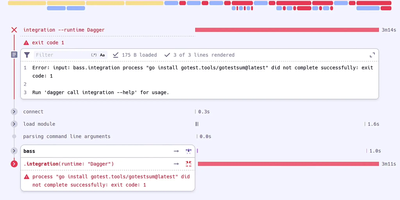
With 16,100 GitHub stars and created by Solomon Hykes (co-founder of Docker), Dagger eliminates proprietary YAML DSLs from CI/CD by letting developers write pipelines as real programs in their preferred language — then executing them identically on a laptop, in GitHub Actions, in GitLab CI, or on any machine with a container runtime. The BuildKit-based Dagger Engine runs every pipeline operation inside OCI containers, constructing a directed acyclic graph where each node is cached by default, parallelized automatically, and produces bit-for-bit reproducible outputs regardless of execution environment. Native SDKs generated from the GraphQL API schema provide Go, Python, TypeScript, PHP, Java, .NET, Elixir, and Rust developers with full type safety, IDE autocomplete, and the ability to unit-test CI pipelines using the same testing frameworks as application code. The module ecosystem enables cross-language composition where a Python team can invoke a Go team's build functions without learning Go, while filesystems, secrets, git repositories, and network tunnels are passed between functions as strongly-typed objects. Pipeline operations cache at container-layer granularity with content-addressed deduplication, and the interactive REPL enables step-by-step pipeline debugging with live container inspection. Host dependencies are explicit and strictly typed, eliminating implicit environment coupling that causes "works on my machine" failures. Running on a dedicated VPS on RepoCloud with guaranteed CPU, RAM, and SSD, full root SSH access, and a browser serial console. Apache 2.0 licensed.