ClassicPress
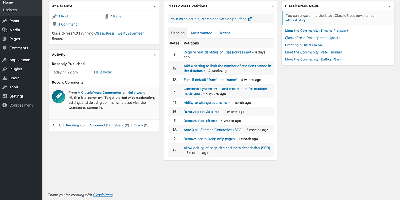
WordPress without Gutenberg: ClassicPress, the community-led fork, keeps the TinyMCE classic editor as the default and strips the block editor and Full Site Editing out of core entirely. The result is roughly half WordPress's size - obsolete libraries like jQueryUI, Thickbox, and Flash support are gone, replaced by native HTML5 elements and modern alternatives like SortableJS - which translates to a measurably faster admin and a leaner attack surface. Forked from WordPress 6.2, it remains compatible with the vast plugin and theme ecosystem targeting that lineage (anything not requiring blocks generally works, helped by a blocks-compatibility mode), and the PHP-first WordPress API developers have used for over a decade works unchanged - no React required to extend your CMS. The fork adds its own improvements: built-in media categories and tags with bulk editing, revision management that lets you prune database bloat, native HTML5 dialogs for accessible touch-friendly menus, and recent releases bring APCu object-cache support, vanilla-JS core widgets, and performant translations. Governance is democratic and community-driven rather than corporate. For content sites, business sites, and blogs where the classic editing workflow is the feature, ClassicPress is stability as a philosophy.
EmDash
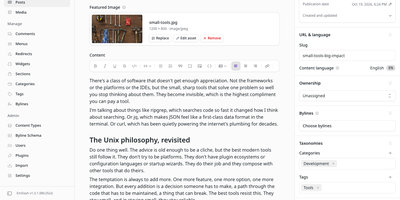
EmDash rebuilds the WordPress publishing experience as an open-source CMS, with drafts, revisions, scheduled posts, a media library, menus, widgets, and plugins that run in sandboxes and can only do what they declare. Writers get a rich-text editor with featured images, slugs, bylines, categories, and tags, plus signed preview links for unpublished work and a calendar of everything published or scheduled. Site builders define their own content types in a visual schema builder, choosing required and searchable fields, URL patterns, comments, SEO metadata, and edit locking so two people never overwrite each other. Uploads are drag and drop, with folders and filename search in the media library. Menus, sidebar widgets, reusable sections, and redirects with a 404 log shape the public site. Access is passkey-first, with OAuth and magic-link fallbacks, four roles from Contributor to Administrator, comment moderation, and personal API tokens. Coming from WordPress? Point the importer at a migration key, a site URL, or an exported XML file and it carries over posts, pages, media, and taxonomies. Plugins add hooks, settings, admin pages, dashboard widgets, custom blocks, and API routes after declaring capabilities such as content:read or email:send, while a built-in MCP server and CLI let AI assistants manage content directly. Blog, marketing, and portfolio templates give new sites a head start. Running on a dedicated VPS on RepoCloud with guaranteed CPU, RAM, and SSD, full root SSH access, and a browser serial console. MIT licensed.
Wordpress
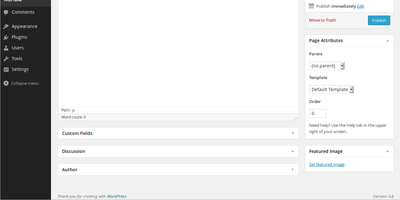
Roughly 43% of all websites and over 60% of the CMS market run on WordPress - the GPL-licensed platform that scales from a personal blog to publishing operations and WooCommerce stores. The Gutenberg block editor composes pages from reusable blocks, and full site editing extends block control to headers, footers, and templates; tens of thousands of plugins and themes cover essentially every capability a site might need, from SEO and caching to membership and e-commerce. WordPress 7.0 "Armstrong" marks the platform's biggest structural update since Gutenberg itself: a React-based DataViews admin replaces the legacy list tables with instant filtering, a provider-agnostic AI Client API ships with connectors for OpenAI, Anthropic, and Google, media processing moves into the browser via WebAssembly, and a universal Font Library manages typography across block, hybrid, and classic themes with local hosting for GDPR compliance. New Breadcrumbs, Icons, and lightbox Gallery blocks reduce plugin dependence, and server-side PHP block registration simplifies development. The REST API and WP-CLI make it automatable end to end. Self-hosting is what WordPress was designed for: your content, database, plugin choices, and upgrade schedule stay entirely under your control, free of wordpress.com plan limits.