Kokoro FastAPI
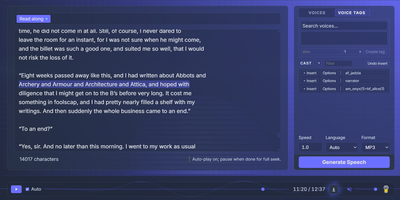
Kokoro-FastAPI turns text into natural-sounding speech across eight languages by serving the 82-million-parameter Kokoro-82M model through an OpenAI-compatible REST API, so any existing OpenAI SDK client can generate audio by just changing the base URL. With over 5,300 GitHub stars since December 2024, the fully Dockerized FastAPI server covers American English, British English, Spanish, French, Hindi, Italian, Japanese, Brazilian Portuguese, and Mandarin Chinese with language-specific phoneme processing. Inline voice mixing blends multiple profiles using weighted ratios like af_bella(2)+af_heart(1), automatically normalizing weights and caching combined voicepacks as PyTorch tensor files for reuse. Audio streams in real time over HTTP with configurable chunk sizes, or generates complete files in MP3, WAV, OPUS, FLAC, AAC, or PCM formats with speed control from 0.25x to 4.0x. Per-word timestamped captions with speaker-tagged voice labels enable subtitle generation for podcasts, audiobooks, and accessibility workflows. Pre-built Docker images support NVIDIA GPU acceleration via CUDA, experimental AMD GPU inference via ROCm, and CPU-only deployment on linux/amd64 and linux/arm64 architectures, with Apple Silicon MPS support available through direct UV execution. The integrated web interface at port 8880 provides browser-based speech generation, while the Swagger UI at /docs exposes the full API reference. Debug endpoints report system statistics for monitoring inference load. Running on a dedicated VPS on RepoCloud with guaranteed CPU, RAM, and SSD, full root SSH access, and a browser serial console. Apache 2.0 licensed.
LocalAI
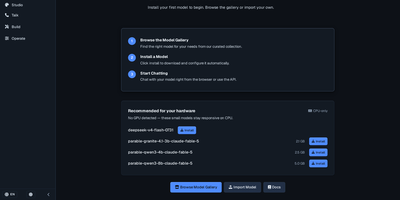
With over 48,000 GitHub stars and monthly releases since March 2023, LocalAI is the self-hosted AI engine that replaces every OpenAI endpoint with a single Docker container running on your own infrastructure — serving chat completions, image generation, text-to-speech, speech-to-text, embeddings, vision, video generation, and function calling through identical API schemas that require zero application code changes. The composable backend architecture isolates each inference engine as a separate gRPC service running in its own OCI container, so llama.cpp, vLLM, SGLang, transformers, whisper.cpp, diffusers, MLX, Stable Diffusion, and Flux install on demand without touching the core, can run on separate machines, and a fault in one never affects others. Hardware acceleration spans NVIDIA CUDA 12 and 13, AMD ROCm, Intel oneAPI/SYCL, Apple Silicon Metal, Vulkan, and NVIDIA Jetson L4T — or runs entirely on CPU without any GPU. Built-in AI agents support autonomous tool use, retrieval-augmented generation, Model Context Protocol integration, and skill-based workflows directly in the web interface. The model gallery provides curated YAML configuration files for hundreds of models that install with a single command, while P2P federated inference distributes model shards across multiple machines for running models larger than any single node's memory. Multi-user API key authentication with quotas and role-based access enables team deployments. Running on a dedicated VPS on RepoCloud with guaranteed CPU, RAM, and SSD, full root SSH access, and a browser serial console. MIT licensed.
Chatterbox TTS
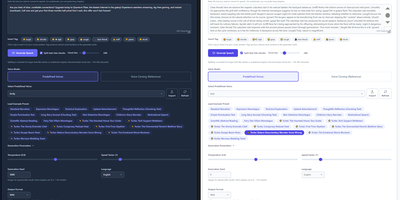
With 26,000 GitHub stars and consistent victories over ElevenLabs in blind evaluations, Chatterbox delivers state-of-the-art text-to-speech with zero-shot voice cloning requiring only 5 seconds of reference audio. The model family spans three architectures: Chatterbox Multilingual V3 (500M parameters, 23+ languages including Arabic, Chinese, Japanese, Korean, Hindi, French, German, Spanish, and Portuguese), Chatterbox-Turbo (350M parameters optimized for voice agents with a single-step distilled decoder achieving ~200ms time-to-first-speech), and Chatterbox-Nano (110M parameters running 3x faster than realtime on 8 CPU cores for edge deployment). Unique among open-source TTS systems, Chatterbox introduces emotion exaggeration control — adjusting intensity from monotone to dramatically expressive via a single parameter — and native paralinguistic tagging where tokens like [laugh], [cough], [chuckle], and [gasp] inject natural vocal reactions inline without post-processing. The alignment-informed inference pipeline eliminates hallucinations and repetition artifacts common in autoregressive TTS. Built-in PerTh neural watermarking embeds imperceptible forensic identifiers in generated audio for provenance tracking. Trained on 500,000 hours of cleaned speech data across all supported languages. Voice conversion scripts enable transforming existing audio into any cloned voice. Deploy via pip install with PyTorch, serve through Gradio interfaces or custom FastAPI endpoints, and expose via HTTP streaming or WebSocket for sub-200ms conversational applications. Running on a dedicated VPS on RepoCloud with guaranteed CPU, RAM, and SSD, full root SSH access, and a browser serial console. MIT licensed.