ExtendDB
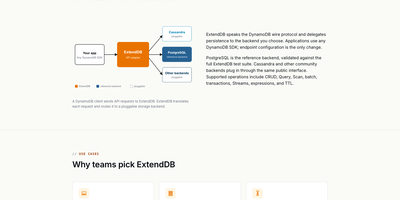
ExtendDB is a DynamoDB-compatible database server that answers the DynamoDB wire protocol from your own infrastructure, so applications written for DynamoDB run unchanged against a database you operate. Any AWS SDK, the AWS CLI, or DynamoDB tooling points at the ExtendDB endpoint and keeps working: tables, items, Query and Scan with key conditions and filters, batch reads and writes, and transactions all behave as the SDK expects. Streams feed change data to your own consumers, TTL expires items on schedule, vector indexes add cosine, Euclidean, and dot product search to on-demand tables, and point-in-time export and import move data in and out. Storage is pluggable, with PostgreSQL as the reference backend, SQLite embedded for small installs, and MongoDB and Cassandra for teams already running them. Every request is SigV4-signed and evaluated by a built-in IAM-style engine with users, groups, roles, policies, permission boundaries, and access keys, and TLS is mandatory on every connection. A web management console administers accounts and credentials, and a JSON metrics endpoint reports DynamoDB-style CloudWatch metric names and dimensions. The server runs as a daemon or in the foreground under Docker, Kubernetes, or systemd, healthchecks without extra tooling, and keeps serving in air-gapped environments with no internet connection at all. Running on a dedicated VPS on RepoCloud with guaranteed CPU, RAM, and SSD, full root SSH access, and a browser serial console. Apache-2.0 licensed.

Skytable
Some data refuses to sit still in rows and columns. Skytable is an open-source NoSQL database that stores information in spaces and models instead of rigid tables, letting a record carry strings, numbers, nested lists, and other complex types the way your application actually thinks about them. Developers query it with BlueQL, a language that feels familiar to anyone who writes SQL but adds modern collection syntax and mandatory parameterisation that blunts injection attacks before they start. Underneath, the engine keeps working data in memory, drives multithreaded asynchronous network I/O, batches writes, and persists through a custom append-only storage layer with delayed-durability transactions that trade a tunable sliver of risk for a lot of speed. Client drivers connect applications directly, an interactive shell handles administration and exploration, authentication protects the root account and additional users, and clustering work in progress aims at the high-availability deployments larger systems expect. Teams reach for it when a document store feels too shapeless, a relational database feels too stiff, and latency budgets leave no room for either. Running on a dedicated VPS on RepoCloud with guaranteed CPU, RAM, and SSD, full root SSH access, and a browser serial console. AGPL-3.0 licensed.