MeshCentral
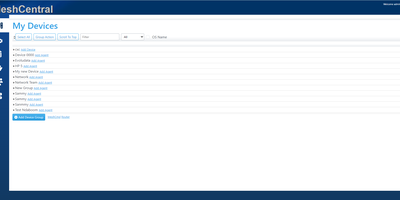
With over 7,000 GitHub stars and continuous development since 2017 by former Intel engineer Ylian Saint-Hilaire, MeshCentral has become the go-to self-hosted alternative to ConnectWise Control and Splashtop for managing devices remotely without per-seat licensing fees. The Node.js server installs via a single npm command and manages Windows, macOS, Linux, and FreeBSD endpoints through lightweight agents that maintain persistent WebSocket connections for real-time remote desktop, terminal access, and file transfer directly in the browser. Intel AMT integration provides out-of-band hardware management including power control and BIOS access even when the operating system is unresponsive. Device groups organize endpoints by location, customer, or function with granular role-based access control for multi-technician environments. Session recording captures remote desktop interactions for compliance auditing, while Wake-on-LAN powers on machines remotely across subnets. The server supports MongoDB for production deployments handling thousands of agents or the embedded NeDB for smaller setups under 200 devices, with a single 8GB VPS comfortably managing 1,500 concurrent agents. Security features include mandatory TLS with automatic Let's Encrypt certificate provisioning, multi-factor authentication via TOTP and FIDO2, SAML-based single sign-on, IP filtering, and HashiCorp Vault integration for secrets management. The web console provides real-time device monitoring with hardware and software inventory, network topology visualization, and customizable branding. TacticalRMM uses MeshCentral as its remote access layer. Running on a dedicated VPS on RepoCloud with guaranteed CPU, RAM, and SSD, full root SSH access, and a browser serial console. Apache-2.0 licensed.
ITFlow
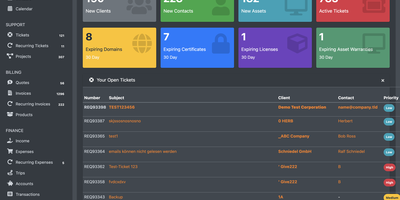
Small MSPs waste thousands of dollars annually on overlapping subscriptions for documentation, ticketing, and billing tools that don't talk to each other. ITFlow replaces that fragmented stack with a unified platform where client contacts, locations, vendors, computer assets, software licenses, domains, SSL certificates, passwords, and documents all live under one roof. The AES-encrypted password vault stores credentials with organized access controls, and domain plus SSL certificate tracking generates automated renewal alerts before expiration disrupts client services. Ticketing supports creation, prioritization, assignment, and SLA tracking, with a client portal where customers submit tickets, view invoices, approve quotes, and access their own documentation independently. The accounting module covers the full lifecycle: quotes, recurring billing, expense tracking, Stripe payment processing, and financial dashboards showing revenue and outstanding balances at a glance. AI integration through Ollama, LocalAI, or ChatGPT accelerates documentation writing and ticket responses directly within the interface. The modular architecture lets you enable only what you need, sidestepping the bloat of enterprise PSA platforms designed for organizations ten times your size. With stable releases since 2025 and zero per-user licensing, ITFlow removes the escalating costs that make commercial PSA tools unsustainable for growing teams. The PHP application deploys with MariaDB and Nginx, ready for production in minutes.
Breeze
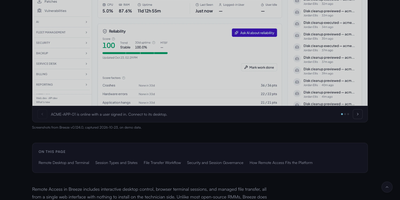
Breeze is an open-source RMM and PSA platform for MSPs that watches every managed device, and its built-in AI operator investigates alerts and drafts fixes for your approval. See live CPU, memory, disk, and network health for the whole fleet, with hardware and software inventory on every Windows, macOS, and Linux endpoint. Approve and deploy operating system and application patches in rings and maintenance windows, or push scripts and software to hundreds of devices at once. Open a remote terminal, browse files, or take over the desktop with multi-display support when a user needs hands-on help. Network discovery scans each site for unmanaged devices, while configuration policies and drift checks keep machines aligned with your baseline. Tickets, time entries, quotes, and invoices live beside the device work, so a resolved issue becomes a billable record without a second system. Clients get their own portal to raise requests and follow progress, and the multi-tenant structure keeps every customer separate from day one. When the AI operator acts, tiered approvals and a full audit log show exactly what it did and who allowed it. Running on a dedicated VPS on RepoCloud with guaranteed CPU, RAM, and SSD, full root SSH access, and a browser serial console. AGPL-3.0 licensed.
ControlR
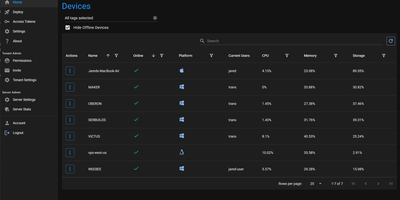
Helping someone fix their computer should not start with a phone call full of instructions nobody can follow: ControlR puts every machine you look after into one browser tab. Install the agent on Windows, Mac, or Linux machines once, and they appear in your device grid with their status ready for action. Open a remote desktop session and see and control the screen as if you were sitting there, drop into a cross-platform PowerShell terminal when a fix is faster typed than clicked, browse the file system to fetch a log or drop off a file, or just open chat when a quick question is all that is needed. Devices are organized with tags, and access follows them: a technician sees the machines their tags cover, while roles decide who can install agents, manage installer keys, administer the tenant, or reach every device. Agent logs stream to the server in real time, which turns bug reports into something you can actually read. Run one tenant for your own fleet, or enable public registration and let each new account become its own isolated tenant, with the database keeping every tenant's devices and users apart. Sensitive settings can arrive through Docker Secrets instead of environment variables, and the whole server runs from a single compose file. Running on a dedicated VPS on RepoCloud with guaranteed CPU, RAM, and SSD, full root SSH access, and a browser serial console. MIT licensed.
ClientSt0r
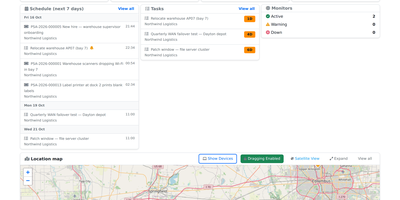
ClientSt0r is a self-hosted operations platform for managed service providers that keeps client documentation, IT assets, credentials, and the service desk in one multi-tenant system running on your own infrastructure. Open any ticket and the client's active contract, the asset it concerns, the runbook that covers it, and the vault entries you are allowed to use appear alongside the conversation, so nobody switches between four products during an outage. Readiness scoring grades every client against what should be documented, explains each gap, and queues the fixes, while versioned documents with owners and review dates keep runbooks from quietly going stale. The credential vault encrypts secrets with AES-256-GCM, isolates them per client, enforces IP, geography, and time-of-day access rules, logs every reveal, generates TOTP codes, checks passwords against known breaches, and imports existing Bitwarden or Vaultwarden libraries. Asset records cover hardware inventory, IP address management, rack layouts, and printable QR labels. The service desk adds queues, SLA timers, dispatch views, time entries, quotes with electronic signatures, invoices, contracts, approvals, a workflow rule builder, a threading email engine, and guided client portal forms, while procurement, profitability reporting, CVE scanning, SSL expiry tracking, and uptime monitoring round out daily operations. Running on a dedicated VPS on RepoCloud with guaranteed CPU, RAM, and SSD, full root SSH access, and a browser serial console. MIT licensed.