RustFS
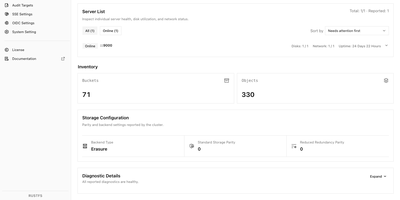
Tools and applications that already speak S3 can use RustFS as their storage backend, so backup jobs, data pipelines, and services keep working while the data stays on infrastructure you control. A built-in web console on port 9001 manages buckets, object uploads and downloads, access keys, users, groups, and IAM policies, with a status page for cluster health, capacity, and scanner activity. Versioning, Object Lock retention, bucket quotas, and server-side encryption with Vault or AWS KMS backends protect objects once they land. Lifecycle rules expire or transition data, and tiering moves cold objects to remote targets such as Amazon S3 or Wasabi. Bucket replication and site replication keep clusters in sync, and event notifications call webhooks when objects change. Single-node mode suits a lab or small server, while distributed mode adds erasure coding, bitrot protection, background healing, and pool expansion or decommissioning as capacity grows. Sign-in works with local users, OIDC single sign-on, or OpenStack Keystone, and FTPS and WebDAV are available by default, with SFTP and the Swift API as opt-in builds. A preview of S3 Tables exposes an Iceberg REST catalog for tools such as DuckDB and PyIceberg, and a documented migration path moves existing MinIO deployments across. Typical uses include backups, container registries, logs and traces, data lakes, and AI training sets. Running on a dedicated VPS on RepoCloud with guaranteed CPU, RAM, and SSD, full root SSH access, and a browser serial console. Apache-2.0 licensed.
Garage
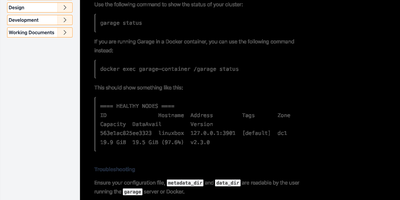
Picture your object storage scattered across a home server, a friend's rack, and a cheap VPS in another country, still answering S3 requests like nothing happened: that is exactly the deployment Garage was built for. Every object is replicated to three zones, so losing a node, a disk, or an entire site degrades the cluster instead of destroying your data. Applications talk to it with the standard S3 API: create buckets, upload objects in multiple parts, list and copy them, and hand out access keys that are scoped per bucket. A separate web endpoint serves static websites straight from buckets with CORS support, which covers personal sites, documentation, and release downloads without another server in the chain. The whole system ships as one dependency-free binary that asks for about a gigabyte of RAM and any x86-64 or ARM CPU from the last decade, second-hand hardware very much included. There is deliberately no consensus protocol to babysit: nodes gossip their cluster layout, tolerate 200-millisecond links, and keep serving reads while parts of the fleet are unreachable. Deuxfleurs runs it in production for their own hosting, and common pairings include restic or rclone backup targets, Matrix media storage, and Nix binary caches. Running on a dedicated VPS on RepoCloud with guaranteed CPU, RAM, and SSD, full root SSH access, and a browser serial console. AGPL-3.0 licensed.
Alarik
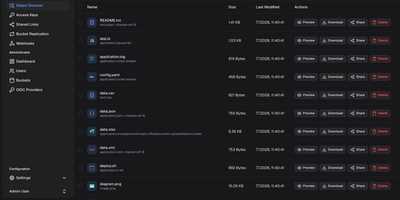
Alarik is a self-hosted S3-compatible object storage server that lets you store files, backups, media, and application data on your own hardware while keeping the S3 APIs your tools already expect. Create buckets, upload objects with multipart support for large files, and retrieve them again through core operations, range reads, presigned URLs, and bucket or object tagging. Versioning keeps earlier copies, delete markers, and listings under your control, while lifecycle rules expire old versions and clean up incomplete uploads automatically. The web console lets you drag and drop files or whole folders, search recursively across nested folders, edit metadata in place, preview individual versions, and share time limited public links. Administrators manage users, access keys, bucket policies, and public access blocks from the same console, with live charts for CPU, memory, traffic, and storage. Bucket webhooks send event notifications when objects change, and replication rules continuously copy data to remote S3 compatible targets, synchronously or asynchronously per rule. Clusters add erasure coded storage across nodes, read repair, bit rot scrubbing, and automatic rebalancing when nodes join, drain, or return. Running on a dedicated VPS on RepoCloud with guaranteed CPU, RAM, and SSD, full root SSH access, and a browser serial console. Apache 2.0 licensed.