Onyx
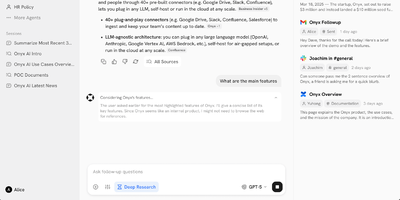
Formerly known as Danswer and now backed by over 31,000 GitHub stars with 253 releases, Onyx delivers a production-ready AI platform that turns any LLM into a context-aware enterprise assistant connected to your organization's actual knowledge. The agentic RAG pipeline combines BM-25 keyword search with prefix-aware embedding models in a hybrid index, then deploys AI agents to retrieve, verify, and synthesize answers with source citations from over 40 connected workplace tools including Google Drive, Confluence, Slack, Notion, Jira, SharePoint, GitHub, and Linear. Custom AI assistants with configurable prompts, backing knowledge sets, and document-level access control enable specialized agents for engineering, sales, support, and research workflows. The platform supports every major LLM provider — Anthropic Claude, OpenAI, Google Gemini, plus self-hosted options via Ollama, LiteLLM, and vLLM for fully air-gapped deployments. Beyond chat, Onyx provides web search with Serper, Google PSE, Brave, and SearXNG integration, an in-house web crawler, code execution, file creation, and multi-step deep research with report generation. Enterprise features include SSO via Google OAuth, OIDC, or SAML with SCIM provisioning, role-based access control, usage analytics by team and agent, query history auditing, PII removal through custom code hooks, and full whitelabeling. Deploy via Docker Compose on any infrastructure. Running on a dedicated VPS on RepoCloud with guaranteed CPU, RAM, and SSD, full root SSH access, and a browser serial console. MIT licensed (Community Edition).

Serviette
Your documents change every day, and your RAG answers should change with them: Serviette keeps a chat and REST API continuously in sync with the files you point it at, no re-indexing jobs to remember. Point it at a local folder, Google Drive, S3 or MinIO bucket, SharePoint library, or even an FTP or WebDAV share, and edits, additions, and deletions flow into the index in real time. One YAML file, or the interactive wizard, chooses among eight vector databases, from embedded DuckDB with zero setup to pgvector, Qdrant, Milvus, Chroma, Weaviate, Pinecone, or MongoDB Atlas. Text, Office files, PDFs with tables, and scanned images are parsed and answerable by default, with audio and video joining when you add the keys. Embeddings can run fully locally with no credentials, and keyless answers simply quote the retrieved passages with their sources. The indexer and the stateless server scale independently, the server shards across workers with one config line, and both a ChatGPT-style web chat and a versioned /api/v1 retrieval API answer on the same port. A free license key from Pathway activates the engine, and benchmarks cover corpora up to 50 GB of text. Running on a dedicated VPS on RepoCloud with guaranteed CPU, RAM, and SSD, full root SSH access, and a browser serial console. MIT licensed.
Casibase
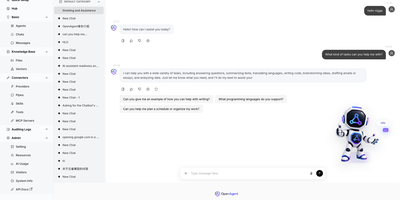
Casibase lets organizations build AI-powered knowledge bases that answer questions from their own documents, connecting to 30+ model providers through a unified admin interface with RAG retrieval and multi-agent orchestration via MCP and A2A protocols. The platform plugs into OpenAI GPT-4o, Anthropic Claude, Meta Llama, Google Gemini, DeepSeek, Ollama local models, HuggingFace, Azure OpenAI, and additional providers, while embedding APIs from OpenAI Ada and Baidu handle vector representation of ingested documents. Document ingestion parses TXT, Markdown, DOCX, PDF, CSV, XLSX, and PPTX files with intelligent chunking strategies for optimal retrieval accuracy. The built-in chat interface provides real-time AI conversations with manual session handover for human agent escalation, and comprehensive chat session logging enables audit trails for compliance. Enterprise identity management integrates Casdoor for Single Sign-On supporting GitHub, Google, WeChat, and OIDC providers with fine-grained access control via the Casbin permission engine. The multi-tenant architecture supports isolated knowledge bases per organization with role-based user management and configurable storage, model, and embedding providers per tenant. The React frontend with Ant Design v5 provides a polished admin dashboard for managing providers, knowledge stores, chat sessions, and user access, while the Go backend with Beego framework handles API logic with MySQL or MariaDB persistence. Running on a dedicated VPS on RepoCloud with guaranteed CPU, RAM, and SSD, full root SSH access, and a browser serial console. Apache 2.0 licensed.

DEEIX Chat
Organizations deploying multiple large language models across departments use DEEIX Chat as their centralized AI workspace for model routing, multimodal conversations, document retrieval, MCP tool execution, and usage governance. Administrators connect upstream channels across OpenAI, Anthropic, Google Gemini, xAI, and OpenRouter protocols while configuring route priorities, traffic weights, and automatic circuit breaking from a unified control plane. Team members switch models mid-conversation, branch message threads, adjust reasoning effort, and generate images or video without managing individual API keys, or optionally bring their own provider keys under admin policy rules. Uploaded PDFs, spreadsheets, and images undergo OCR and semantic chunking so users can attach personal or shared knowledge bases directly to chat sessions with traceable retrieval evidence. Interactive responses render live HTML, SVG, Mermaid diagrams, KaTeX math, and stateful parameter sliders inside a sandboxed preview pane alongside the conversation. Built-in support for Streamable HTTP Model Context Protocol servers lets users discover and invoke external tools with per-message execution limits and full call inspection. Integrated permission groups, OIDC single sign-on, TOTP two-factor authentication, token and per-call billing ledgers, and audit logs give operators complete visibility over usage and spend. Running on a dedicated VPS on RepoCloud with guaranteed CPU, RAM, and SSD, full root SSH access, and a browser serial console. Apache-2.0 licensed.