Tymeslot
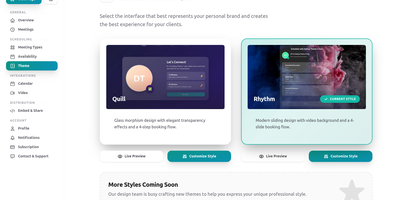
Built on Elixir's fault-tolerant OTP runtime, Tymeslot delivers the complete scheduling toolkit that Calendly charges for and Cal.com relicensed away from open source in 2026. Share one booking link and let clients pick available slots — your calendar stays synchronized and double-bookings disappear automatically through real-time availability checking against Google Calendar, Microsoft Outlook, and any CalDAV server including Nextcloud. Meeting types support configurable durations, buffer times, and availability windows that clients can book without email back-and-forth. Phoenix LiveView powers the real-time UI with WebSocket connections that update instantly as bookings arrive, without client-side JavaScript framework overhead. The platform attaches Zoom video rooms to confirmed bookings through your own Marketplace app credentials, sends confirmation and reminder emails via SMTP, Postmark, SendGrid, Mailgun, or AhaSend, and supports custom booking page themes with embed options for integration into existing websites. Circuit breakers, connection pooling, and graceful degradation maintain availability during provider outages. Authentication supports local accounts, GitHub OAuth, and reCAPTCHA protection on public booking forms. Self-hosting deploys as a single container with PostgreSQL embedded — no separate database container required. Two named volumes persist uploads and database state, while the same image powers the managed cloud at tymeslot.app so self-hosted users get identical features without a crippled community edition. Deploy via Docker, Cloudron with automatic updates, or Railway from a community template. Running on a dedicated VPS on RepoCloud with guaranteed CPU, RAM, and SSD, full root SSH access, and a browser serial console. AGPL-3.0 licensed.
Thunderbird Appointment
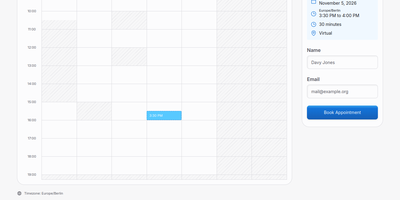
One link replaces the scheduling dance: Thunderbird Appointment publishes your availability as a booking page where visitors choose a slot and the meeting lands on your calendar. You connect the calendars you already keep, Google Calendar or any CalDAV server, and the service reads your busy times and writes new bookings back as real events. Weekly schedules define the days and hours on offer, the length of each slot, and how far ahead or how last-minute a booking may be. Each booking page carries its own title, agenda, and location, from a street address to a Zoom link created for the meeting automatically. Visitors see open times in their own timezone, pick one, and leave their name and email; no account is required on their side. Requests can land as confirmed bookings right away or wait for your approval first, and every booking appears in your bookings list with attendee details. Your own calendar view gathers every connected calendar in one place, so personal and work commitments stop colliding. The interface speaks several languages, honors light and dark themes, and lets each user set the week start and 12 or 24 hour clocks. Self-hosters sign in with a password, and larger deployments can plug in an OIDC provider for single sign-on. Running on a dedicated VPS on RepoCloud with guaranteed CPU, RAM, and SSD, full root SSH access, and a browser serial console. MPL-2.0 licensed.
Cal.diy
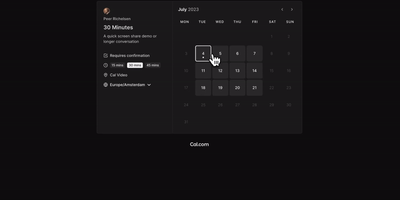
With over 47,000 GitHub stars, Cal.diy is the fully open-source community fork of Cal.com that strips away every proprietary license gate and enterprise paywall to deliver a pure MIT-licensed scheduling platform you completely own. The booking engine supports individual event types including recurring events, seated events with capacity limits, and paid bookings through Stripe and PayPal, all backed by customizable availability schedules with date overrides, buffer times, minimum notice periods, and travel schedule support. Calendar synchronization is bidirectional across nine providers — Google Calendar, Outlook and Office 365, Apple Calendar, CalDAV, Lark, Feishu, Zoho, Exchange, and ICS feeds — so every booking automatically appears on your existing calendar while blocking conflicting slots. Video conferencing links generate automatically for Zoom, Google Meet, Microsoft Teams, Webex, Jitsi, Daily.co, Whereby, and Huddle01, eliminating manual link management. The automation layer connects through webhooks, Zapier, n8n, Make, and Pipedream to CRM platforms like HubSpot, Salesforce, and Close, messaging services including Discord, Telegram, and WhatsApp, and analytics tools such as Google Analytics 4, PostHog, and Fathom. The entire application is built on the T3 stack — Next.js for server-rendered pages, tRPC for end-to-end type-safe APIs, Prisma for PostgreSQL database access, and Tailwind CSS for the responsive interface. Unlike Cal.com's open-core model, Cal.diy requires no license key and includes no gated features. Running on a dedicated VPS on RepoCloud with guaranteed CPU, RAM, and SSD, full root SSH access, and a browser serial console. MIT licensed.
Calnode
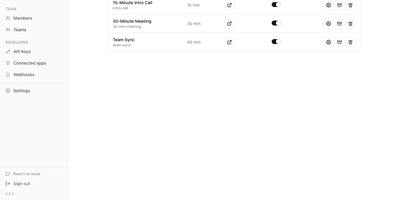
One binary replaces your booking link and your meeting room: Calnode is a complete scheduler you run yourself, small enough to audit and cheap enough to forget. Create event types with durations, custom questions, and locations, set DST-correct availability with date overrides, and share a booking page where guests pick a slot, reschedule, or cancel without an account. Two-way sync with Google Calendar, Microsoft 365, and CalDAV checks real free and busy time across every connected calendar, then mints Meet or Teams links automatically. Teams route bookings round-robin, collectively, or by priority, while paid event types collect through Stripe before the slot confirms. Choose Calnode Rooms and the meeting itself happens in the browser on your LiveKit server, with host controls, consent-aware recording into your own storage, and an AI notetaker that files a transcript and summary on the booking. Agents get first-class access through the REST API, HMAC-signed webhooks, and a native MCP server, and visitors can even book by describing a time in plain language. Everything runs from one static binary and one SQLite file with streaming Litestream backups. Running on a dedicated VPS on RepoCloud with guaranteed CPU, RAM, and SSD, full root SSH access, and a browser serial console. Apache-2.0 licensed.
calrs
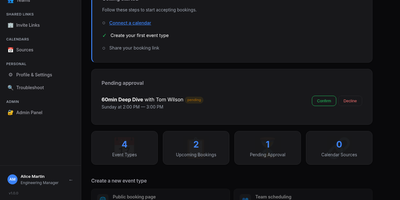
Share a link, and let people book time with you without the email volley that usually decides when a meeting happens. calrs connects to the calendar you already use, whether that is Nextcloud, Fastmail, BlueMind, iCloud, or any other CalDAV server, computes your real free and busy times from synced events and your availability rules, and shows guests only the slots that genuinely work. Create event types for intro calls, support sessions, or coaching, each with its own duration, buffers, minimum notice, booking limits, and confirmation mode, then publish them on your public profile or keep them private behind single-use invite links. Teams get round-robin scheduling that picks the least busy member, collective meetings that require everyone free, and dynamic group links that intersect several calendars on the fly for a one-off call. Guests pick a slot in their own timezone, receive HTML email with calendar invites attached, and can cancel or reschedule themselves from the confirmation email, while you approve pending bookings from the dashboard or straight from your inbox. When a slot looks wrong, the availability troubleshooter draws a timeline showing exactly which event or rule blocked it. Reminders go out before meetings, credentials are encrypted at rest, and the whole interface speaks ten languages with seven themes. Running on a dedicated VPS on RepoCloud with guaranteed CPU, RAM, and SSD, full root SSH access, and a browser serial console. AGPL-3.0 licensed.