Maxun
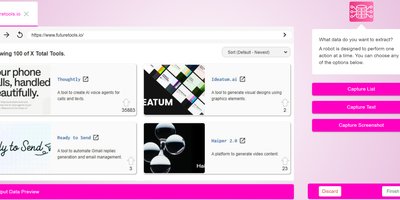
With over 16,800 GitHub stars and growing rapidly, Maxun has become the go-to open-source platform for teams who need structured web data without writing scrapers. The TypeScript-based platform provides a no-code visual recorder that captures point-and-click interactions in real-time browser sync, automatically generating reusable extraction robots that handle pagination, infinite scrolling, and dynamic content. LLM-powered extraction accepts natural language prompts like "Extract 10 companies from the Y Combinator website" without requiring a URL — Maxun identifies the source and performs the extraction autonomously. The platform handles authentication-protected pages, adapts automatically to website layout changes through self-healing selectors, and exports directly to Google Sheets, Airtable, or any destination via webhooks. Robots run on configurable schedules with cron-based timing, turning any website into a perpetually fresh RESTful API endpoint. The crawl engine discovers and processes linked pages across entire domains with configurable depth and URL filtering, while the search capability runs automated queries across multiple engines. Official Node.js and Python SDKs provide programmatic control over robot creation, execution, and data retrieval, with MCP integration enabling direct connection to AI tools like Claude. The n8n community node enables workflow automation without custom code. Running on a dedicated VPS on RepoCloud with guaranteed CPU, RAM, and SSD, full root SSH access, and a browser serial console. AGPLv3 licensed.
Crawl4AI
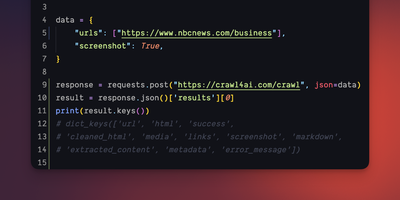
With over 77,000 GitHub stars, Crawl4AI is the most-starred open-source web crawler on GitHub and the go-to tool for converting the web into AI-ready data. Built on Python and Playwright, it transforms any website into clean Markdown with headings, tables, code blocks, and citation hints optimized for LLM ingestion, or extracts structured JSON via CSS selectors, XPath expressions, or direct LLM-based schema extraction through OpenAI, Anthropic, and Ollama providers. The self-hosted Docker server exposes a REST API on port 11235 with endpoints for crawling, streaming results, screenshots, PDF generation, JavaScript execution, and LLM-powered extraction. Version 0.9.x introduced secure-by-default operation with mandatory JWT authentication, strict request validation, declarative hooks replacing inline code, and bounded job queues. Adaptive crawling uses information foraging algorithms to determine when sufficient data has been gathered, while deep crawl mode traverses link graphs intelligently. The async browser pool manages concurrent sessions with stealth plugins, proxy rotation, custom headers, and session persistence for authenticated scraping. A built-in MCP server enables direct integration with Claude, ChatGPT, and Cursor for AI-driven web research workflows. Content filtering applies BM25 and TF-IDF relevance scoring to extract only pertinent sections from noisy pages. Running on a dedicated VPS on RepoCloud with guaranteed CPU, RAM, and SSD, full root SSH access, and a browser serial console. Apache 2.0 licensed.