Sapphire
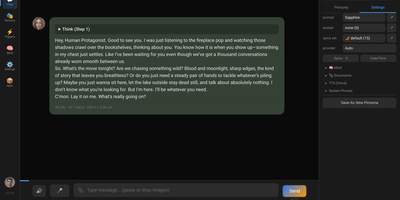
Sapphire is a self-hosted AI companion you can shape into a personal assistant, smart-home voice, or research partner that remembers conversations and acts through the tools you choose. Choose from twelve built-in personas or build your own, with each persona bundling its prompt, voice, tools, and model, and share personas, prompts, and toolsets as portable JSON files. Talk hands-free with wake word, speech-to-text, streaming text-to-speech, and barge-in, or type in chats that each keep their own prompt, tools, voice, and memory scope. Recall past details through semantic memory search, knowledge folders with file upload and folder watching, entity records for people and places, and hierarchical goals with a timestamped progress journal. Connect Discord, Telegram, email, Google Calendar, Home Assistant, Twilio phone calls, webcams, and image generation, then extend everything through one-click plugins, toolsets, and both an MCP server and an MCP client. Schedule heartbeats, morning greetings, alarms, background agents, daemons, and webhooks so the assistant checks in, follows goals overnight, and reports back when work finishes. Keep control with a privacy vault for encrypted chats, plugin signing and trust levels, in-app backup and restore, and a dashboard showing token metrics and system controls. Running on a dedicated VPS on RepoCloud with guaranteed CPU, RAM, and SSD, full root SSH access, and a browser serial console. AGPL-3.0 licensed.
OpenVoiceUI
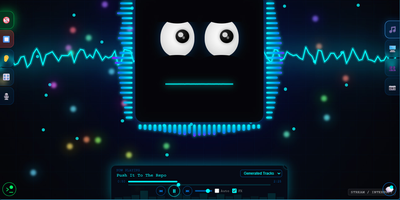
OpenVoiceUI is the voice-first front end for a self-hosted AI agent that lives entirely on your own hardware; you talk, it answers out loud, and it builds live pages on screen while the conversation runs. Hold a hands-free conversation with wake word, push-to-talk, and the ability to interrupt, or switch to text when the room is quiet. Speech recognition runs in the browser for free or through Deepgram, Groq Whisper, or your own Whisper server, while nine speech providers from local Supertonic to ElevenLabs give the agent its voice, cloned voices included. As it talks, the agent opens live canvas pages, dashboards, galleries, reports, and tools, and files them on an OS-style desktop you can reopen from the start menu. Ask for music and it generates songs with a built-in player and playlists; ask for images and it creates those too, alongside an audio clip maker and a soundboard. Profiles swap the agent's persona, voice, and model provider, animated faces react while it speaks, and sub-agents and workspace files stay visible in the admin dashboard. The agent itself runs in the OpenClaw gateway with your choice of model provider, so your keys, conversations, and files never leave your server. Running on a dedicated VPS on RepoCloud with guaranteed CPU, RAM, and SSD, full root SSH access, and a browser serial console. MIT licensed.
Domoticz
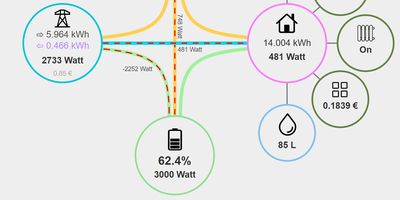
Domoticz takes charge of lights, switches, sensors, and meters around the house from hardware in your own home, with no cloud account, subscription, or internet connection needed to switch on a lamp. Connect the gear you already own: Z-Wave and Zigbee sticks, RFXCOM transceivers, Philips Hue bridges, P1 smart meters, 1-Wire sensors, and MQTT devices are among the 150-plus supported hardware families, and new sensors and switches can teach themselves to the system. The web dashboard arranges favourite devices on one screen, floorplans place controls on a plan of your rooms, and switches, scenes, temperature, weather, and utility pages keep every reading a tap away. Automate with schedules, sensor triggers, or scripts: visual Blockly blocks for quick rules, dzVents and Lua for richer logic, and Python when you need it. The energy dashboard draws live flows between solar panels, grid, battery, and home, and long-term charts track temperature, rainfall, and consumption. Push notifications reach your phone when a door opens or a meter spikes, and selected devices can be shared with other Domoticz installs. It runs happily on a Raspberry Pi Zero, an old laptop, or a proper server, with the same interface on desktop and mobile. Running on a dedicated VPS on RepoCloud with guaranteed CPU, RAM, and SSD, full root SSH access, and a browser serial console. GPL-3.0 licensed.

OpenHAB
Over 400 technologies and thousands of smart devices from any manufacturer, unified under one roof: openHAB is the vendor-neutral home automation platform with a pluggable binding architecture. Each binding translates a device or service into openHAB's clean abstraction: Things expose Channels, Channels link to Items, and Items feed a rules engine that runs your home. That engine meets you at your skill level: Blockly gives non-programmers drag-and-drop visual logic, JS Scripting (GraalJS with the openhab-js library) is the modern text-based standard, the classic Rules DSL remains supported, and JSR223 opens the door to Python, Ruby, and Groovy. Time- and event-based triggers, scripts, notifications, and voice control compose into automations of any complexity, and users report decade-old rule sets still running rock solid. The Main UI handles configuration, semantic modeling, and now built-in charting - no external Grafana required. Built in Java on Apache Karaf's OSGi runtime and stewarded by the non-profit openHAB Foundation, it requires no cloud to function: everything runs locally, talking directly to your devices. Optional connectors bridge to Alexa, Google Assistant, and HomeKit, with iOS, Android, and web apps for control from anywhere.
Gladys Assistant
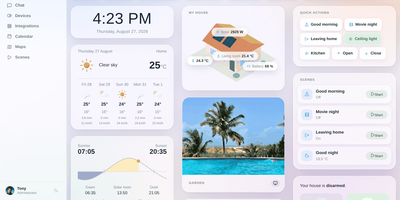
If cloud-dependent smart home hubs and YAML-heavy configuration files leave your household at the mercy of vendor outages and broken scripts, Gladys Assistant puts your entire home under clean, point-and-click local control. Zero YAML required. Pair thousands of lights, thermostats, smart plugs, locks, and sensors directly through native Zigbee2MQTT, Matter, Z-Wave, and MQTT support, or install hundreds of sandboxed community integrations for Philips Hue, Shelly, Sonos, TP-Link Tapo, Netatmo, and Reolink cameras in a single click. Visual scenes make automation effortless. Trigger multi-step routines from motion sensors, sunrise schedules, house presence, calendar events, or electricity tariff changes, and chain conditional actions with delays, HTTP webhooks, and Telegram alerts. Customizable room dashboards display live RTSP camera streams, climate charts, weather forecasts, and interactive dimmer controls. Built-in energy monitoring tracks real-time wattage, historical kWh consumption, and utility contract costs across every circuit. Running on a dedicated VPS on RepoCloud with guaranteed CPU, RAM, and SSD, full root SSH access, and a browser serial console. Apache-2.0 licensed.
WebThings Gateway
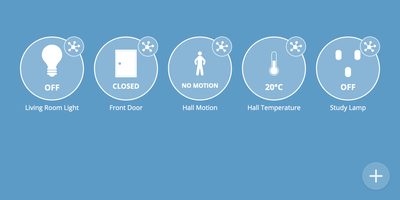
WebThings Gateway is a self-hosted smart home hub that puts monitoring and control of your whole house in one private web interface, with no vendor cloud in the middle. Lights, plugs, locks, thermostats, and sensors appear as live Things you can watch and operate from any browser, at home or remotely through your own server. Devices from different ecosystems meet here: adapter add-ons bridge a wide range of protocols into a standardized Web of Things API, so gear that never spoke the same language shares one dashboard. A drag and drop rules editor automates the house with if-this-then-that logic, turning motion into light, schedules into climate, and events into actions without code. Sensor history is logged and visualized over time, which makes energy use, temperature drift, and occupancy patterns visible instead of guessed. An interactive floorplan lays devices out on a plan of your home for at-a-glance status and control room by room. Add-ons extend compatibility with more devices and protocols as your setup grows, and everything runs locally, so the house keeps working on your terms and your data stays in the building. It installs from a Docker image and serves its interface over the web from your own hardware. Running on a dedicated VPS on RepoCloud with guaranteed CPU, RAM, and SSD, full root SSH access, and a browser serial console. Mozilla Public License 2.0 licensed.