Botpress
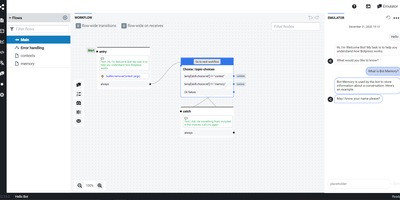
Build, deploy, and monitor chatbots and LLM-powered agents on one open-source conversational AI platform: Botpress. Its Studio is a visual development environment: a drag-and-drop canvas arranges conversation logic with nodes for messages, questions, choices, and actions, while a built-in emulator simulates conversations for debugging before anything goes live. Agents ground their answers in a knowledge base assembled from uploaded documents, ingested websites, and past conversations via retrieval-augmented generation, and the LLM layer connects to multiple model providers - GPT-4, Claude, Mistral - with a configurable model strategy. An autonomous engine handles reasoning, tool orchestration, persistent memory across sessions, and sandboxed code execution, and custom code actions in TypeScript extend agents past prebuilt workflows. Over 100 integrations deploy the same bot to WhatsApp, Telegram, Slack, Microsoft Teams, and web chat, and connect it to HubSpot, Zendesk, Zapier, and arbitrary APIs and webhooks. Human handoff, conversation analytics, and quality monitoring cover production operation. Originating in 2017 from a Montreal team, the community edition is developed openly on GitHub.
Mabeyn
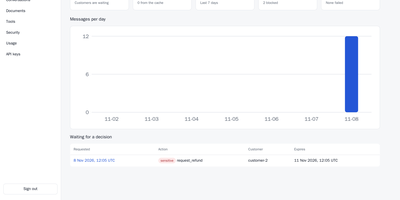
Customer-support bots tend to fail in two ways, inventing answers and taking actions nobody approved, and Mabeyn is a support agent built to stop both. Upload PDF, Markdown, or HTML files, or add a public web page, and policy answers come only from that material, citing the exact section and admitting when nothing fits. Register HTTP endpoints from your backend as tools, label each read, write, or sensitive, and attach policies that check the real order; the customer's identity comes from the verified session, never the model. Sensitive actions such as refunds wait in an approval queue that shows the exact arguments and the thread; once an admin approves, the answer reaches the shopper's chat without a reload. Returning shoppers are remembered: facts they state are kept for 180 days, instructions and personal data are never stored, and customers and admins can read or erase every note. A four-layer firewall screens messages, uploaded documents, tool calls, and replies, masks card numbers and e-mail addresses on the way out, and logs each block as a filterable security event. Businesses stay isolated in separate workspaces, each with secret and publishable API keys, per-customer rate limits, and daily token and cost reports. One script tag adds a streaming chat bubble to any page, and a shopper who asks for a person flags the conversation as escalated. Running on a dedicated VPS on RepoCloud with guaranteed CPU, RAM, and SSD, full root SSH access, and a browser serial console. MIT licensed.