BottleCRM
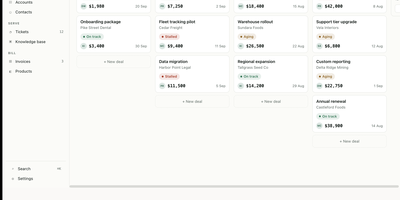
BottleCRM delivers a self-hosted customer relationship management platform that unifies sales lead qualification, visual deal pipeline tracking, helpdesk ticketing, and client invoicing into one workspace. Sales representatives capture prospects through embeddable website forms or CSV imports, qualifying leads before converting them into synchronized account, contact, and opportunity records. Account executives manage visual Kanban deal boards with stage aging timers and weighted pipeline forecasting, dragging cards across qualification phases while preserving complete interaction timelines. Customer support teams handle incoming inquiries with multi-level ticket hierarchies, business-hours service level agreement clocks, automated escalations, approval workflows, and canned response macros. Billing managers generate professional quotes and invoices directly from won deals, applying customizable line-item tax rates and tracking payment statuses through customer self-service portals. Development teams connect autonomous AI agents and third-party software using personal access tokens against the documented REST API to automate data entry and workflow updates. Running on a dedicated VPS on RepoCloud with guaranteed CPU, RAM, and SSD, full root SSH access, and a browser serial console. MIT licensed.
Quackback
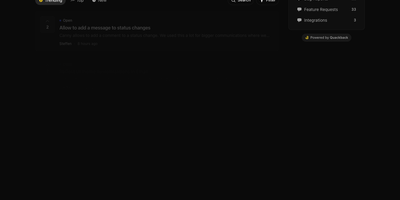
Quackback unifies customer feedback boards, feature voting, public roadmaps, release changelogs, help centers, status pages, and a multi-channel support inbox into a single self-hosted workspace that replaces Canny, Productboard, and Intercom. Product teams use its branded boards to collect feature requests and bug reports, merge duplicate submissions, and rank demand by user votes or customer segments. When a request moves into development, two-way integrations with Linear, GitHub, and Jira automatically update the card across customizable Kanban status columns or quarterly timeline views on your public roadmap. Support agents work out of a shared inbox that brings real-time Messenger web chat, inbound email threads, and durable support tickets together under one roof, complete with SLA timers, office hours, saved macros, and CSAT surveys. Conversations that uncover a feature gap convert directly into votes on existing feedback posts without losing thread context. Quinn, the built-in AI assistant, answers common questions from your Help Center articles, drafts agent replies, and exposes a Model Context Protocol server so external AI tools can triage posts or manage tickets. Once features ship, publishing a scheduled changelog entry automatically notifies every voter via email and in-app alerts. Running on a dedicated VPS on RepoCloud with guaranteed CPU, RAM, and SSD, full root SSH access, and a browser serial console. AGPL-3.0 licensed.
Bytedesk
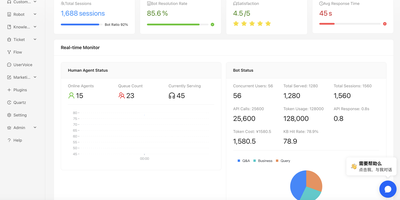
Support teams handling website live chat, email queues, and social messaging channels gain a unified, AI-assisted helpdesk in Bytedesk. Incoming conversations from web widgets, mobile SDKs, WhatsApp, WeChat, and email flow into a single agent workbench equipped with skill-group routing, VIP priority rules, and automatic human handoff. Customer-facing AI agents connect to Ollama, DeepSeek, OpenAI, Qwen, and Zhipu models to answer recurring inquiries using retrieval-augmented generation (RAG) over internal knowledge bases and FAQ libraries, complete with function calling and Model Context Protocol (MCP) tool execution. Complex escalations convert into SLA-tracked tickets with custom approval workflows, or transition directly into browser-based WebRTC video calls, screen sharing sessions, and FreeSwitch voice call center queues. Supervisors track real-time queue depth, bot resolution rates, token usage, automated AI quality scores, and customer satisfaction surveys from the analytics dashboard. Native client SDKs for Web, iOS, Android, Flutter, UniApp, WordPress, and WooCommerce make embedding customizable chat widgets straightforward across any storefront. Running on a dedicated VPS on RepoCloud with guaranteed CPU, RAM, and SSD, full root SSH access, and a browser serial console. AGPL-3.0 licensed.
Call-Me
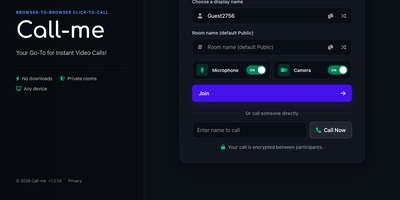
Call-Me puts a click-to-call video button on your website so a visitor can start an encrypted one-to-one video call with your team right in the browser, with no downloads, no accounts, and no phone numbers. A shared link carries everything: send a customer to a named room such as Support or Reception, or link straight to one person so the call rings them directly, which suits support desks, telehealth check-ins, tutoring, and sales consultations. Everyone in a room sees who else is present and available, and one click on a name starts the call. During the call you can chat in real time, share your screen, send files, switch between cameras, microphones, and speakers, hide your video, or mute yourself. Web push notifications flag an incoming call even when your tab sits in the background, so a staffed room never silently misses a visitor. An optional host password keeps the operator side of the room private. A REST API reports connected users, rooms, availability, and active calls, and can start a call for you, while webhooks post join, leave, and call start and end events to your other systems. The interface speaks multiple languages and adapts to phones and desktops alike. Running on a dedicated VPS on RepoCloud with guaranteed CPU, RAM, and SSD, full root SSH access, and a browser serial console. AGPL-3.0 licensed.