Strapi
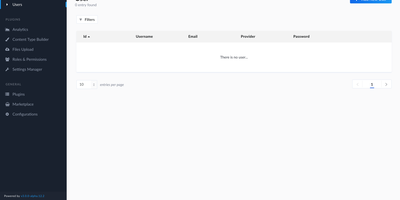
The leading open-source headless CMS with over 72,800 GitHub stars and more than 20 million npm downloads, Strapi has powered content APIs for thousands of organizations since its creation in 2015, providing a complete backend for websites, mobile applications, IoT devices, and any frontend framework through auto-generated REST and GraphQL endpoints. The visual Content-Type Builder lets editors define collections, single types, components, dynamic zones, and relations without code, while Strapi AI introduced in 2026 generates complete content schemas from natural language descriptions, Figma file uploads, or existing JavaScript application code analysis. Version 5 rewrote the platform with a TypeScript-first architecture, replacing the Entity Service with the Document Service API, switching admin panel builds from Webpack to Vite, and integrating internationalization directly into core with unlimited locale support. Database flexibility spans PostgreSQL, MySQL, MariaDB, and SQLite with automatic migration handling. The media library manages uploads to local storage, Amazon S3, or Cloudinary with image optimization and responsive formats. Granular role-based access control defines permissions per content type, field, and locale. The plugin marketplace extends functionality with GraphQL, SEO, email, custom fields, and community contributions, while lifecycle hooks, custom controllers, and middleware enable arbitrary backend logic. Draft and publish workflows, webhooks for external system integration, API token authentication, data import and export, and CRON job scheduling round out a platform that handles content operations from prototype to production. Running on a dedicated VPS on RepoCloud with guaranteed CPU, RAM, and SSD, full root SSH access, and a browser serial console. MIT licensed.
mCaptcha
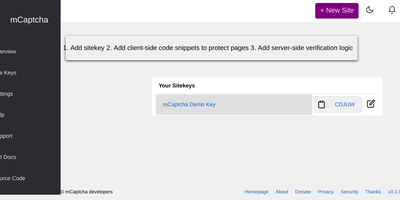
The CAPTCHA bargain - annoy your users and feed their behavior to Google - gets replaced with economics by mCaptcha. Instead of image puzzles, it uses SHA256 proof-of-work: every visitor's browser silently solves a small computational challenge (via a WebAssembly library) before submitting a form. Humans never notice the milliseconds; bots hammering your site must burn more compute sending requests than your server spends answering them, which makes attacks more expensive than defense - the property that also makes mCaptcha genuine DoS protection, not just bot filtering. Written in Rust, the system is fully automated: difficulty scales with traffic, so challenges stay trivial in normal conditions and harden under attack. The privacy and accessibility wins are structural rather than promised: no tracking, no profiling, no user-pattern data collection, and no visual puzzles that exclude users with visual or cognitive impairments - the design was published in Communications of the ACM. Rate limiting is IP-independent, so users behind NATs, VPNs, or Tor get the same experience instead of endless challenge loops, and proofs resist replay attacks, neutering captcha farms. Migration is deliberately easy: the API is compatible with reCAPTCHA and hCaptcha, making it a drop-in replacement. AGPL-licensed core with proprietary-friendly client libraries.
Ever Works
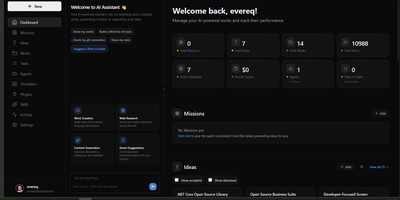
Ever Works transforms a single text prompt into a fully researched, written, coded, and deployed website through autonomous AI agents that operate on a configurable 15-step generation pipeline. Unlike one-shot builders, it continuously improves generated content on a schedule, keeping sites fresh without manual intervention. The platform integrates with six AI providers (OpenAI, Anthropic, Google, Groq, Mistral, Ollama) via gateways like OpenRouter and Vercel AI Gateway, while its plugin system connects ten search providers including Tavily, Brave, Exa, SerpAPI, and Perplexity for deep autonomous research. Every generation is Git-native — code and content live in your own GitHub repositories as commits, providing full version control, portability, and zero vendor lock-in. The monorepo ships a NestJS 11 REST API with JWT authentication, a Next.js 16 web dashboard for managing works, a CLI for terminal operations, an MCP server for AI agent integration, and admin tooling. Content management supports items, categories, tags, and collections, while deployment targets include Vercel and Kubernetes. Background processing runs on Trigger.dev with BullMQ scheduling, and monitoring leverages Sentry plus PostHog for error tracking and product analytics. The platform supports OAuth via GitHub and Google, subscription billing, email notifications, and AI chat conversations for natural-language interaction with your generated works. Running on a dedicated VPS on RepoCloud with guaranteed CPU, RAM, and SSD, full root SSH access, and a browser serial console. AGPL-3.0 licensed.
Centrifugo
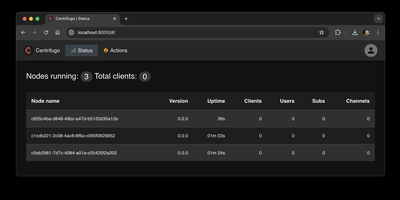
Benchmarked at one million concurrent WebSocket connections and 30 million delivered messages per minute on a single server, Centrifugo is a self-hosted real-time messaging server that integrates with any backend language — Node.js, Python, Go, Ruby, PHP, Java — without requiring architectural changes to your existing application. It handles persistent connections over WebSocket, HTTP-streaming, Server-Sent Events, gRPC, and experimental WebTransport, routing messages through a channel-based PUB/SUB model with automatic reconnection recovery that replays missed messages from hot channel history. Built-in horizontal scaling operates through Redis (including Redis Cluster, AWS ElastiCache, Valkey, KeyDB, and DragonflyDB), NATS, or PostgreSQL brokers, allowing multi-node deployments without external message queues. The server provides JWT-based authentication using HMAC or RSA keys, granular channel permissions, online presence tracking showing who is currently subscribed to a channel, and an RPC proxy that forwards client calls to your backend over HTTP or gRPC. The embedded ReactJS admin web interface displays real-time connection statistics, node information, and provides an interactive API console for publishing messages, managing subscriptions, and inspecting channel history. Official client SDKs are available for JavaScript, Dart, Go, Swift, and Java, with unidirectional transports requiring no SDK at all. Centrifugo also supports delta updates to minimize bandwidth, connection event proxying, and Prometheus-compatible metrics for Grafana monitoring. Running on a dedicated VPS on RepoCloud with guaranteed CPU, RAM, and SSD, full root SSH access, and a browser serial console. Apache 2.0 licensed.
OpenReplay
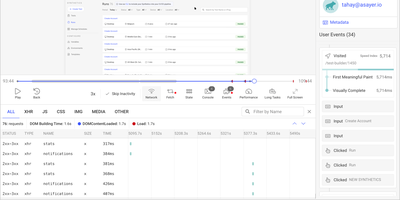
Backed by 12,400+ GitHub stars and positioned as the self-hosted alternative to FullStory and Hotjar, OpenReplay delivers the open-source session replay platform that keeps every byte of user behavior data on your own infrastructure. The JavaScript tracker captures pixel-perfect recordings of clicks, scrolls, form inputs, and navigation with automatic sensitive data masking, while simultaneously logging network requests, console errors, JavaScript exceptions, and Redux, VueX, MobX, NgRx, Pinia, and Zustand store state changes for complete technical context. DevTools mode reconstructs each session with full stack traces, GraphQL queries from Apollo and Relay, Fetch and Axios request payloads, CPU and memory metrics, and page speed waterfall charts — effectively giving developers a browser inspector tied to any user session. Product analytics surfaces conversion funnels, user journeys, click heatmaps, web vitals trends, and retention cohorts without requiring custom instrumentation. Co-browsing connects support agents to live user sessions with cursor control and WebRTC audio, enabling real-time assistance without third-party screen-sharing software. Integrations push session context into Sentry, Datadog, CloudWatch, Stackdriver, and Elastic for front-to-back debugging. Feature flags enable gradual rollouts with session-level targeting. The platform deploys to any cloud via Docker and Kubernetes with auto-scaling ingestion handling up to 50,000 sessions per month on the open-source edition. Running on a dedicated VPS on RepoCloud with guaranteed CPU, RAM, and SSD, full root SSH access, and a browser serial console. AGPLv3 licensed.
SurfSense
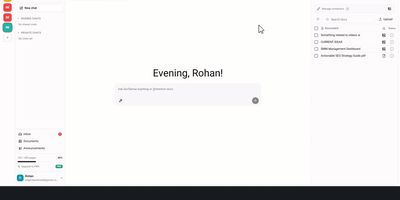
Positioned as the open-source NotebookLM alternative for AI agents, SurfSense delivers a live web research platform where your agents access structured data from Reddit, YouTube, Instagram, TikTok, Amazon, Walmart, Google Maps, Google Search, Indeed, and any page on the open web through one REST API or MCP server. Scheduled and event-triggered agents transform findings into briefs, alerts, podcasts, and presentations, while a built-in knowledge base keeps every discovery searchable with Perplexity-style cited answers using hybrid semantic and full-text search powered by PostgreSQL with pgvector. Upload PDFs, Office documents, images, and audio files, or sync Google Drive, OneDrive, and Dropbox — 50+ file formats supported with AI file sorting that auto-organizes documents by source, date, and topic. The MCP server exposes scrapers, knowledge base, and workspaces as native tools for Claude, Cursor, and any MCP-compatible agent. Cross-country proxy rotation handles Reddit, TikTok, and Google Search scraping with geo-aware sticky sessions and captcha-aware anti-bot handling. The platform features collaborative chats, multi-format document export, git-native knowledge base with Open Knowledge Format export, and a desktop quick-ask panel with global shortcut. Docker Compose deployment manages nine services including Caddy proxy, PostgreSQL, Redis, FastAPI backend, Celery workers, zero-cache real-time sync, and Next.js frontend with automatic Watchtower updates. Running on a dedicated VPS on RepoCloud with guaranteed CPU, RAM, and SSD, full root SSH access, and a browser serial console. AGPL-3.0 licensed.

Bulwark Webmail
Transforming your Stalwart Mail Server into an all-in-one private communication hub, Bulwark Webmail delivers fast web-based email, collaborative calendars, shared contacts, and cloud files in a single unified interface. Users can manage multiple email accounts from an integrated inbox with conversational message threading, nested organizational tags, scheduled delivery, and instant full-text search across thousands of archived messages. The rich text composer provides markdown shortcuts, inline image embedding, reusable canned response templates, and automated draft synchronization. Team members can coordinate schedules across day, week, month, and agenda calendar views with drag-to-reschedule adjustments, interactive iMIP meeting invitations, and external CalDAV calendar subscriptions. The integrated address book organizes individual contacts into custom groups with full vCard import and export support, while the files module lets users browse server storage, preview incoming attachments, and upload documents directly through the browser. Built-in security safeguards enforce multi-factor authentication, cryptographic S/MIME signatures, client-side encryption at rest, and automated HTML luminance remapping to keep dark emails legible. Running on a dedicated VPS on RepoCloud with guaranteed CPU, RAM, and SSD, full root SSH access, and a browser serial console. AGPL v3 licensed.
CaddyUI
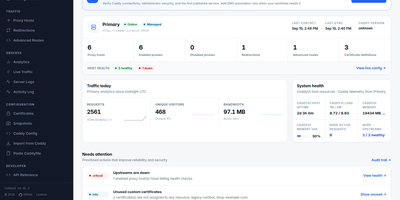
Providing an intuitive control plane for modern reverse proxy infrastructure, CaddyUI enables system administrators to manage proxy hosts, automated TLS certificates, and traffic routing without hand-editing configuration files. Operators can create and adjust reverse proxy destinations, URL path rewrites, custom headers, and redirection rules using structured forms that validate against the proxy engine before saving. The platform coordinates automatic ACME certificate requests and renewals, displaying live certificate expiration timelines, validation stages, and internal self-signed certificate authority options for local network services. Fleet management tools synchronize proxy rules across multiple distributed server instances, preventing configuration drift across staging and production clusters. Automated post-deployment health checks verify upstream endpoint availability, HTTP status codes, and latency thresholds, instantly rolling back to the previous configuration if an expectation fails. An integrated observability suite delivers real-time visitor traffic analytics, geographic maps, HTTP response code breakdowns, and single-click client IP blocking to counter malicious probing attempts. Administrators can schedule automated database backups, configure multi-user access with role permissions, and integrate CrowdSec threat intelligence to protect backends. Running on a dedicated VPS on RepoCloud with guaranteed CPU, RAM, and SSD, full root SSH access, and a browser serial console. Apache 2.0 licensed.
Grimoire
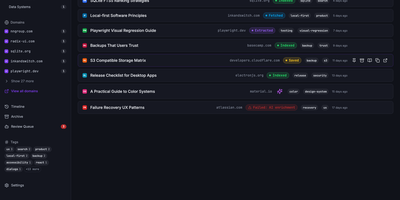
Grimoire captures, extracts, and indexes the content behind your bookmarks so you can search what pages actually say, not just their titles and URLs. The ingestion pipeline accepts links from the web UI, REST API, MCP server, browser bookmarklet, or bulk import, then fetches each page and extracts readable content using specialized parsers for GitHub repos, GitHub issues, StackOverflow threads, YouTube transcripts, PDFs, and standard web articles. Everything stores locally in SQLite with file-based content archives. Search operates in three modes: FTS5 keyword matching for exact terms, semantic embedding search for meaning-based retrieval using vector similarity, or a hybrid ranking mode combining both. Optional AI providers including OpenAI, Ollama, Anthropic, DeepSeek, and any OpenAI-compatible endpoint generate automatic tags, summaries, and embeddings without being required for core functionality. The interface built with React 18, Vite, TypeScript, Tailwind CSS, and Radix UI supports categories, nested tags, notes, archive and trash states, read-later flags, and multi-user isolated spaces. A single Bun-powered Hono process serves both the compiled frontend and the REST API on port 3210, requiring only one Docker container and a SQLite volume. Backup and restore export bookmarks, content, settings, and metadata as portable ZIP archives. Nearly 3,000 GitHub stars reflect growing adoption among developers and researchers. Running on a VPS on RepoCloud with guaranteed CPU, RAM, and SSD, full root SSH access, and a browser serial console. MIT licensed.
GoatCounter
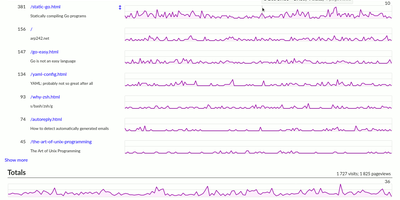
GoatCounter delivers meaningful web traffic insights — pageviews, referrers, browsers, screen sizes, country-level geolocation — without setting a single cookie, without collecting personal data, and without forcing GDPR consent banners on your visitors. Written entirely in Go and distributed as a single compiled binary consuming roughly 25MB of RAM, it adds just 3.5KB to your pages via the tracking script, with a JavaScript-free tracking pixel alternative for sites that avoid scripts entirely, plus backend middleware integration and log file import for server-side collection. The dashboard displays pageview counts per path with hourly resolution, referrer sources grouped by domain with full URL on hover, browser and OS version breakdowns, screen size distributions, and country-level location data derived from IP addresses that are immediately discarded after geolocation. Campaign tracking supports UTM parameters and custom data attributes. A public stats option exposes your dashboard at a shareable URL for build-in-public transparency. SQLite serves as the default database requiring zero administration, while PostgreSQL handles higher-traffic deployments with multi-site setups. Built-in ACME and TLS certificate management eliminates reverse proxy requirements for HTTPS — no Nginx or Caddy needed. The REST API provides programmatic access to all analytics data. Deploy as a single binary, via Docker with the official arp242/goatcounter image, or through native packages. Running on a dedicated VPS on RepoCloud with guaranteed CPU, RAM, and SSD, full root SSH access, and a browser serial console. EUPL-1.2 licensed.
CyberScraper 2077
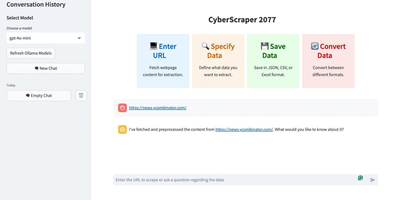
With 3,100+ GitHub stars, CyberScraper 2077 replaces brittle CSS selectors and XPath queries with natural language data extraction powered by Large Language Models. Users paste a URL, describe the data they want in plain English, and the AI extracts structured results from any website — no HTML parsing knowledge required. The tool supports three LLM backends: OpenAI GPT models for maximum accuracy, Google Gemini for cost-effective extraction, and local Ollama instances for fully private scraping where URLs and data never leave your server. Built on Python asyncio with Playwright browser automation, it handles concurrent page fetching with content-based and query-based LRU caching to minimize redundant API calls. The Streamlit web interface runs on port 8501 and provides one-click export to JSON, CSV, HTML, SQL, Excel, and direct Google Sheets upload. Tor network integration routes requests through onion routing for anonymous scraping of both clearnet and .onion hidden service sites with automatic circuit management and stream isolation. Stealth mode randomizes user agents, manages cookies, and controls JavaScript execution timing to bypass bot detection systems. Multi-page scraping navigates through paginated results with automatic URL pattern detection. Docker deployment packages all dependencies including Playwright browsers into a single container. Running on a dedicated VPS on RepoCloud with guaranteed CPU, RAM, and SSD, full root SSH access, and a browser serial console. MIT licensed.
Bracket
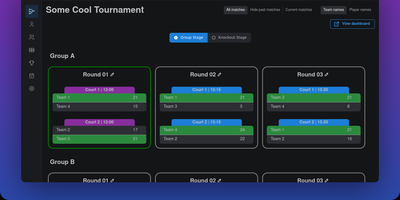
Organizers running sports leagues, gaming tournaments, and community athletics can deploy Bracket as an open-source competition control hub that coordinates multi-stage events without recurring SaaS subscription fees. Competition directors can configure multi-tier tournament topologies combining single elimination, double elimination, round-robin pools, and dynamic Swiss format brackets within a unified event schedule. An interactive calendar grid enables operators to drag and drop fixtures between designated courts, assign start times, and balance player recovery intervals across multiple playing areas. Public dashboard displays generate real-time match outcomes, court assignments, and standings boards that spectators can monitor on mobile devices or overhead venue monitors with customized team logos. Club administrators can manage multiple regional athletic organizations, register rosters through bulk CSV spreadsheet imports, and coordinate simultaneous divisions spanning amateur and championship flights. Integrated OpenAPI REST endpoints allow external scoring overlays, live stream graphic generators, and automated result bots to query match statuses or submit verified referee scorecards programmatically. Running on a dedicated VPS on RepoCloud with guaranteed CPU, RAM, and SSD, full root SSH access, and a browser serial console. AGPL-3.0 licensed.

Isso
Named from the German "Ich schrei sonst" - roughly "or I'll scream" - Isso is a lightweight Python/JavaScript commenting server, a drop-in Disqus replacement for people who noticed what Disqus does to reader privacy and page load times. The design premise is printed right in the docs: comments are not Big Data. So the backend is a single SQLite file rather than a database cluster, and the entire client is one embeddable JavaScript file - 65 kB, 20 kB gzipped - that you drop into any static site, blog, or CMS. Commenters write in Markdown, need no account, and can edit or delete their own comments within a configurable window (15 minutes by default). Spam control comes from an optional moderation queue: held comments stay invisible until you activate them via an admin interface or email notification links. Migration is a first-class feature, with importers for Disqus and WordPress exports, so years of existing threads move over intact. Because everything is server-rendered from your own instance, no third party tracks your readers, and real-world switchers report smaller pages and faster loads than the Disqus embed. MIT-licensed, running since 2012.

Artalk
Artalk embeds a full commenting system into any webpage with three lines of JavaScript, packing multi-site management, social login, spam filtering, and Markdown rendering into a client that weighs roughly 40KB. One server instance manages comments for unlimited websites with complete data isolation between sites, eliminating the need for separate deployments per project. The framework-agnostic Vanilla JS client renders a complete comment interface with Markdown support, LaTeX mathematical formula rendering, image uploads, emoji packs compatible with OwO format, and automatic dark mode detection. An integrated admin dashboard accessible through the comment box provides comment moderation queues, IP banning, comment pinning, page-level statistics, and content management without direct database access. Social login authenticates commenters through GitHub, Google, Twitter, Discord, and additional OAuth providers, while captcha protection spans four backends: image captcha, Cloudflare Turnstile, Google reCAPTCHA, and hCaptcha. Spam filtering layers include Akismet integration, keyword block lists, and cloud moderation services that catch unwanted content before publication. Email notifications support SMTP, Aliyun DM, and Sendmail transports with customizable templates, and multi-channel push notifications extend to Telegram, Bark, and other messaging platforms. The OpenAPI-documented HTTP API enables programmatic comment management. Database flexibility covers SQLite, MySQL, PostgreSQL, and SQL Server. A plugin marketplace offers community extensions for custom behavior. Continuously maintained for over 8 years. Running on a dedicated VPS on RepoCloud with guaranteed CPU, RAM, and SSD, full root SSH access, and a browser serial console. MIT licensed.
Stormkit
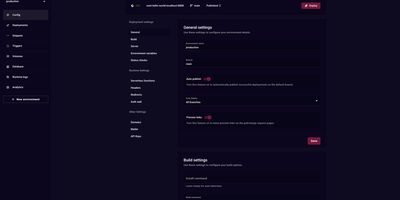
Stormkit delivers a self-hostable PaaS that eliminates vendor lock-in while providing Vercel-class deployment workflows. The Go backend handles build orchestration, hosting, and background job processing while the React frontend provides a complete management dashboard for applications, environments, and team collaboration. Git integration with GitHub, GitLab, and Bitbucket enables push-to-deploy workflows where every commit triggers automated builds with preview links posted directly to pull requests. Serverless functions use filesystem-based routing — each TypeScript or Node.js file in the API directory becomes an endpoint automatically, deploying to AWS Lambda with configurable timeouts. PostgreSQL database schemas ship with automatic migrations, isolated credentials per environment, and secure environment variable injection preventing credential leakage between staging and production. Custom domains provision TLS certificates automatically through Let's Encrypt with support for custom certificates and headers. The environment system creates isolated deployment contexts for production, staging, and development with independent variables, domain bindings, and auto-publish rules per branch. Privacy-respecting server-side analytics track visitors, referrers, and top paths without client cookies or third-party scripts. Role-based access control manages team permissions across applications. Docker Compose deployment provisions the full stack including the API server, hosting service, build runner, and worker server. Running on a dedicated VPS on RepoCloud with guaranteed CPU, RAM, and SSD, full root SSH access, and a browser serial console. AGPL-3.0 licensed.
Automatisch
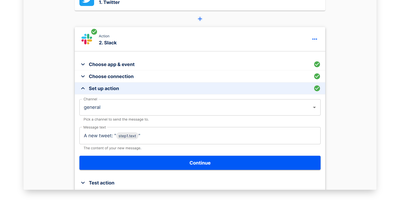
Automatisch runs your Zapier workflows on your own hardware - an open-source, self-hosted automation platform built as a direct alternative. Flows are chains of steps: one trigger (a polling or webhook event such as a new GitHub issue, a Stripe payment, or a form submission) followed by action steps that pass data downstream (post to Slack, append a Google Sheets row, update Notion). The visual builder deliberately mirrors Zapier's trigger-action model, so migrating existing Zaps requires no retraining and no programming knowledge. Roughly 60 integrations cover common business services - Slack, GitHub, Google Sheets, Notion, Stripe, Discord - and connections store credentials per service, with multiple accounts per app supported. Every execution runs on your own server: execution history, logs, and payload data never touch a third-party processor, which matters for GDPR, healthcare, and finance workloads. Error handling with retry logic, a REST API for programmatic flow management, and Docker Compose deployment round out the platform. The AGPL-3.0 Community Edition has no feature limits or per-task billing; an Enterprise Edition adds SSO, roles, and audit logs.
Convoy
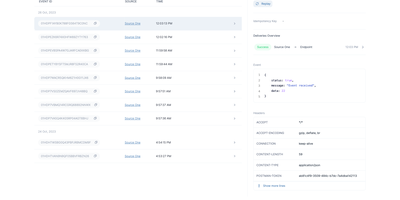
Convoy is an enterprise-grade webhooks gateway that manages both incoming and outgoing webhook traffic to guarantee reliable event delivery without exposing internal microservices to the public internet. Organizations deploy the platform at the edge to ingest events from message brokers such as Apache Kafka, RabbitMQ, and Google Cloud PubSub, or receive HTTP webhooks from third-party services directly. The gateway enforces delivery policies through configurable rate limiting per endpoint, circuit breaking during downstream outages, and automated retries using constant or exponential backoff with jitter. Developers can generate customer-facing webhook portals embedded via iframes, allowing end users to inspect delivery attempts, verify HMAC-SHA256 signatures, and manually replay failed events. Comprehensive security controls include static egress IP proxying to prevent server-side request forgery, automated rolling secret keys, and instant alerting via Slack or email when endpoints fail consecutively. Running on a dedicated VPS on RepoCloud with guaranteed CPU, RAM, and SSD, full root SSH access, and a browser serial console. Elastic License 2.0 licensed.
Laranode
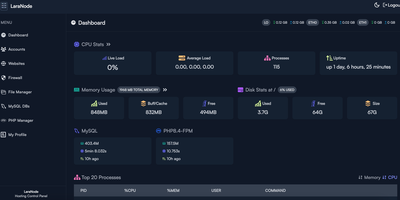
Built for self-hosted server deployments, Laranode transforms bare Linux installations into multi-tenant web hosting platforms with automated Let's Encrypt certificates and isolated PHP environments without recurring license fees. System administrators can provision isolated user accounts with dedicated document roots, configure custom domains, and deploy SSL certificates across all active websites in seconds. The integrated PHP manager enables per-site runtime isolation from legacy PHP 7.4 through cutting-edge PHP 8.5 releases, preventing version conflicts between separate production web applications. Operators can create MySQL databases, manage database users, inspect active connections, and adjust UFW firewall port access directly from the visual dashboard. An integrated browser-based file manager lets developers browse directories, edit configuration files, extract compressed archives, and modify file permissions without external FTP tools. Real-time telemetry monitors CPU utilization, memory consumption, disk capacity, and network traffic over customizable historical timeframes to catch bottlenecks early. Automated backup routines archive full accounts, individual websites, or specific databases to local storage, remote SFTP servers, or S3-compatible cloud object stores with point-in-time recovery verification. Running on a dedicated VPS on RepoCloud with guaranteed CPU, RAM, and SSD, full root SSH access, and a browser serial console. MIT licensed.