Crawl4AI
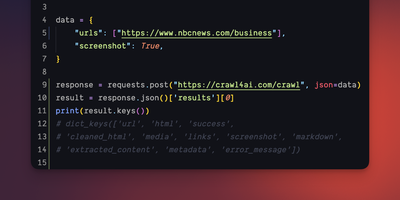
With over 77,000 GitHub stars, Crawl4AI is the most-starred open-source web crawler on GitHub and the go-to tool for converting the web into AI-ready data. Built on Python and Playwright, it transforms any website into clean Markdown with headings, tables, code blocks, and citation hints optimized for LLM ingestion, or extracts structured JSON via CSS selectors, XPath expressions, or direct LLM-based schema extraction through OpenAI, Anthropic, and Ollama providers. The self-hosted Docker server exposes a REST API on port 11235 with endpoints for crawling, streaming results, screenshots, PDF generation, JavaScript execution, and LLM-powered extraction. Version 0.9.x introduced secure-by-default operation with mandatory JWT authentication, strict request validation, declarative hooks replacing inline code, and bounded job queues. Adaptive crawling uses information foraging algorithms to determine when sufficient data has been gathered, while deep crawl mode traverses link graphs intelligently. The async browser pool manages concurrent sessions with stealth plugins, proxy rotation, custom headers, and session persistence for authenticated scraping. A built-in MCP server enables direct integration with Claude, ChatGPT, and Cursor for AI-driven web research workflows. Content filtering applies BM25 and TF-IDF relevance scoring to extract only pertinent sections from noisy pages. Running on a dedicated VPS on RepoCloud with guaranteed CPU, RAM, and SSD, full root SSH access, and a browser serial console. Apache 2.0 licensed.
Anakin
Backed by Y Combinator and powering scraping infrastructure across 195 countries, Anakin delivers a production-grade web scraping API purpose-built for AI agents and RAG pipelines that need clean, structured data from sites that actively block conventional scrapers. The single Go binary server handles JavaScript-heavy SPAs through its Camoufox anti-detect browser service with automatic fingerprint rotation, while the HTTP-first handler chain tries lightweight extraction before escalating to full browser rendering — keeping response times under 2 seconds for static pages. The built-in React 19 dashboard provides visual scraping with live results, job tracking with status filters, domain configuration management with handler chain CRUD, and proxy performance monitoring via Thompson Sampling scoring. Structured JSON extraction leverages Gemini AI to transform raw HTML into typed schemas without manual selector maintenance. SDKs span Python, TypeScript, Go, .NET, Java, and Ruby, while the MCP server exposes all 21 tools directly to Claude, Cursor, Windsurf, and any Model Context Protocol-compatible agent. The hosted platform extends the open-source engine with AI web search returning full page content with citations, multi-source agentic research across 20+ sources per query, Wire pre-built actions covering 944 websites with 5,201 structured endpoints, persistent browser sessions for authenticated scraping, and website change monitoring with scheduled alerts. Deploy via Docker Compose with three containers or run the binary directly with optional PostgreSQL persistence. Running on a dedicated VPS on RepoCloud with guaranteed CPU, RAM, and SSD, full root SSH access, and a browser serial console. AGPL-3.0 licensed.
Change Detection
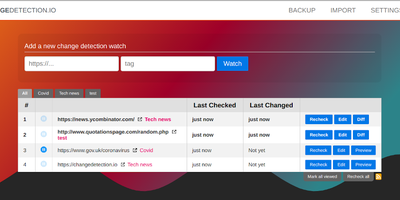
Price drops, restocks, job postings, government announcements, competitor edits - changedetection.io watches web pages and alerts you the moment anything changes, down to PDF text and checksums. Point it at a URL, set a check interval, and precise filters decide what counts as a change: a Visual Selector targets page elements by pointing and clicking, CSS selectors and XPath narrow scope, trigger-text and ignore-text rules (with regex support) cut noise, and JSONPath or jq handles API responses. A dedicated re-stock and price detection mode extracts product metadata and fires on thresholds - alert only when the price drops below your target or the percentage change exceeds a limit. JavaScript-heavy sites render through a real Chrome browser via Playwright, with the ability to execute JS steps first (log in, click, scroll) before extracting text. Notifications reach 85+ services through Apprise - Discord, Slack, Telegram, email, webhooks - optionally with a screenshot of the changed page, and AI-powered summaries (any OpenAI-compatible endpoint, including local Ollama) describe what changed. Per-watch proxies, custom headers, and POST/GET control cover hostile targets. Apache-2.0 licensed with local file-based storage: the URLs you monitor and why stay entirely your business.
Halo
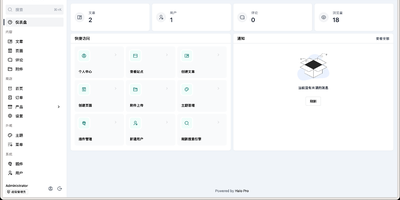
Halo is a modern CMS that handles blogs, knowledge bases, corporate sites, and full e-commerce storefronts from a single installation, distinguished by a polyglot plugin architecture that runs both Java and JavaScript extensions on a GraalVM runtime. Built on Spring Boot 3 with a Vue.js admin console, the platform delivers a clean content management experience with Markdown and rich-text editing, live preview, scheduled publishing, draft management, media uploads, and granular multi-user role-based access controls. Plugins can be enabled or disabled at runtime without restarting the server, and the official marketplace offers over 100 free themes plus a growing library of extensions covering SEO optimization, search integration, paid content access, AI writing assistance, and Q&A chatbots. Storage backends are configurable through plugins, supporting local disk, S3-compatible object storage, and other providers. The fully documented RESTful API enables headless CMS usage for decoupled frontend architectures. Database support includes embedded H2 for quick starts, with production deployments on PostgreSQL or MySQL. Nearly 40,000 GitHub stars and over 2.5 million Docker pulls reflect the project's maturity and active development pace. A single Docker command gets a functional instance running on port 8090. Running on a dedicated VPS on RepoCloud with guaranteed CPU, RAM, and SSD, full root SSH access, and a browser serial console. GPL-3.0 licensed.
Maxun
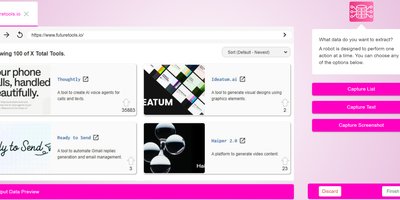
With over 16,800 GitHub stars and growing rapidly, Maxun has become the go-to open-source platform for teams who need structured web data without writing scrapers. The TypeScript-based platform provides a no-code visual recorder that captures point-and-click interactions in real-time browser sync, automatically generating reusable extraction robots that handle pagination, infinite scrolling, and dynamic content. LLM-powered extraction accepts natural language prompts like "Extract 10 companies from the Y Combinator website" without requiring a URL — Maxun identifies the source and performs the extraction autonomously. The platform handles authentication-protected pages, adapts automatically to website layout changes through self-healing selectors, and exports directly to Google Sheets, Airtable, or any destination via webhooks. Robots run on configurable schedules with cron-based timing, turning any website into a perpetually fresh RESTful API endpoint. The crawl engine discovers and processes linked pages across entire domains with configurable depth and URL filtering, while the search capability runs automated queries across multiple engines. Official Node.js and Python SDKs provide programmatic control over robot creation, execution, and data retrieval, with MCP integration enabling direct connection to AI tools like Claude. The n8n community node enables workflow automation without custom code. Running on a dedicated VPS on RepoCloud with guaranteed CPU, RAM, and SSD, full root SSH access, and a browser serial console. AGPLv3 licensed.
CapRover
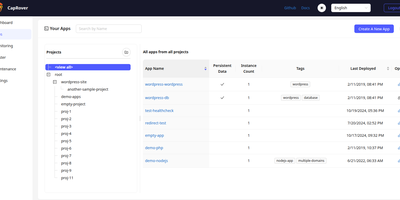
With over 15,000 GitHub stars and nearly nine years of active development, CapRover is the self-hosted PaaS that replaces Heroku's pricing with your own infrastructure while keeping the deploy-and-forget simplicity. The web dashboard manages application lifecycle from deploy through scaling — configure custom domains, environment variables, persistent volumes, instance counts, and nginx templates without touching config files or SSH. The CLI tool enables scriptable deployments with a single command from your terminal or CI/CD pipeline, while webhook-based deployment triggers automated builds from Git pushes. The one-click app marketplace provides over 100 pre-configured services including WordPress, Ghost, PostgreSQL, MySQL, MongoDB, Redis, Grafana, Portainer, and dozens more, each deployed as a Docker container with volumes and environment variables preconfigured. Automatic HTTPS provisions and renews Let's Encrypt certificates for every custom domain with one-click HTTP-to-HTTPS redirects. Under the hood, Docker Swarm orchestrates containers across multiple nodes for horizontal scaling and load balancing, while nginx handles routing with fully customizable EJS-generated configuration templates per application. Deployment supports four methods: CLI push, tarball upload through the web UI, Docker image reference, and Git repository connection. The build system supports Dockerfiles, captain-definition files with build packs, and direct Docker image pulls. NetData integration provides real-time server monitoring dashboards. Running on a dedicated VPS on RepoCloud with guaranteed CPU, RAM, and SSD, full root SSH access, and a browser serial console. Apache 2.0 licensed.
Umami
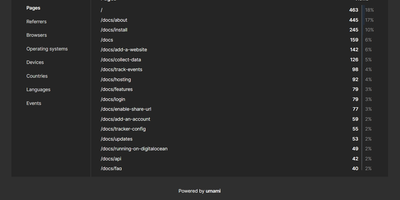
No cookies, no fingerprinting, no cross-site tracking, no personal data collection - Umami's privacy contract is the foundation of the open-source web analytics platform. IP addresses are hashed rather than stored, which makes it GDPR, CCPA, and PECR compliant by default - the consent banner can come off the site entirely. The tracking script is under 2 KB, roughly 20x smaller than Google Analytics, so measurement stops being a page-weight tax. The dashboard covers the core metrics - pageviews, visitors, bounce rate, visit duration, referrers, browsers, devices, and countries - with any date range and filtering by country or device. Beyond pageviews, custom events track clicks, form submissions, and signups via a data attribute or one JavaScript call, and advanced reports add funnels, user journeys, retention and cohort analysis, goals, and automatic UTM campaign tracking. Anonymous session views show individual visitor activity without identifying anyone. Teams share websites with role-based access, one instance manages unlimited sites, and a full REST API exposes every metric programmatically. MIT-licensed and self-hosted on PostgreSQL or MySQL via Docker, your analytics data never leaves your infrastructure.
MySQL
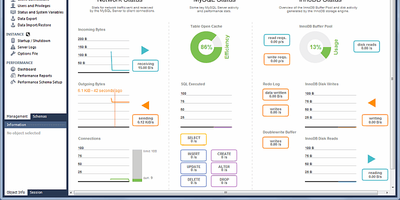
Powering Facebook, Uber, Twitter, and Booking.com, MySQL processes billions of queries daily as the world's most widely deployed open-source relational database. Its default InnoDB storage engine delivers full ACID compliance with row-level locking, crash recovery, and foreign key enforcement, making it the backbone of mission-critical e-commerce, SaaS, and financial applications. MySQL's Document Store bridges relational and NoSQL paradigms, allowing developers to work with schema-less JSON collections alongside traditional SQL tables through the X DevAPI protocol. For high availability, InnoDB Cluster combines Group Replication, MySQL Router, and MySQL Shell into an integrated solution with automatic failover, while InnoDB ClusterSet extends this across data centers for disaster recovery. The database supports multiple storage engines including MyISAM for read-heavy analytics, Memory for temporary high-speed caching, and Archive for compressed historical data. Native JSON functions like JSON_TABLE() transform document data into relational result sets, and spatial data types enable GIS applications. MySQL integrates with every major programming language through official connectors for Python, Java, Node.js, PHP, C++, and .NET, and works seamlessly with frameworks like Django, Laravel, Rails, and Spring. Replication topologies support read replicas for horizontal scaling, and the new Change Stream Applier in MySQL 26.7 enables configurable parallel transaction application with up to 1,024 workers per channel. Running on a dedicated VPS on RepoCloud with guaranteed CPU, RAM, and SSD, full root SSH access, and a browser serial console. GPLv2 licensed.
GoAccess
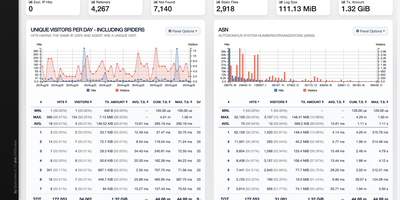
GoAccess processes millions of web log entries in seconds and renders the results as interactive dashboards that update every 200 milliseconds in the terminal or every second via WebSocket-connected HTML reports. Written entirely in C with only ncurses as a dependency, it achieves exceptional performance even on resource-constrained servers, reducing memory usage by approximately 20% and parsing time by 35% in recent releases through optimized in-memory hash tables with on-disk persistence support. The analyzer parses virtually every web log format out of the box (Apache Combined and Common, Nginx, Amazon CloudFront, Amazon S3, AWS Elastic Load Balancing, Google Cloud Storage, Squid, W3C IIS, Caddy JSON, and Traefik) while supporting fully custom log format strings for non-standard configurations. The self-contained HTML dashboard displays 15+ interactive panels covering unique visitors, requested files, static files, 404 errors, referring sites, search keyphrases, geographic location with city-level GeoIP resolution, operating systems, browsers, HTTP status codes, time distribution, and virtual host metrics. WebSocket authentication via JWT provides secure remote access, and incremental log processing ensures data continuity across daemon restarts. Docker deployment requires a single command with volume-mapped access logs. Over 20,800 stars with active development since 2010. Running on a dedicated VPS on RepoCloud with guaranteed CPU, RAM, and SSD, full root SSH access, and a browser serial console. MIT licensed.
Firecrawl
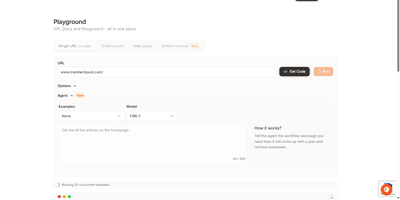
With over 164,000 GitHub stars and one of the fastest-growing open-source projects in the AI tooling ecosystem, Firecrawl is the web context API that turns any website into clean markdown, structured JSON, or screenshots optimized for large language models. The Scrape endpoint converts a single URL into LLM-ready output with approximately 67% fewer tokens than raw HTML, handling JavaScript rendering, rotating proxies, anti-bot bypasses, and dynamic content extraction with zero configuration. The Crawl endpoint recursively scrapes entire websites from a single request with configurable depth, URL filters, and concurrent page limits. The Map endpoint discovers all URLs on a domain instantly for sitemap generation. The Search endpoint performs web searches and returns full page content from results. The Interact endpoint scrapes a page then continues working with it — clicking buttons, filling forms, and extracting dynamic content using AI prompts or code. The Agent endpoint provides autonomous web data gathering where users describe what they need in plain English. SDKs are available for Python, Node.js, Go, Rust, Ruby, PHP, Java, C#/.NET, and Elixir, with an MCP server for connecting to any AI agent or MCP client. Self-hosting deploys via Docker Compose and requires Redis and a Playwright-based browser service for JavaScript rendering. Running on a dedicated VPS on RepoCloud with guaranteed CPU, RAM, and SSD, full root SSH access, and a browser serial console. AGPL-3.0 licensed.
Ackee
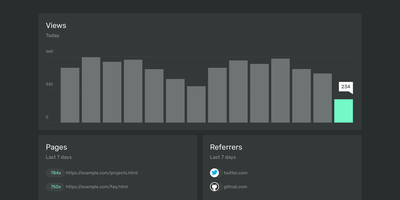
Page views, referrers, browsers, and screen sizes - Ackee delivers the analytics developers actually check, from a deliberately minimal Node.js and MongoDB stack that skips both Matomo's weight and Google Analytics' cloud dependency. Its defining constraint is anonymization: no cookies, no unique user tracking, and a multi-step anonymization process that keeps visitors unidentifiable while the aggregate numbers stay useful. In its default anonymous mode Ackee collects no personally identifiable information at all, which means GDPR and CCPA compliance out of the box and no cookie consent banner on your sites. A detailed mode adds screen size, language, and per-visit referrers - still without cookies or fingerprinting. Integration mirrors the Google Analytics pattern: create a domain in settings, drop the generated ackee-tracker snippet into your pages, and data appears in a clean single-page dashboard. One instance tracks multiple domains, and custom events capture button clicks, signups, and conversions. The distinctive engineering choice is the fully documented GraphQL API: everything the dashboard shows comes from that API, so you can query active visitors, average duration, and view statistics programmatically, feed data in from apps and services beyond websites, or build an entirely custom interface on top. If you want bare-minimum analytics with a real API and zero privacy anxiety, this is the tool.
ArchiveBox
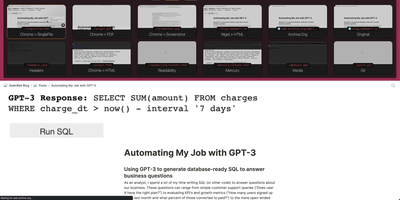
Backed by 27,700+ GitHub stars and actively developed with the v0.9.x architectural overhaul introducing an event-driven plugin ecosystem, ArchiveBox delivers the open-source self-hosted web archiving platform that preserves websites, bookmarks, social posts, media, source code, and research material in durable formats before link rot, platform shutdowns, and censorship erase them permanently. Feed it URLs one at a time or schedule automated imports from browser history, RSS feeds, Pocket, Pinboard, Instapaper, Wallabag, Shaarli, JSON, CSV, HTML bookmark exports, and browser extension captures. Each snapshot stores redundant copies as original HTML, rendered single-file HTML via SingleFile, full-page PDF, screenshot PNG, WARC archive, article text via Readability, favicons, HTTP headers, media files via yt-dlp, git repository clones, and structured metadata in SQLite. The Docker Compose deployment bundles Chrome, wget, curl, yt-dlp, SingleFile, and Readability parsers with automatic dependency management and isolation. Interact through the self-hosted web UI with search, tagging, and admin controls, the comprehensive CLI for batch operations, the REST API for programmatic access, or the Python API for custom integrations. The new abx-plugins system enables community extractors with per-plugin configuration, while the append-only-log architecture provides resumable crawls and audit trails. S3, B2, and Google Cloud storage backends sync archives to remote storage via rclone. Running on a dedicated VPS on RepoCloud with guaranteed CPU, RAM, and SSD, full root SSH access, and a browser serial console. MIT licensed.
Payload CMS
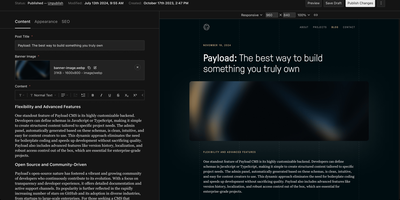
Backed by 44,000 GitHub stars and now part of Figma, Payload is the first headless CMS that installs natively into your Next.js application's /app directory rather than running as a separate service. The code-first architecture uses TypeScript config files to define collections, globals, and field schemas — from which Payload auto-generates database tables with migrations, a fully customizable React admin panel, REST and GraphQL endpoints, and type-safe Node.js local APIs you can call directly in React Server Components. The Lexical-based rich text editor supports block-based layout building, inline media embeds, and nested field structures, while the built-in localization engine handles unlimited locales with field-level translations. Authentication ships out of the box with HTTP-only cookie sessions, CSRF protection, role-based access control definable at the document, field, and operation level, and support for OAuth providers. Version history tracks every document change with full draft and publish workflows, and Live Preview renders content edits in real-time using server components. The job queue system manages background tasks and multi-step workflows deployable via Vercel Cron or standalone workers. Database flexibility spans PostgreSQL, MongoDB, and SQLite through swappable adapters, and the plugin ecosystem includes official modules for SEO, form builders, redirects, nested documents, and search alongside hundreds of community extensions. Running on a dedicated VPS on RepoCloud with guaranteed CPU, RAM, and SSD, full root SSH access, and a browser serial console. MIT licensed.
1Panel
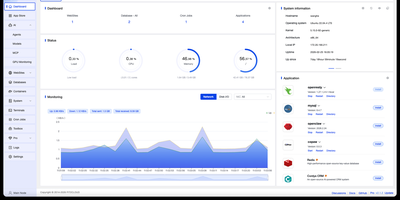
Backed by over 36,000 GitHub stars and 120 contributors with 123 releases since 2022, 1Panel has rapidly become the go-to open-source alternative to cPanel and Plesk for modern Linux server management. The platform delivers a clean Vue.js dashboard powered by a Go backend using the Gin framework, providing visual management of Docker containers, images, networks, and volumes without touching the command line. Its curated app marketplace offers one-click installation of 165+ trusted open-source applications including Nextcloud, Bitwarden, Umami analytics, WordPress, and NocoBase, each running in isolated containers for maximum security. Native AI capabilities set 1Panel apart from every competing panel: deploy Ollama LLMs directly from the dashboard, spin up OpenClaw personal agents, monitor GPU utilization, and manage AI models through a unified interface. Website management includes automatic domain binding, Let's Encrypt SSL certificate provisioning, and Nginx configuration with zero manual setup. Security runs deep with built-in firewall rules, fail2ban integration, container isolation, WAF protection, and comprehensive audit logging enabled from day one. Automated backups support AWS S3, Cloudflare R2, and local storage with one-click restore from any snapshot. The panel supports Debian, Ubuntu, CentOS, and Rocky Linux across x86_64, aarch64, armv7l, ppc64le, and s390x architectures. Running on a dedicated VPS on RepoCloud with guaranteed CPU, RAM, and SSD, full root SSH access, and a browser serial console. GPL-3.0 licensed.
Huginn
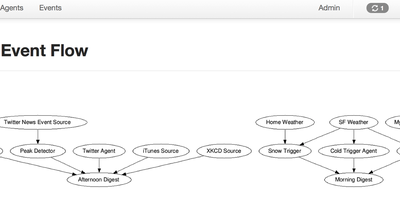
Huginn has established itself as the definitive open-source automation engine for developers who refuse to hand their workflow data to third-party cloud services. The platform lets you build agents that scrape websites, monitor RSS feeds, track weather via APIs, watch Twitter streams, aggregate news, detect price changes, and trigger notifications through email, SMS via Twilio, Slack webhooks, or social media posts to Twitter and Tumblr. Each agent creates and consumes JSON events, propagating them along a directed graph where complex multi-step workflows emerge from simple single-purpose components. The web interface provides visual agent management with drag-and-drop scenario building, real-time event logs, scheduling controls, and a built-in agent library covering dozens of use cases out of the box. Huginn supports Liquid templating for dynamic event transformation, regex-based content extraction, JavaScript-based data manipulation, and HumanTaskAgent for crowd-sourced workflow steps. Custom agents can be packaged as Ruby gems and loaded via the ADDITIONAL_GEMS environment variable without modifying core code. Deployment options include Docker with the official huginn/huginn all-in-one image or huginn/huginn-single-process for production multi-container setups with PostgreSQL or MySQL backends, plus native support for Heroku and OpenShift PaaS platforms. Running on a dedicated VPS on RepoCloud with guaranteed CPU, RAM, and SSD, full root SSH access, and a browser serial console. MIT licensed.
Roundcube
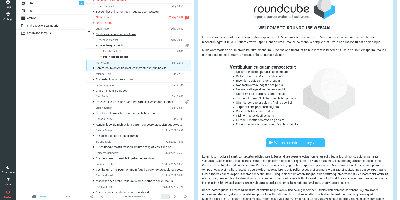
Two decades of continuous development made Roundcube the standard-bearer of open-source webmail - a PHP IMAP client that gives any mail server a polished, application-like interface in the browser. It connects to whatever IMAP/SMTP stack you run - Dovecot, Postfix, a hosted mailbox - and delivers the full desktop-client experience: drag-and-drop message management, threaded conversation views, full MIME and HTML mail handling, find-as-you-type address book with groups and LDAP connectors, multiple sender identities, full-text search, and spell checking in dozens of languages. The default Elastic skin is genuinely responsive, working as well on a phone as a desktop, and the entire UI is skinnable. The plugin API is where deployments get shaped: managesieve exposes server-side filter management in the UI, enigma brings PGP encryption and signing via GnuPG, markasjunk trains spam filters, zipdownload batches attachments, password lets users change credentials, and attachment_reminder catches the classic forgotten-attachment email - among hundreds of community plugins. Built-in caching keeps large mailboxes fast, IMAP ACLs and shared folders support team setups, and XSS protection is engineered into the rendering pipeline. It scales from a single personal mailbox to unlimited users, backed by MySQL, MariaDB, PostgreSQL, or SQLite. GPL-licensed with regular security releases.
Neko
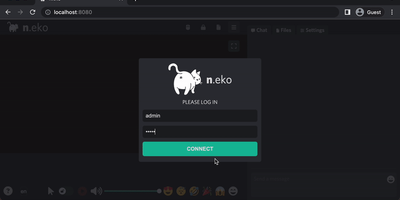
With over 21,000 GitHub stars and six years of steady development through version 3.1.0, Neko transforms any Docker container into a fully interactive browser or desktop environment streamed to web browsers via WebRTC with sub-300-millisecond glass-to-glass latency. The Go backend captures X server display frames using the Pion WebRTC library while the Vue.js frontend renders the remote session with native audio synchronization, delivering a significantly smoother experience than Apache Guacamole or noVNC which rely on image-over-WebSocket approaches. Multiple users simultaneously view and collaboratively control the same session with real-time input synchronization and host-managed control passing between participants. Pre-built Docker images cover Firefox, Chromium, Google Chrome, Tor Browser, Brave, Vivaldi, and Microsoft Edge alongside full desktop environments including XFCE and KDE for running any Linux application. Neko Rooms provides multi-tenant deployment with a REST API for programmatic room provisioning, while Neko Apps extends the platform with additional containerized applications beyond browsers. Sessions persist on the server independently of client connections — close your laptop, reconnect from your phone, and resume exactly where you left off. Optional VPN and Tor integration routes traffic through encrypted tunnels for privacy-sensitive browsing. RTMP broadcasting streams sessions to external platforms. The embeddable client supports iframe integration for custom portals and applications. Running on a dedicated VPS on RepoCloud with guaranteed CPU, RAM, and SSD, full root SSH access, and a browser serial console. Apache-2.0 licensed.
BigBlueButton
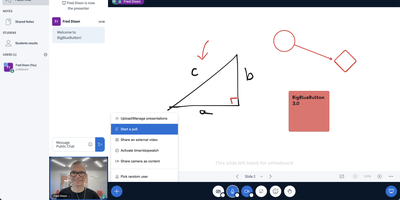
Used daily by millions of educators and learners in over 65 languages and embedded as the default virtual classroom in Moodle Cloud, Canvas, Sakai, D2L, Jenzabar, and Schoology — together comprising more than 75% of the worldwide learning management system market — BigBlueButton has been the leading open-source web conferencing platform for education since its creation at Carleton University in 2007. The platform delivers WebRTC-based real-time audio, video, and screen sharing with a tldraw v2-powered multi-user whiteboard featuring infinite canvas support, allowing multiple participants to annotate slides and draw simultaneously. Breakout rooms support up to eight concurrent groups with collaborative whiteboards enabled by default, and polling with customizable response types lets instructors assess understanding in real time. The built-in Learning Analytics Dashboard answers three questions at a glance: who is attending, who is participating, and who is learning based on poll responses, providing actionable engagement metrics without requiring webcam surveillance. Session recording captures audio, video, slides, chat, and whiteboard annotations for asynchronous playback on any device. The plugin architecture introduced in version 3.0 enables custom extensions, while IMS LTI 1.0 compliance allows integration with Blackboard, Desire2Learn, Pearson Learning Studio, and any conformant platform without custom code. The REST API enables programmatic session management, user authentication, and recording access for custom frontends like the included Greenlight application. Version 4.0 introduces LiveKit-based media and a redesigned interface. Running on a dedicated VPS on RepoCloud with guaranteed CPU, RAM, and SSD, full root SSH access, and a browser serial console. LGPL-3.0 licensed.