Decidim
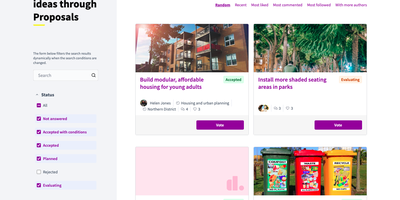
When a city, union, or association wants its people to propose, debate, and vote on decisions in the open, Decidim gives it a self-hosted platform for the whole conversation. One idea can travel from first draft to delivered result without leaving the platform. It begins as a proposal in a creation wizard that compares it with existing ones and accepts geolocation and attachments. Neighbors answer and rate comments in debates, or meet in person or online with registration limits and published minutes. Money questions go to a participatory budget, where residents vote on projects with costs. Proposal voting can be limited, weighted, or cost-based, and elections come with a voting booth. Once approved, the accountability component turns the proposal into a result with progress reports that show residents how far delivery has come. All of it happens inside spaces: participatory processes with phases, assemblies for standing councils and working groups, conferences with a program of sessions, and initiatives that gather signatures. Surveys, pages, blog posts, and newsletters round out the platform. Verification by identity document, postal letter code, or uploaded census can gate specific actions such as proposing or voting. One installation hosts several organizations, each with its own domain, languages, and participants. Proposals, results, and survey answers export as CSV or JSON, and a read-only GraphQL API exposes public data. Running on a dedicated VPS on RepoCloud with guaranteed CPU, RAM, and SSD, full root SSH access, and a browser serial console. AGPL-3.0 licensed.
OpenSlides
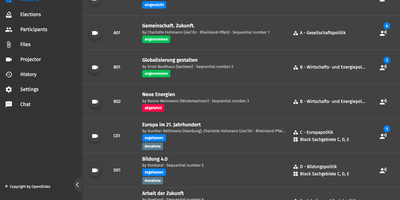
If an assembly needs motions, amendments, speaker lists, and secret ballots on one shared screen, OpenSlides is the open-source web application that runs them. Before the meeting, administrators set up committees and meetings, import participants from CSV or connect a SAML identity provider for single sign-on, email invitations with login data, and sort people into groups with freely defined rights. Members file motions in an HTML editor, attach documents, gather supporters, and send them through customizable workflows with automatic numbering by category, and amendments and change recommendations attach to specific line numbers. Motions can be forwarded to other meetings. During the session the agenda reorders by drag and drop, and every item, motion, or election gets its own speaker list with countdowns, points of order, and recorded speaking time. Votes are open, secret, or nominal and run live for present participants in voting groups, with proxy delegation, vote weighting, multiple rounds, and Yes/No/Abstain options per candidate or list. Results appear against a chosen reference value on projectors, in PDF exports, or as individual tallies. Several projectors can show the current item, a lower third for the active speaker, and live results, and Autopilot guides participants through whatever is happening. A video livestream brings in remote attendees. Afterward, motions export to PDF, CSV, or XLSX. Running on a dedicated VPS on RepoCloud with guaranteed CPU, RAM, and SSD, full root SSH access, and a browser serial console. MIT licensed.
Loomio
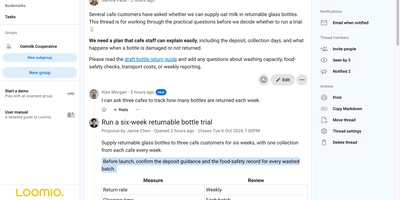
Decisions that scatter across email threads and chat scrollback get one home in Loomio, where a group discusses a question, votes, and publishes what it decided. Every decision starts as a thread with context, comments, @mentions, reactions, tags, and attachments, and tasks inside it carry assignees and emailed due-date reminders. Proposals ask for a defined response plus an optional written reason, using sense check, advice, consent, or consensus templates. Polls handle simple choices, scores, dot voting, ranked choice, meeting-time availability, and multi-winner STV elections. Coordinators set a participation quorum, require a vote share, weight votes, limit voting to appointed delegates, or hide results until close with anonymous voting. Groups nest subgroups, pick Open, Closed, or Secret visibility, and admit members freely, by request, or by invitation. People reply to discussion emails and catch up through a daily digest, and webhook integrations post invitations and outcomes to Slack, Discord, Microsoft Teams, Matrix, and Mattermost. Published outcomes stay searchable, and groups export CSV, HTML, or JSON and print threads to PDF. Comments translate on request, the interface is available in 24 languages, and a user API, server API, and webhooks connect other tools. Running on a dedicated VPS on RepoCloud with guaranteed CPU, RAM, and SSD, full root SSH access, and a browser serial console. AGPL-3.0 licensed.
ClearFlask
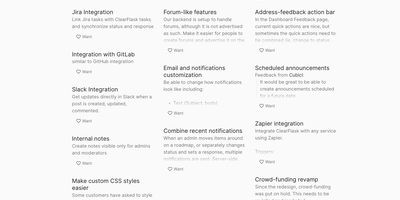
Instead of digging requests out of email and chat threads, ClearFlask collects them on a branded portal where customers vote, comment, and follow each idea from submission to release. The portal can be a simple feedback form or an open board where customers browse, vote on, and discuss each other's ideas. Visitors identify themselves through single sign-on from your own app, OAuth providers you configure, email with an optional domain whitelist, browser push notifications, or as guests. In the dashboard, the Feedback page turns a request into a task, sends a reply, merges duplicates, or shelves it for later. The Roadmap page is a drag-and-drop Kanban board with editable columns, and moving a card notifies the people following that idea. Each content category has its own statuses, transitions, and tag groups, so an idea board, a knowledge base, a blog, and a Q&A section can behave differently. Announcements double as a changelog that visitors can subscribe to. Votes can be simple upvotes, up and down votes, or weighted emoji, and threaded comments keep every discussion organized. Posts import from CSV, project data can be exported for outside analysis, a documented API and webhooks connect other tools, and the interface ships in over twenty languages. Running on a dedicated VPS on RepoCloud with guaranteed CPU, RAM, and SSD, full root SSH access, and a browser serial console. Apache-2.0 licensed.
Antragsgrün
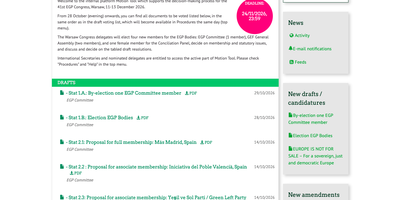
When hundreds of delegates want to rewrite the same resolution, Antragsgrün keeps every proposed change visible, line-numbered, and ready to merge. Organizers define motion types for resolutions, statutes, and candidacies, each with its own sections, deadlines, and permissions, and members submit documents online with supporters, screening by administrators, and attachments such as images or PDFs. Amendments appear as tabs beside the paragraph they change and as red and green inline diffs; paragraph comments, likes, tags, and versions keep the discussion orderly. Administrators merge amendments into the final text by accepting or rejecting each change, with collisions flagged and drafts saved along the way. During the meeting, agenda items, speaking lists with separate queues, timed speakers, and votings with simple, absolute, or two-thirds majorities run on the same site, and a Currently Debated widget shows what is under discussion. Print-ready PDFs, OpenDocument texts, amendment spreadsheets, HTML, and RSS feeds cover every format a delegate asks for, and consultations can run in several languages in parallel. Custom themes, user groups, email notifications, and optional two-factor login adapt it to each organization. Running on a dedicated VPS on RepoCloud with guaranteed CPU, RAM, and SSD, full root SSH access, and a browser serial console. AGPL-3.0 licensed.