
Light-Interview
Light-Interview is a practice room for job interviews where you answer out loud and get a scored report afterwards. Fill in a target role, company, job description, and resume, and the app writes a question set to match. A digital interviewer reads each question, listens, and asks a follow-up when an answer is thin, and the browser records every answer on its own. Reports show relevance, completeness, professionalism, STAR structure, logic, speaking pace, pauses, and filler words, with the transcript beside the recording so you can jump to the moment that cost points. Rewrite a weak answer, record it again, and compare the two takes. Answers below the pass line land in a mistake book for retries, and each job goal gets a daily three question plan and a weekly review. Coding assessments run in a web editor with Java, Python, C++, JavaScript, and Go, judged in disposable containers with no network access. A resume library, spoken English and Japanese practice, and study groups with peer review round out the toolkit. Running on a dedicated VPS on RepoCloud with guaranteed CPU, RAM, and SSD, full root SSH access, and a browser serial console. Apache-2.0 licensed.
SearXNG
Up to 280 search services - Google, Bing, DuckDuckGo, Brave, Qwant, Startpage - aggregated without tracking or profiling: SearXNG is a privacy-respecting metasearch engine (AGPL-3.0, successor to Searx). Your instance queries the upstream engines on your behalf: your IP address, cookies, and search history never reach them, tracker parameters are stripped from result URLs, and an optional image proxy fetches thumbnails server-side so result pages leak nothing. It can even route outbound queries through Tor for full anonymity. Search is organized into categories - general, images, videos, news, maps, music, IT, science, files - with bang shortcuts for targeting specific engines, and every source can be enabled, disabled, or weighted per category in settings.yml. A plugin system adds calculators, hash tools, tracker removal, and unit conversions inline, and preferences (themes, safe search, languages, engine selection) persist in cookies rather than server-side accounts. The real argument for running your own instance rather than trusting a public one is control: you decide the logging policy (none), the engine mix, rate limiting, and who gets access - making it the default search backend for browsers, families, and teams that want Google-quality results without the profile.
dbx
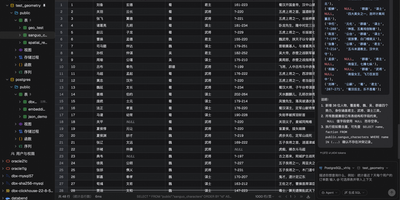
Universal database administration across modern enterprise infrastructure is simplified through dbx, a lightweight web client and SQL studio supporting over ninety database engines. Database administrators connect to MySQL, PostgreSQL, SQLite, Redis, MongoDB, ClickHouse, DuckDB, Oracle, and Microsoft SQL Server through authenticated network connections and encrypted SSH tunnels. The interactive query editor provides real-time multi-schema autocomplete, syntax linting, execution plan analysis, and natural language SQL query synthesis powered by configurable large language model backends. Teams visualize complex relational database architectures using interactive entity-relationship diagrams that map table foreign key constraints, primary indexes, and table partition layouts automatically. Operators inspect live Redis memory usage breakdowns, monitor real-time server command throughput, and manage key expirations without opening raw terminal sessions. The editable data grid supports multi-row modifications, foreign key reference lookups, CSV and JSON exports, and binary blob data inspection directly inside the browser viewport. Software developers expose connected databases directly to external AI coding assistants through native Model Context Protocol server endpoints. Running on a dedicated VPS on RepoCloud with guaranteed CPU, RAM, and SSD, full root SSH access, and a browser serial console. Apache-2.0 licensed.
Senlo
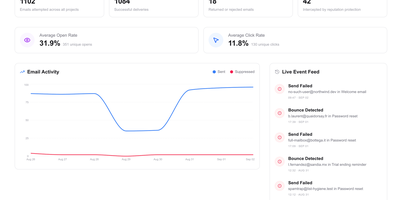
Product teams get a visual home for the transactional and lifecycle emails their application sends with Senlo, which sits on top of the delivery provider they already use instead of replacing it. A drag-and-drop editor builds responsive templates without hand-written HTML, exports to MJML or plain HTML when needed, and keeps templates versioned so edits can be reviewed and rolled back safely. Event-triggered automations turn product activity into onboarding sequences, trial reminders, and win-back flows: your app feeds contact events through the API, and Senlo decides which message goes out next. The transactional API sends a rendered template in one call, so receipts, password resets, and alerts stop living as scattered strings in your codebase. Delivery stops being a black box, with sends, deliveries, bounces, and engagement tracked per workspace, a live feed of failures, and suppressions that block bad addresses before they damage sender reputation. Because sending stays with Resend, Postmark, SES, Mailgun, or your own SMTP server, switching providers never means rebuilding a template. Running on a dedicated VPS on RepoCloud with guaranteed CPU, RAM, and SSD, full root SSH access, and a browser serial console. AGPL-3.0 licensed.
WGDashboard
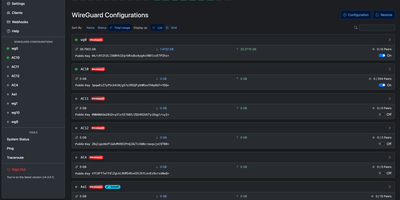
Managing WireGuard and AmneziaWG servers no longer means SSH sessions and typing wg show, because one browser dashboard covers every configuration and peer. WGDashboard finds existing configurations under /etc/wireguard and /etc/amnezia/amneziawg, so a running server appears right after installation. The home screen shows CPU, storage, memory, and swap meters above each configuration with its usage totals, peer count, and an on and off switch. Open a configuration for live data usage charts and a peer grid with search, sorting, tags, and bulk selection. Peers can be added one at a time or in bulk with generated keys and the next free addresses, then edited, restricted, deleted, or shared as a QR code, link, or email. Scheduled jobs restrict or delete peers when set conditions are met. Built-in ping and traceroute tools plot their results on a map. Settings add optional TOTP multi-factor sign-in, API keys, webhooks, light and dark themes, and a language selector. A remote server list connects one dashboard to others. Installation works on bare-metal Linux or in Docker. Running on a dedicated VPS on RepoCloud with guaranteed CPU, RAM, and SSD, full root SSH access, and a browser serial console. Apache-2.0 licensed.
Pi Web
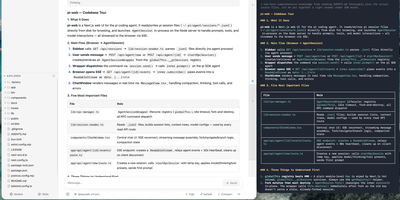
Pi Web is a browser interface for the Pi coding agent ecosystem, providing a visual workspace that reads the same local configuration and session files as the CLI. The session workspace groups conversations by project with running state indicators, context usage percentages, cost tracking, and compaction details, while two branching modes let users create independent session files from earlier messages or fork branches within existing sessions to explore alternative coding directions. Real-time streaming via Server-Sent Events delivers agent responses with structured Markdown rendering, thinking steps, tool call visualization, and image drag-and-drop input. The project file explorer browses working directories with syntax-highlighted source preview, Git diff inspection, and rendering for Markdown, images, audio, PDFs, and DOCX files with automatic refresh. Git worktree support switches checkouts from the sidebar while keeping sessions from the same repository grouped together. The Models panel manages provider authentication via OAuth and API keys, model selection, model smoke tests, and models.json configuration shared bidirectionally with the CLI agent. The Skills panel lists, searches, installs, and toggles agent skills without terminal access. The interface ships with English and Simplified Chinese translations, light and dark themes, a chat minimap, keyboard shortcuts, and completion sounds. Basic Auth protects remote access when binding to non-loopback addresses. Running on a dedicated VPS on RepoCloud with guaranteed CPU, RAM, and SSD, full root SSH access, and a browser serial console. MIT licensed.
LittleLink Server
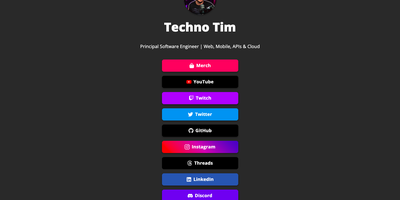
One page, every place you exist online, hosted on a domain you own. LittleLink Server is a self-hosted link-in-bio page that publishes your profile, avatar, bio, and social buttons from a single Docker container, with no account fees and no third-party branding on your links. More than sixty brand buttons cover the major social, streaming, music, and creator platforms, and custom buttons add any destination with your own text, colors, icons, and ordering. Themes restyle the page in a few environment variables, and because configuration is read at request time, edits take effect on a container restart with no rebuild. Page metadata, Open Graph titles and images, favicons, and language are all configurable, so the link you paste into a bio unfurls properly in chats and feeds. The server generates its sitemap and robots rules at request time, with controls for index status and extra crawler rules, including blocking specific AI crawlers by name. Analytics support connects the page to your tracking provider, and a health check endpoint keeps uptime monitors and container orchestrators informed. Creators, streamers, developers, and small businesses use it as the stable home base behind every profile bio: one short URL that always points at the current set of destinations. Running on a dedicated VPS on RepoCloud with guaranteed CPU, RAM, and SSD, full root SSH access, and a browser serial console. MIT licensed.
Novu
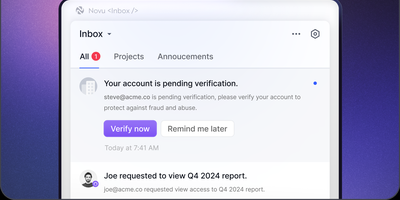
Powering notification delivery for thousands of organizations with over 39,000 GitHub stars, Novu is the open-source communication infrastructure that eliminates the need to build separate integrations for every messaging channel. The TypeScript-based platform provides a single API endpoint that routes notifications across In-App Inbox, Email via SendGrid, Mailgun, AWS SES, and Postmark, SMS through Twilio, Vonage, and Plivo, Push via Firebase Cloud Messaging, Expo, and APNS, and Chat through Slack, Discord, Microsoft Teams, and WhatsApp. The embeddable React Inbox component delivers real-time WebSocket-powered notifications with read/unread states, action buttons, and user-controlled preferences directly inside your application. The workflow engine orchestrates complex multi-channel delivery with conditional branching, time delays, digest batching to reduce notification fatigue, throttle controls, and per-step channel fallbacks. Novu Connect introduces Agent Communication Infrastructure enabling AI agents built with LangChain, Claude, or custom frameworks to hold threaded two-way conversations with humans across any supported channel through a single conversation model with identity resolution and credential management. The backend runs on Node.js with NestJS, MongoDB for notification storage, Redis with BullMQ for job queuing, and Socket.io for real-time delivery. Self-hosting deploys via Docker Compose with the dashboard accessible at port 4200. Running on a dedicated VPS on RepoCloud with guaranteed CPU, RAM, and SSD, full root SSH access, and a browser serial console. MIT licensed.
Cube
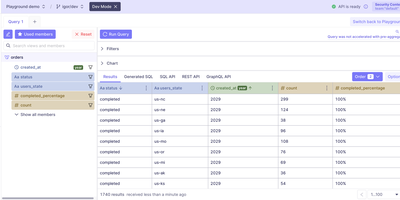
BI tools, customer-facing apps, and AI agents all receive the same governed answer from Cube Core, an open-source semantic layer where every metric is defined once, in code. Models are written in YAML or JavaScript. Cubes describe business entities with measures, dimensions, and joins. Views curate datasets for consumers. Git holds every version, with code review and CI like any other codebase. Queries arrive through a Postgres-compatible SQL API with a MEASURE function, through REST returning JSON, or through GraphQL, which means any tool that speaks Postgres connects without custom drivers. Sources include Snowflake, BigQuery, Databricks, Amazon Athena, Presto, and Postgres. Pre-aggregations declared in the model refresh in the background and live in Cube Store. An aggregate-aware planner routes matching queries to those rollups, and dashboards answer in milliseconds without rescanning the warehouse. Access policies set member-level visibility, row-level filters, and data masking from the security context. Multi-tenant SaaS analytics becomes practical: each customer sees only their own rows, whichever API asks. A development-mode Playground, meant for local use and never for public exposure, composes queries from measures and dimensions, shows the generated SQL, charts the results, and copies ready-made SQL, REST, and GraphQL calls. Running on a dedicated VPS on RepoCloud with guaranteed CPU, RAM, and SSD, full root SSH access, and a browser serial console. Apache 2.0 licensed.
MateClaw
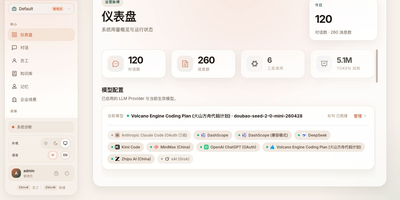
MateClaw delivers a multi-agent AI platform where digital employees run as persistent team members with roles, goals, and accumulated skills rather than stateless chat completions. The Spring Boot backend on Spring AI Alibaba provides ReAct iterative reasoning and Plan-and-Execute decomposition on a StateGraph runtime, with parallel delegation between employees and dynamic context pruning for multi-step tasks. Five career templates ship ready (Product Researcher, Customer Support, Knowledge Curator, Data Analyst, Executive Assistant) while custom employees inherit configurable backstories, pixel-art avatars, and dedicated tool bindings. The MCP integration supports stdio, SSE, and Streamable HTTP transports with per-employee tool isolation preventing capability bleed between agents. ACP bridges bring Claude Code, Codex, and other coding agents in as first-class employees. Workflow orchestration composes multiple employees and system actions into publishable linear DSL processes with seven step modes: sequential, fan_out, collect, conditional, await_approval, dispatch_channel, and write_memory. The trigger system wires cron schedules, webhooks, channel messages, employee lifecycle events, content matches, and workflow completions to automated flows. The Admin Runtime Console provides real-time visibility into running employees with token usage tracking and one-click force-recycle. Spring Boot Actuator monitoring, full audit trail, and per-channel error isolation deliver production-grade reliability. Running on a dedicated VPS on RepoCloud with guaranteed CPU, RAM, and SSD, full root SSH access, and a browser serial console. Apache-2.0 licensed.

Open-Meteo
High-resolution weather forecasts became a free commodity because of Open-Meteo - and this deployment puts the whole open-source engine on your own infrastructure. The public open-meteo.com service aggregates national weather models (NOAA GFS, DWD ICON, ECMWF, Meteo-France, and others) into one consistent JSON interface; self-hosting gives you that same API without rate limits, third-party dependency, or usage metering. The architecture is two cooperating services: the API server exposes forecast endpoints fully compatible with Open-Meteo query parameters - latitude, longitude, hourly and daily variables like temperature, precipitation, wind, and radiation - while a background sync worker downloads fresh weather model data on a configurable interval into a shared persistent volume at /app/data, so forecasts stay current and survive restarts without re-downloading. You control which weather models to mirror, which variables to store, how much historical depth to keep, and how often to refresh - meaning a lean deployment can sync only the model and region you actually query. Responses are plain HTTP/JSON, so integration with dashboards, Home Assistant-style automations, agricultural monitoring, IoT fleets, or any application takes minutes. For anyone making thousands of forecast calls a day, replacing a metered weather API with your own instance turns a recurring bill into a flat infrastructure cost.
Leon
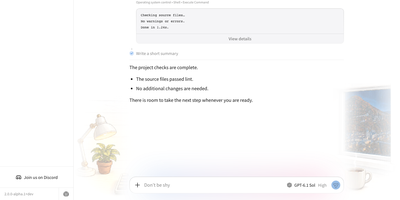
Leon is a personal AI assistant that lives on your own server, remembers what matters to you, and finishes real tasks with tools instead of just chatting. Ask for something in the browser web app and Leon plans the work, runs tools in isolated workers, checks the results, recovers from failures, and writes a short summary. Agent mode handles open-ended requests, controlled mode follows predictable native skills, and smart mode picks the better route for each task. Layered memory keeps durable facts and preferences, daily summaries, and recent discussion context, and Leon can search earlier conversations when exact details matter. Answers can arrive as interactive charts with region toggles, forms, and calculators instead of walls of text, and generated files become downloadable artifacts. Setup cards guide you through connecting services such as Spotify, owner-installed MCP servers add more tools, and a browser tool and computer use handle web pages and desktop applications. Pick models per profile, from a local llama.cpp model to OpenAI, Anthropic, DeepSeek, Groq, or OpenRouter. Profiles keep config, secrets, sessions, and memory separate, so one server can serve several people, with optional token authentication for remote clients. Workspaces group conversations under a shared brief, and Leon Satellite lets a remote Leon use enabled tools on your own device. Running on a dedicated VPS on RepoCloud with guaranteed CPU, RAM, and SSD, full root SSH access, and a browser serial console. MIT licensed.
Postiz
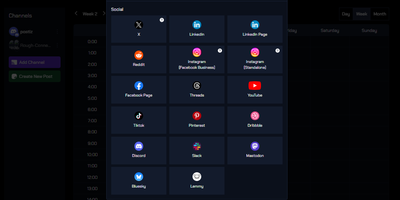
Powering over $145K monthly recurring revenue as a one-person company and holding 34,000+ GitHub stars, Postiz has emerged as the most widely adopted open-source alternative to Buffer, Hootsuite, and Hypefury — combining social media scheduling with AI-driven content creation and agentic automation in a single self-hosted platform. The Next.js 14 frontend with React 18 and Tailwind CSS delivers a visual calendar and Canva-like design editor, while the NestJS backend orchestrates publishing across 30+ social networks including X, LinkedIn, Instagram, TikTok, YouTube, Reddit, Pinterest, Threads, Dribbble, Discord, Bluesky, Mastodon, and Facebook. Temporal handles durable workflow execution for reliable scheduled posting, retry logic, and background job processing. The built-in AI assistant generates post ideas, captions, hashtags, images, and short videos from natural language prompts — all within a single chat interface. An agentic layer exposes a CLI and MCP server that allow AI agents like OpenClaw, Claude, and ChatGPT to autonomously plan, draft, and schedule posts programmatically. Team collaboration includes role-based permissions, approval workflows, multi-workspace management for agencies, and commenting on scheduled content. A full REST API with a NodeJS SDK, N8N custom nodes, and Make.com integration enables automation pipelines. Analytics track engagement, reach, and growth across all connected accounts from a unified dashboard. The self-hosted stack deploys via Docker Compose with PostgreSQL, Redis, and Temporal pre-wired — no feature limitations compared to the cloud version. Running on a dedicated VPS on RepoCloud with guaranteed CPU, RAM, and SSD, full root SSH access, and a browser serial console. AGPL-3.0 licensed.
OmniRoute
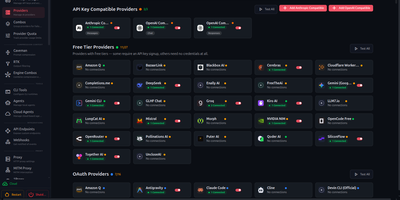
OmniRoute is an AI gateway, aggregating 338 LLM providers including OpenAI, Anthropic Claude, Google Gemini, DeepSeek, Kimi, MiniMax, and GLM into a single OpenAI-compatible endpoint at localhost:20128. The gateway catalogs over 1,200 models across 90 free-tier providers and 40 free-forever providers, automatically rotating through tier-1, tier-2, and tier-3 fallback chains when any provider exhausts its quota or returns errors. RTK plus Caveman stacked token compression reduces eligible context by 15 to 95 percent before forwarding requests, cutting API costs dramatically without degrading output quality. OmniRoute exposes its full routing engine through a built-in MCP server with 104 tools across 31 scopes over stdio, HTTP, and SSE transports, plus an A2A protocol server with six autonomous agent skills and JSON-RPC 2.0 streaming. The gateway integrates directly with Claude Code, Cursor, GitHub Copilot, Codex CLI, OpenCode, and Cline through standard base-URL configuration. Seventeen routing strategies include latency-optimized, cost-minimized, and auto-scoring modes that evaluate candidates on success rate, context fit, model fitness, quota state, and circuit-breaker health. The Next.js dashboard provides real-time provider status, usage analytics, combo chain configuration, and model catalog browsing via a responsive PWA. Running on a dedicated VPS on RepoCloud with guaranteed CPU, RAM, and SSD, full root SSH access, and a browser serial console. MIT licensed.
ClawMetry
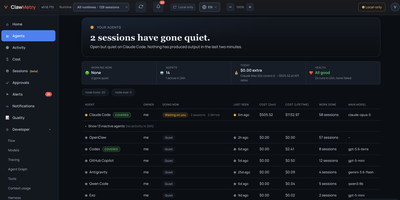
Without an SDK, a proxy, or a single line of agent code changed, ClawMetry reads the session files your AI agents already write and puts every session, tool call, token, and dollar on one live dashboard. The sessions view replays a run turn by turn, with a timeline that gives each tool call its own duration and cost, so a four-minute shell command stands apart from a call that took milliseconds. Usage charts split tokens and spend by runtime, model, session, and day. A live flow diagram follows messages from chat channels through the gateway to models and tools, and a context view tracks window use per turn along with compaction events. The Brain tab streams reasoning, tool calls, and errors as they happen, while memory, skills, health, logs, and cron jobs each get a tab of their own. OTLP receivers accept traces, metrics, and logs from runtimes that keep no local files. The MIT-licensed app reads OpenClaw, NVIDIA NemoClaw, Goose, and Qwen Code for free. Paid plans add the other 28 runtimes, including Claude Code, Codex, and Cursor, plus approval queues for risky tool calls, budget limits, anomaly detection, and a cost optimizer. Session data stays on your server unless you choose to run cloud sync. Running on a dedicated VPS on RepoCloud with guaranteed CPU, RAM, and SSD, full root SSH access, and a browser serial console. MIT licensed.
Networking Toolbox
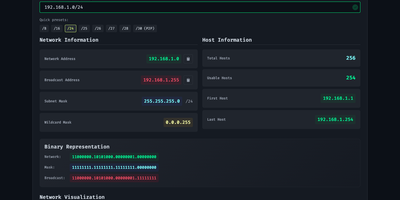
Subnet math, DNS lookups, DHCP options, and certificate checks share one browser tab in Networking Toolbox, a free toolkit for sysadmins and network engineers. Need to carve a /24 into departments? The VLSM planner fits named subnet requirements into a parent block, reports each subnet's efficiency and the leftover space, and exports the plan as CSV or JSON. Merging address lists? CIDR utilities summarize, split, compare, and deaggregate prefixes, with set operations for difference, overlap, and containment. Writing configs? Generators build DHCPv4 and DHCPv6 options, PXE profiles, Kea or ISC snippets, and SPF, DKIM, DMARC, CAA, TLSA, and SRV records, and DNSSEC helpers calculate key tags and DS records. Something broken? Diagnostics query DNS through Cloudflare, Google, Quad9, OpenDNS, or a resolver of your choice, read TLS certificate chains, grade HTTP security headers, trace redirects, check TCP ports, look up BGP routes and RDAP records, and test mail servers. Need a refresher? Reference guides explain private ranges, CGNAT, IPv6 address types, and common ports. A keyboard search palette puts any tool a few keystrokes away, and bookmarked tools stay available offline. Eighteen themes, four languages, custom branding, and accessibility switches make it feel like your own, and a keyless JSON API serves the subnet, CIDR, IP, and DNS utilities to scripts. Running on a dedicated VPS on RepoCloud with guaranteed CPU, RAM, and SSD, full root SSH access, and a browser serial console. MIT licensed.
Codeg
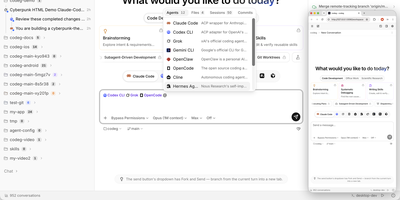
Run Claude Code, Codex, Gemini CLI, OpenCode, and sixteen other AI coding agents from one workspace instead of juggling twenty terminals. Every agent connects through the Agent Client Protocol, so conversations render as structured chats with tool cards, live diffs, and interactive replies rather than raw terminal scrollback. Codeg imports the session history each agent already keeps on disk, making every past conversation searchable and resumable, even when you hand the thread to a different agent. Mention one agent with an @ to delegate work to another, or run several side by side and watch their progress stream into the same conversation. Queued to-dos execute unattended in isolated git worktrees, leaving finished changes ready for your review and approval instead of touching your working tree. An infinite canvas arranges chats, files, terminals, and notes on one board, while git tooling, token usage tracking, and MCP server support stay one panel away. Deployed as a headless server, Codeg answers in any browser and through Telegram, Lark, and WeChat channels, so agent work continues while you are away from your desk. Running on a dedicated VPS on RepoCloud with guaranteed CPU, RAM, and SSD, full root SSH access, and a browser serial console. Apache-2.0 licensed.
Prismor
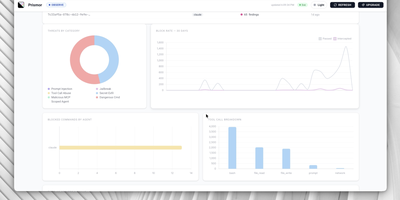
Prismor sits between your AI coding agents and the tools they want to use, judging every shell command, file read, and API call before it runs so a helpful agent cannot quietly become a destructive one. Run it in observe mode to watch what agents actually do across every workspace, then switch chosen rules to enforce and block secret leaks, prompt-injection pivots, privilege escalation, and risky package installs before execution. When a call is sensitive rather than forbidden, Prismor can pause it for human approval, letting a person decide instead of the model. Plain-language prompt guardrails such as never push to main are added to the agent context per agent and per session, and edits are picked up on the next prompt. Every action lands in a hash-chained, Ed25519-signed audit trail you can verify later, while the web dashboard breaks down sessions, findings, friction, and token spend so you can see where runs went wrong. Agents that cannot be hooked are still governed through the LLM proxy or the MCP gateway, which evaluates each tool call and scans responses for injected instructions before the model sees them. Honeytoken canary files trip a critical finding the moment an agent reads them, catching reconnaissance early. Running on a dedicated VPS on RepoCloud with guaranteed CPU, RAM, and SSD, full root SSH access, and a browser serial console. Apache-2.0 licensed.