ToolKernel
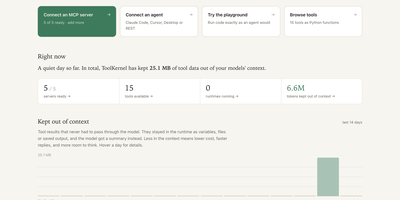
ToolKernel hands an AI agent a Python notebook wired to every MCP server you use, so big tool results stay in variables and the model reads only what it printed. Connect servers with the same mcp.json format as Claude Desktop and each tool becomes a typed function with keyword arguments and a docstring. The agent sees just seven small meta-tools and searches for a signature only when it needs one. Code runs in a persistent runtime per session, so variables stay in memory between calls, like cells in a notebook. An output guard keeps every result within a budget, turns large values into previews with shape and samples, and saves overflow for paging. Policies allow, deny, rate-limit, or hold a call until a person approves it in the web UI, and credentials never enter the runtime. The web UI records every step beside what the model saw and what stayed in the sandbox, with pages for servers, tools, a playground, approvals, and benchmarks. Claude Code and Cursor connect over MCP, stdio-only clients use a shim, and any other model can call a REST API with OpenAI or Anthropic tool formats. In the bundled benchmark, agents answered 20 of 21 data questions correctly, against 8 of 21 with tools wired in directly. Running on a dedicated VPS on RepoCloud with guaranteed CPU, RAM, and SSD, full root SSH access, and a browser serial console. Apache-2.0 licensed.
Euron Open ContextForge
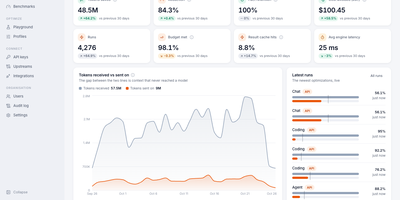
Euron Open ContextForge shrinks the history, retrieved passages, and tool output an LLM app is about to send, so each call costs fewer tokens and still carries every fact the task needs. Counts use the target model's own tokenizer, exact for OpenAI families. System instructions, recent turns, pinned messages, and tool call pairs are never rewritten, and any string you name stays intact. Duplicates go first (repeated turns, repeated test logs), then bulk tool output, with JSON kept valid and file reads kept whole. No GPU, no paid model, no network: the same input always gives the same output. What remains is ranked by relevance, recency, and importance, and older history folds into a verbatim summary of goals, constraints, decisions, facts, errors, and open questions. Six workload profiles (coding, agent, research, RAG, support, chat) split the budget differently, and a missed budget escalates balanced mode to aggressive. A citation map records whether each document id was kept, compressed, merged, or dropped, so references still resolve. Use it as a library, a REST API with optimize, count, summarize, rank, and job endpoints, or a streaming proxy that any OpenAI SDK can point at. A dashboard adds a playground with before and after panes, a per-stage trace, run history, and a benchmark against plain truncation. Budgets it cannot meet are reported, never silently cut. Running on a dedicated VPS on RepoCloud with guaranteed CPU, RAM, and SSD, full root SSH access, and a browser serial console. MIT licensed.