Keeper
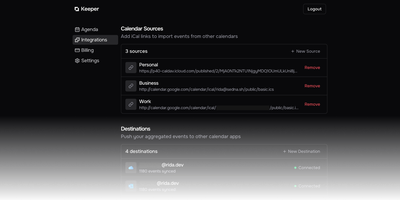
Work, personal, business, and school calendars at different providers double-book because no one system sees your real availability - Keeper solves that multi-calendar collision problem. Its pull-compare-push sync engine aggregates events from Google Calendar, Outlook/Office 365, iCloud, FastMail, any CalDAV server, or read-only iCal/ICS feeds, and pushes blocking events to one or many destination calendars so time slots align everywhere. The design is deliberately content-agnostic - it syncs timeslots, not titles or descriptions, so a personal appointment shows as busy time on your work calendar without leaking details. Sync logic is clean: events Keeper creates carry a traceable UID suffix, deletions propagate, and orphaned entries are purged automatically. A token-authenticated aggregated iCal feed combines selected calendars into one subscribable URL for Apple Calendar or Thunderbird. An optional MCP server gives AI agents read-only calendar access over OAuth 2.1 - list calendars and query events by date range, with no write capability. Built with Next.js and Bun under AGPL-3.0, the standalone Docker image bundles web, API, cron, worker, Redis, and PostgreSQL in one container, and self-hosting unlocks every Pro feature - unlimited calendars and one-minute sync intervals - for free.
Apache SeaTunnel
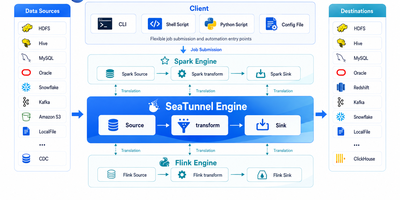
Apache SeaTunnel is a distributed integration platform that runs batch, streaming, and change-data-capture pipelines between databases, message queues, data lakes, lakehouses, and SaaS applications without hand-rolled scripts. Pipelines are declared once in a configuration file and executed on your choice of the native Zeta engine, Apache Flink, or Apache Spark, so the same job definition travels across engines without connector rewrites. Real-time CDC captures row changes from major databases with a snapshot-first handoff that never locks the source, while checkpoint-backed recovery restarts jobs from the last completed checkpoint with exactly-once semantics. When an upstream table gains a column, schema evolution propagates the change downstream automatically instead of pausing the pipeline for manual surgery. Roughly two hundred connectors cover relational databases, Kafka, object storage, search indexes, vector stores, and business apps, and the multi-table routing keeps every record on the right destination path. Engineers can dry-run configurations against sampled data before a full launch, isolate failures per table, and route bad records to dead-letter queues. Release 3.0.0 adds AI-assisted configuration generation from natural language, Python sources and transforms, and document parsing with text chunking for RAG preparation. Running on a dedicated VPS on RepoCloud with guaranteed CPU, RAM, and SSD, full root SSH access, and a browser serial console. Apache-2.0 licensed.
Kinto
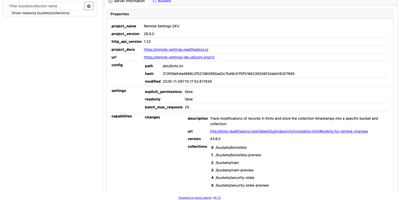
Web and mobile applications get a ready-made backend from Kinto: create buckets and collections through a REST API, save records as plain JSON, and every signed-in device reads the same data without any custom server code. Permissions attach to individual buckets, collections, and records, so you can keep a shared dataset public, limit a collection to a signed-in group, or hand a teammate write access to exactly one collection. Groups bundle people and carry permissions as a unit, which keeps multi-user applications tidy as rosters change. Synchronisation is the headline act: each object carries an incrementing revision number, clients poll for changes since a revision they already hold, and the JavaScript client stores data in IndexedDB so applications keep working offline and publish updates when the connection returns. Collections can declare a JSON schema, and the server rejects records that do not match, which stops malformed writes at the door. The history plugin records every change with its author, an audit trail you can query or roll back from. Records can carry file attachments, and the Kinto Admin web console renders buckets, collections, and records in a browser so you can inspect data, edit entries, and repair permissions without curl. Mozilla runs this model to deliver Firefox configuration and blocklists, and your VPS instance speaks the identical API. Running on a dedicated VPS on RepoCloud with guaranteed CPU, RAM, and SSD, full root SSH access, and a browser serial console. Apache-2.0 licensed.

SyncTube
SyncTube turns any browser into a shared movie room where one link opens a synchronized player and live chat for the whole group. Paste a YouTube, Twitch, Vimeo, or PeerTube URL, or a direct mp4 or m3u8 link, and the room watches the same frame at the same moment. A leader takes global control of play, pause, seeking, and playback rate, and smaller groups can open pausing or resuming to everyone. Local files start playing for the room while they upload, and external subtitle files plus separate audio tracks cover voiceovers and fan translations. Chat doubles as a remote control: timed commands jump the whole room forward or back, skip a sponsored segment, boost quiet audio, or return to the moment before an accidental rewind. Playlists accept ranged link patterns for episode batches, viewers vote to skip, and keyboard shortcuts drive fullscreen, refresh, and sync toggles without leaving the player. Operators can cache supported site videos on the server, restyle every front-end file, and extend subtitle rendering or quality switching through plugins. Admins moderate with bans and kicks from chat, and the whole service runs from one small server that fits a private friends-only room or a public community channel. Running on a dedicated VPS on RepoCloud with guaranteed CPU, RAM, and SSD, full root SSH access, and a browser serial console. MIT licensed.