InvenTree
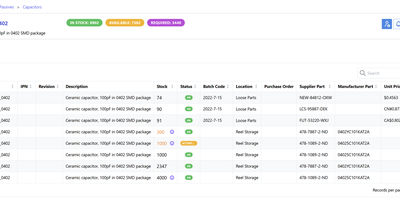
InvenTree is an inventory management system for electronics manufacturers, makerspaces, and small-to-medium businesses. The hierarchical part categorization system organizes components into unlimited nested categories, while stock items tracked across cascading locations and sub-locations provide instant visibility into current inventory levels, with optional serial number tracking for individual item traceability and acceptance testing. Intelligent BOM management calculates sub-part requirements, validates availability against current stock, supports multi-format BOM upload including KiCad integration, and generates detailed bills of materials with full database enrichment. Build orders consume BOM-allocated stock to produce assembled parts with step-by-step work order tracking, while purchase orders manage supplier relationships with pricing history, lead times, and automatic stock receipt processing. The modern React frontend built with Mantine, TanStack Query, and Zustand provides responsive data tables, tree-select navigation, a preview drawer, and a snippet editor. The extensible plugin system supports 19 mixin types including BarcodeMixin for scanner integration, LabelPrintingMixin for Zebra and Brother printers, AppMixin for custom database tables, and ScheduleMixin for periodic background tasks. Companion mobile apps on Android and iOS provide barcode scanning and stock operations in the warehouse. Docker Compose deploys with PostgreSQL, MySQL, or MariaDB backends behind any reverse proxy. Running on a dedicated VPS on RepoCloud with guaranteed CPU, RAM, and SSD, full root SSH access, and a browser serial console. MIT licensed.
Nora
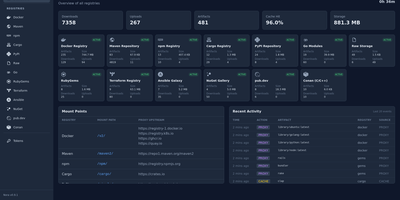
Public registries rate-limit your CI, log every pull, and pick the worst moment to go down; Nora replaces that dependency with a self-hosted artifact registry that hosts and caches seventeen package formats behind a single address. Point Docker, Maven, npm, pip, Cargo, and eleven other clients at one endpoint, and Nora serves your private artifacts while transparently caching upstream packages fetched from Docker Hub, Maven Central, npmjs, and crates.io. Each base image or library downloads once and is then served locally, so builds get faster, stop tripping rate limits, and survive upstream outages. Curation rules decide what is allowed to reach your builds: allowlists and blocklists filter packages by name, minimum release-age rules hold back freshly published versions, and new digests can wait in quarantine until approved. Anything you publish keeps its name: a hosted package is never silently replaced by an upstream package sharing it. Pipelines publish without stored secrets through OIDC identity from GitHub Actions and GitLab CI, and API tokens with read, write, and admin roles cover the rest. A web dashboard shows downloads, cache hit rates, storage usage, and recent activity for every registry, and audit logs plus Prometheus metrics feed your monitoring. For disconnected networks, a mirror command prefetches whatever your lockfiles name, an import tool migrates Artifactory or Nexus repositories, and backup and restore keep a spare copy. Running on a dedicated VPS on RepoCloud with guaranteed CPU, RAM, and SSD, full root SSH access, and a browser serial console. MIT licensed.
iDempiere
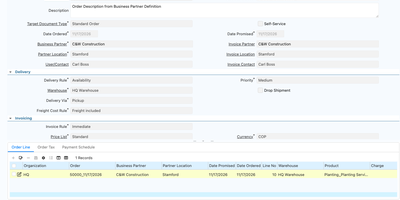
One browser login, one shared set of master data, and a complete paper trail run through iDempiere, an open-source ERP, CRM, and supply chain suite covering sales, purchasing, stock, manufacturing, projects, and accounting. Sales live in one tool, stock in another, and the ledger in a spreadsheet. Here a customer order moves from quote to sales order, shipment, invoice, and payment on shared master data. Purchasing mirrors it, from requisition to purchase order, material receipt, vendor invoice, and payment. Returns, credit notes, and debit notes handle corrections. Leads, opportunities, and customer service requests with standard responses share the system. Warehouses with locators hold stock; price lists, bills of materials, and Manufacturing Light cover pricing and production. Projects and fixed assets, depreciation setup included, track jobs and equipment. Running several companies? Each tenant keeps its own organizations and accounting parameters, which gives one server separate books and financial reports. Missing a screen? Build windows and fields in the Application Dictionary without code, or let the Create Window, Tab and Field from Table process build one automatically. Jasper reports go out by email or run as scheduled jobs, and data exports to Excel and CSV. Changes travel from test to production as 2Pack archives, plugins keep custom code outside the core, and a REST API and JSON web services connect other systems. Running on a dedicated VPS on RepoCloud with guaranteed CPU, RAM, and SSD, full root SSH access, and a browser serial console. GPL-2.0 licensed.
OpenArtifact
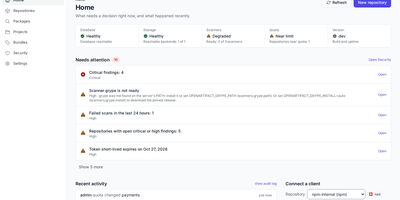
One registry for every package your builds produce: OpenArtifact stores and serves 23 artifact formats behind a single URL scheme and permission model on infrastructure you control. Create hosted repositories for the packages you publish, proxy repositories that cache upstream registries and keep serving when they go down, and group repositories that merge members in order behind one address. Point Maven, npm, PyPI, Docker and OCI clients, Helm, Cargo, NuGet, Go, RubyGems, Debian, RPM, and a dozen more tools at it with their native protocols, no plugins or wrappers. Control who can publish and pull with users, groups, permission targets, and API tokens, sign people in through OIDC or SAML single sign-on, and give CI tokenless login through OIDC token exchange. Scan what you store: software bills of materials in CycloneDX and SPDX, vulnerability findings from OSV, Trivy, and Grype, license compliance checks, and secret detection run against your artifacts. Set cleanup policies and storage quotas so old snapshots stop eating disk, attach custom properties to artifacts, and promote release bundles through your pipeline stages. Store blobs on a local filesystem, S3, Google Cloud Storage, Azure, Garage, SeaweedFS, or an OCI registry, federate selected formats between instances, and import an existing Nexus or Artifactory server with the oa command line tool. Running on a dedicated VPS on RepoCloud with guaranteed CPU, RAM, and SSD, full root SSH access, and a browser serial console. AGPL-3.0 licensed.
OpenBoxes
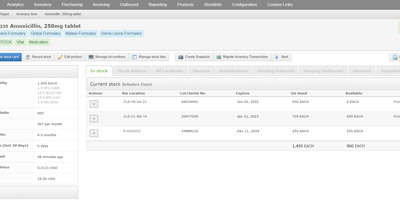
OpenBoxes is an open-source warehouse management system that keeps medication and supplies visible from central depot to clinic cabinet, so staff always know what is in stock, where it sits, and when it expires. The product catalog holds medications, medical devices, office supplies, and fixed assets, with suppliers, manufacturers, pricing, classifications, and custom attributes on every item. Inventory is tracked by facility and bin location down to lot and expiration date, and every adjustment, transfer, and removal leaves a full transaction history. Reorder points and stock alerts flag low stock, overstock, and expiring items before they become emergencies. Inbound, purchase orders, invoices, and budget codes manage procurement; goods receipt captures lots and expiry dates, and suggested putaway directs stock to the right bins. Outbound, requisitions and stock lists drive requests from upstream facilities, FEFO picking pulls the earliest-expiring lots first, and packing produces packing lists with customs documentation. Cycle counting keeps records honest without closing the warehouse, and dashboards surface stock value, fast movers, and expiring stock. Barcode scanners and a mobile-friendly interface speed up receiving and counting on the floor, and spreadsheet imports load products, locations, and opening stock in bulk. A REST API and webhooks connect OpenBoxes to ERPs, DHIS2 health information systems, and integration platforms like n8n and OpenFn, and location-restricted roles keep each facility on its own shelves. Running on a dedicated VPS on RepoCloud with guaranteed CPU, RAM, and SSD, full root SSH access, and a browser serial console. EPL-1.0 licensed.
Carbon ERP
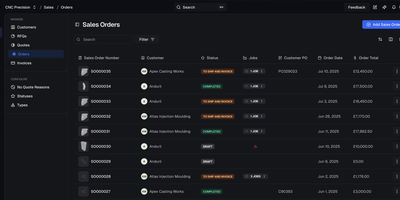
Carbon delivers a unified manufacturing operating system that eliminates the integration tax of running separate ERP, MES, and QMS platforms. The Remix and TypeScript frontend paired with Supabase PostgreSQL backend provides full-stack type safety from database schema to React components, with real-time subscriptions pushing production floor updates to every connected client. The built-in MCP server exposes 1,374 operations across 15 modules through three discovery tools, enabling AI agents to interact with manufacturing data while respecting attribute-based access control. Nested bill of materials with unlimited depth supports complex assemblies, while the MRP engine calculates material requirements across multi-level structures with configurable lead times and safety stock. The configurator handles configure-to-order scenarios with rule-based variant generation. Full lot and serial traceability from receiving through shipping satisfies AS9100, ISO 13485, CFR Part 11, and ITAR compliance requirements. Custom fields extend any entity without schema modification, and the app framework lets integrators build domain-specific modules that plug into the core navigation, permissions, and data layer. Typed API clients for TypeScript, Python, C#, and cURL enable programmatic access to every manufacturing operation. Docker-based local development boots Postgres, Redis, Inngest, and the application stack with a single CLI command. Running on a dedicated VPS on RepoCloud with guaranteed CPU, RAM, and SSD, full root SSH access, and a browser serial console. AGPL-3.0 licensed.
Fleetbase
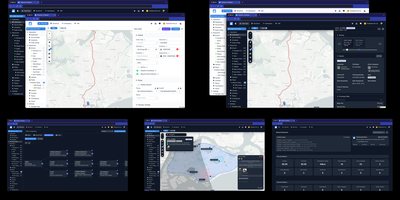
Tracking over 50,000 fleet vehicles across production deployments, Fleetbase delivers a modular logistics operating system where each module—Fleet-Ops, Storefront, Pallet, and Ledger—works independently yet shares a unified data layer that eliminates middleware between ordering, dispatch, warehousing, and accounting. The Fleet-Ops core handles real-time driver tracking through a SocketCluster-based WebSocket event bus, interactive map-based dispatch with both directed and ad-hoc driver assignment, configurable order workflows with custom rules, automation triggers, and activity flows, plus a Kanban-style order board for visual pipeline management. Service zones let dispatchers define geographic operating areas, while proof-of-delivery capture and route optimization close the last-mile loop. The Storefront module provides headless e-commerce with products, carts, and checkout that feed directly into dispatch queues, and the Ledger module records invoices and financial journal entries across all operations. The Navigator driver app—also AGPL-3.0 licensed and fully white-label—delivers turn-by-turn navigation, live order communication, and fault reporting to drivers in the field. The extension architecture pairs backend Laravel Composer packages with frontend Ember Engine modules, enabling third-party developers to build first-class platform extensions without forking. A RESTful API with full documentation, webhook delivery via Redis-backed queues, and push notification support through APNs and FCM round out the integration surface. Running on a dedicated VPS on RepoCloud with guaranteed CPU, RAM, and SSD, full root SSH access, and a browser serial console. AGPL-3.0 licensed.
Inventoros
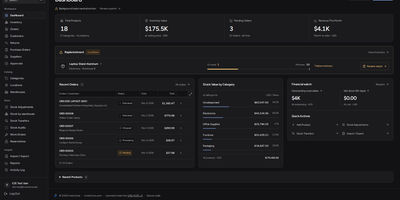
Between the spreadsheet and enterprise software sits Inventoros, a self-hosted system for tracking stock, orders, and suppliers across warehouses. A replenishment panel on the dashboard flags products below their minimum, and purchase orders go to suppliers by email and are received into stock. Products carry SKUs, variants, kits, batches with expiry dates, and serial numbers, with barcodes and QR labels for products and locations. Warehouses nest aisles, shelves, and bins, stock moves between them, and staff can be limited to the sites they work in. Orders handle approvals, payments, refunds, PDF invoices, partial shipments, and returns, and a customer portal shows invited contacts their orders, shipments, and balances. Twelve built-in reports cover valuation, turnover, dead stock, profit margin, and ABC analysis, and a custom report builder exports to CSV, Excel, or PDF on a schedule. Webhooks, a REST API, GraphQL, signed plugins, and an MCP server connect it to the rest of your stack and to AI clients acting with a user's token. Running on a dedicated VPS on RepoCloud with guaranteed CPU, RAM, and SSD, full root SSH access, and a browser serial console. AGPL-3.0 licensed.