BookLore
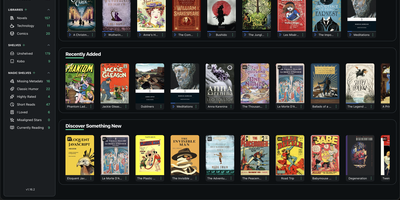
BookLore centralizes personal electronic book, audiobook, and comic collections into an organized private media server equipped with automated metadata scrapers and e-reader synchronization. Users can drop EPUB, PDF, CBZ, and MOBI files into a watched BookDrop directory to trigger automated format parsing, background cover retrieval, and staged queue imports. Integrated metadata scrapers query Google Books, Open Library, Goodreads, and Amazon to automatically fill synopsis summaries, author records, publishing dates, and review scores. Dynamic Magic Shelves categorize volumes through custom rule-based filters, author collections, and full-text search indexes across your complete literature catalog. The browser-based reader renders documents with adjustable typography, night modes, audio playback controls, text annotations, and persistent bookmarking. Hardware e-readers and mobile devices connect through native Kobo Store emulation APIs, bidirectional KOReader progress synchronization, and OPDS catalog feeds. Multi-tenant permissions provide each household member with private reading statistics, personalized shelves, email book delivery, and direct send-to-Kindle dispatch. Running on a dedicated VPS on RepoCloud with guaranteed CPU, RAM, and SSD, full root SSH access, and a browser serial console. GNU AGPLv3 licensed.
Emby
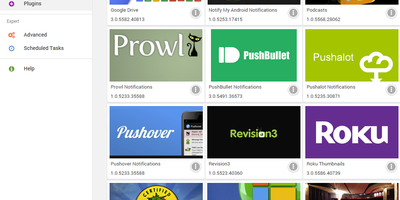
Point Emby at your movie, music, and photo libraries and it becomes a private streaming service: metadata and artwork arrive from TMDB and TVDB, everything lands in a polished browsable interface, and media transcodes on the fly whenever a client can't play the original format. The client reach is the selling point: native apps span Android TV, Apple TV, Google TV, Fire TV, Roku, LG and Samsung smart TVs, iOS, Android, Apple CarPlay, Android Auto, plus web browsers and desktop apps for Windows, macOS, and Linux, and DLNA devices are auto-detected for casting and remote control. Multi-user support gives each household member their own account, watch history, favorites, and recommendations, with genuinely capable parental controls: content restrictions, access schedules, time limits, and live monitoring with remote control of kids' sessions. Live TV works with hardware tuners like HDHomeRun or M3U playlists, with free guide data in the US, Canada, and UK. The server and core features are free; an optional Premiere key adds hardware-accelerated transcoding, DVR recording, offline sync, and Cinema Mode intros.
Radarr
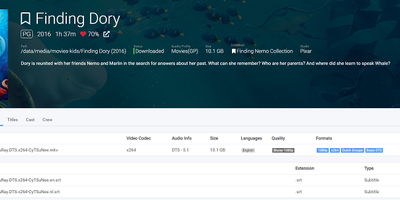
The movie half of the *arr stack: Radarr is a .NET collection manager that automates acquiring films for Usenet and BitTorrent users the way Sonarr does for TV. Add a movie once and Radarr handles the rest: it monitors indexers and RSS feeds, grabs a matching release the moment one appears, sends it to SABnzbd, NZBGet, qBittorrent, Deluge, Transmission, rTorrent, or another connected download client, then imports, sorts, and renames the file into your library structure. Quality profiles are the control surface - define allowed resolutions and a cutoff, and Radarr keeps upgrading files automatically, replacing a DVD rip when a Blu-ray release lands. Custom formats go further, scoring releases by codec, HDR metadata, release group, streaming source, or arbitrary regex so the copy you want always wins the pick. Failed downloads retry with another release automatically; a manual search shows every candidate and explains why one was skipped. Release parsing recognizes director's cuts, special editions, AKA titles, and hardcoded subs. Plex and Kodi integration handles notifications, library refreshes, and metadata like posters, trailers, and subtitles, and a calendar view tracks upcoming releases. It pairs naturally with Jellyseerr for request management and shares its API conventions with the whole *arr ecosystem.
Beszel
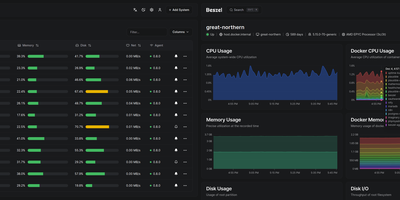
Reaching 24,000 GitHub stars within two years of its first commit in July 2024, Beszel delivers Netdata-grade monitoring dashboards from a single Docker container with no Prometheus stack, no external database, and no complex configuration — just a one-binary hub on PocketBase (SQLite embedded) and a sub-15 MB agent per host that auto-discovers Docker and Podman containers on contact. The agent connects outbound via WebSocket or SSH tunnel, requiring zero open ports on monitored servers and zero manual network configuration. Per-host metrics cover CPU usage, memory with swap and ZFS ARC breakdown, disk I/O across multiple partitions, network throughput, load average, sensor temperatures, battery charge, and GPU utilization with power draw for Nvidia, AMD, and Intel cards — features that competitors lock behind paid tiers. S.M.A.R.T. disk health including eMMC wear indicators and Linux mdraid array status surface hardware degradation before failures occur. Container statistics track CPU, memory, and network history per container with automatic discovery as new containers start. Configurable threshold alerts notify via email, Discord, Telegram, ntfy, Pushover, Gotify, Matrix, Mattermost, Signal, Slack, Microsoft Teams, and Twilio when metrics exceed defined limits. Multi-user accounts with OAuth/OIDC authentication let teams share monitored systems with role-based access, while automatic backups persist data to disk or S3-compatible storage. Running on a dedicated VPS on RepoCloud with guaranteed CPU, RAM, and SSD, full root SSH access, and a browser serial console. MIT licensed.
OliveTin
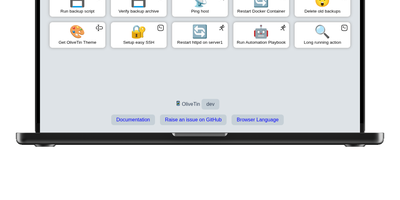
With over 3,600 GitHub stars and a philosophy of deliberate simplicity, OliveTin eliminates the need for SSH sessions, admin panels, and complex automation platforms by letting you define shell commands in a YAML config file and access them as clickable buttons through a clean browser interface. The Go binary consumes only a few megabytes of RAM, running on everything from tiny ARM and RISC-V devices through Linux VMs, containers, macOS, and Windows. Each button executes a predefined shell command with optional typed arguments that render as dropdowns, text fields, and validated inputs, preventing free-form command entry while giving users controlled access to server operations. Access control lists define exactly who can view or run each action — guests, family members, or junior administrators see only the buttons they are permitted to use. Entity templates generate actions dynamically from lists of hosts, containers, or other resources, creating one template that produces many buttons without manual duplication. Flexible triggers extend beyond browser clicks: cron schedules, webhooks, calendar file events, and filesystem watchers run actions automatically when conditions are met. Authentication supports OAuth2, JWT, and header-based methods for integration with reverse proxies and identity providers. Dashboards organize actions into folders and fieldsets for clear navigation across dozens of commands. No plugin system, no extension marketplace, no premium tiers — every feature ships in the single open-source release. Running on a dedicated VPS on RepoCloud with guaranteed CPU, RAM, and SSD, full root SSH access, and a browser serial console. AGPL-3.0 licensed.
Stalwart
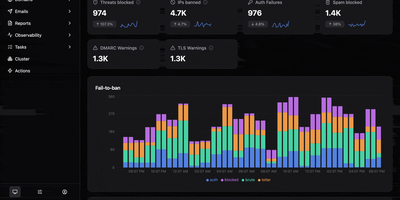
With 14,000 GitHub stars and 81 releases since March 2023, Stalwart is the most protocol-complete open-source mail server available — delivering JMAP, IMAP4rev2, IMAP4rev1, POP3, SMTP, CalDAV, CardDAV, and WebDAV from a single Rust binary that compiles to a memory-safe, zero-garbage-collection executable with predictable latency under load. The SMTP server implements DMARC, DKIMv2, DKIMv1, SPF, and ARC for complete message authentication with automatic DKIM key rotation, while transport security enforces DANE, MTA-STS, and SMTP TLS reporting to prevent downgrade attacks. Built-in spam filtering with statistical classifiers, DNS blocklists, and collaborative reputation databases eliminates the need for external Rspamd or SpamAssassin deployments. Encryption at rest protects stored messages with S/MIME or OpenPGP, and automatic TLS certificate provisioning via ACME supports TLS-ALPN-01, DNS-01, and HTTP-01 challenges without manual certificate management. The ManageSieve server enables server-side email filtering rules, while full-text search indexes message bodies and attachments for instant retrieval. Pluggable storage backends support RocksDB for embedded deployments, PostgreSQL, MySQL, and S3-compatible object storage for distributed architectures. LDAP and SQL-based authentication integrate with existing directory services, and the web administration panel manages domains, accounts, quotas, and DKIM keys. Security audited with memory safety guaranteed by Rust's ownership model. Running on a dedicated VPS on RepoCloud with guaranteed CPU, RAM, and SSD, full root SSH access, and a browser serial console. AGPL-3.0 licensed.
Kima
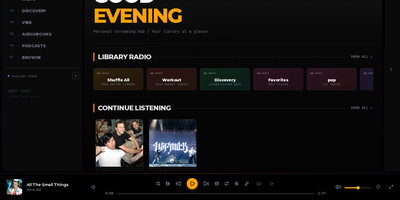
Streaming personal music collections with neural discovery and intelligent playlist curation is what Kima accomplishes as a modern self-hosted audio server that replaces Spotify and Apple Music. Listeners organize their FLAC, MP3, and AAC audio files into responsive grid layouts that scale up to eight columns on ultra-wide displays while automatically fetching album covers, artist biographies, and synchronized line-by-line lyrics. The built-in Vibe System utilizes CLAP neural network audio embeddings to map an entire music collection across two-dimensional clusters and three-dimensional interactive galaxy views, enabling users to explore acoustic relationships or queue smooth sonic paths between distant tracks. Music fans can import playlists directly from Spotify, Deezer, and YouTube using deterministic ISRC matching, while automated Made For You mixes generate era-specific playlists, workout stations, and discovery queues based on individual listening habits. Integrated podcast search pulls subscriptions from iTunes with automatic episode tracking across devices, while native Audiobookshelf connectors synchronize spoken-word chapter positions and playback progress directly into the unified web player. OpenSubsonic API endpoints allow mobile users to stream libraries through native clients like Symfonium and DSub using scoped authentication tokens, while administrators manage multi-user accounts with time-based two-factor authentication. Running on a dedicated VPS on RepoCloud with guaranteed CPU, RAM, and SSD, full root SSH access, and a browser serial console. GPL-3.0 licensed.
Mail-in-a-Box
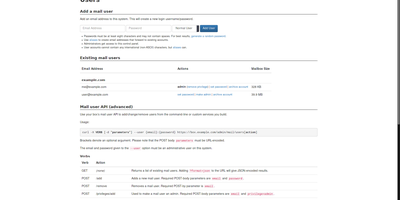
Mail-in-a-Box turns a single Ubuntu server into a fully functional email system with one setup command, installing and configuring Postfix for SMTP, Dovecot for IMAP, Roundcube for webmail, and Z-Push for Exchange ActiveSync push notifications in an automated sequence that would take days to replicate manually. The DNS server auto-configures the full suite of email authentication records: SPF, DKIM, DMARC, DNSSEC with DANE TLSA, MTA-STS, and SSHFP. Getting all of these right is what separates email that lands in inboxes from email that lands in spam, and most manual installations never achieve the complete set. Nextcloud integration adds CardDAV contact sync and CalDAV calendar sharing across devices. Let's Encrypt certificates provision and renew automatically for every hosted domain. The web control panel manages users, aliases, custom DNS records, and automated backups, protected by TOTP two-factor authentication. Daily health checks verify that services run correctly, ports remain open, TLS certificates stay valid, and DNS records resolve properly, alerting you before delivery problems develop. Multiple domains and users operate from one installation with internationalized domain name support. Built-in HTTPS static site hosting uses the TLS infrastructure already in place. Runs on a dedicated RepoCloud VPS with guaranteed resources, root SSH, and browser serial console for complete email sovereignty. CC0 public domain licensed.
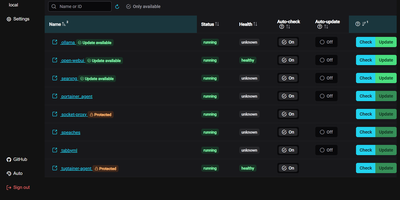
Tugtainer
Tugtainer delivers a visual command center for Docker environments that automates container image updates, monitors registry releases, and manages application lifecycles across multiple servers without command-line intervention. System administrators can inspect running containers across all connected hosts, trigger immediate image pulls, and configure automated cron schedules for recurring health and registry checks. Flexible update policies allow teams to flag production databases as notification-only while automatically updating stateless web applications whenever new image tags publish. When updating linked services, the platform analyzes Docker Compose project definitions and custom dependency labels to stop and restart containers in strict dependency order, preventing broken network links and orphaned volume mounts. Administrators can authenticate private container registries, browse image layers and tags, and view real-time container log streams directly within the browser console. Automated pruning jobs continuously reclaim server disk space by deleting obsolete, untagged images and dangling build layers after successful deployments. Multi-channel alerting integrates with over fifty notification providers, delivering real-time update summaries and error warnings directly to Discord, Telegram, Slack, and email webhooks. Running on a dedicated VPS on RepoCloud with guaranteed CPU, RAM, and SSD, full root SSH access, and a browser serial console. MIT licensed.
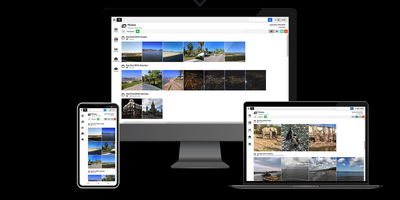
LibrePhotos
With over 8,000 GitHub stars and continuous development since 2020, LibrePhotos delivers the core intelligence of Google Photos — face recognition, object detection, semantic search, and automatic album generation — entirely on your own hardware without sending a single photo to a third-party server. The Django 5 backend processes uploaded media through a machine learning pipeline that runs face detection via the face_recognition library, clusters identified faces using scikit-learn and HDBSCAN, generates image captions through BLIP and Moondream 2, and classifies scenes using Places365 or Google's SigLIP 2 vision-language model with zero-shot classification against 900+ real-world tags. Semantic search lets you find photos by natural language queries like "sunset at the beach" without manual tagging, while metadata search filters by person, camera, lens, file type, and filesystem path. The React 18 frontend built with Vite presents a timeline view, fullscreen lightbox with slideshow mode, photo detail sidebar showing location and people, and a folder navigation view with breadcrumb paths. RAW files from any camera are converted via ImageMagick, videos processed through FFmpeg, and Live Photos paired with their RAW+JPEG counterparts as unified entries. Public album sharing via link provides fine-grained privacy controls, and duplicate detection uses perceptual hashing to identify near-identical images. Deployment runs as a single unified Docker container or via Docker Compose with Kubernetes manifests also available. Running on a dedicated VPS on RepoCloud with guaranteed CPU, RAM, and SSD, full root SSH access, and a browser serial console. MIT licensed.
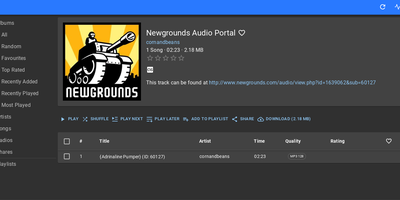
Navidrome
Spotify economics without the subscription or catalog gaps: Navidrome, the reference self-hosted music server, streams your own FLAC, MP3, and ALAC collection from a single Go binary with a React/Material UI web player. Its Subsonic/OpenSubsonic API compatibility is the superpower: 50+ existing clients work out of the box, from Symfonium and DSub on Android to Feishin and Sonixd on desktop, plus Android Auto, CarPlay, and Android TV apps. Transcoding is server-managed and FFmpeg-backed - FLAC direct-plays at home and downsamples to MP3, AAC, or Opus over mobile bandwidth, with the OpenSubsonic transcoding extension letting clients declare capabilities and receive per-track direct-play or transcode decisions automatically. Multi-user support gives every account its own play counts, favorites, ratings, and playlists, and multi-library support scopes different collections to different users. The feature list covers serious listening: Last.fm and ListenBrainz scrobbling, artist bios and images, embedded and external lyrics, audiobook bookmarks, saved play queues that resume on another device, internet radio, jukebox mode, and M3U playlist auto-import kept in sync with your folder. Resource usage is famously low - it runs happily on a Raspberry Pi and scales to six-figure track counts.
Fireshare
The moment after ShadowPlay saves a great clip is what Fireshare was built for: your friends see it now, not after a YouTube upload, processing queue, and platform terms review. Drop videos into a watched folder and this Flask/React application generates a unique shareable URL for each one, complete with Open Graph metadata - so pasting the link into Discord, Twitter, or Slack produces a proper embed with title, description, and video thumbnail instead of a raw URL. Viewers need no account and no app. Visibility is per-file: public (browseable on your feed), private (unlisted, reachable only by direct link), or password protected. For game clips specifically, Fireshare organizes automatically - clips sort by game with cover art pulled from SteamGridDB, no manual tagging - while tags and full-library search cover everything else. Optional transcoding (CPU or GPU) creates lower-quality renditions so viewers on weak connections get automatic quality adaptation, and video cropping trims clips in place. The extras round out a genuinely finished tool: view counters, timestamped share links, a shuffle button, restrictable uploads, Discord notifications for new videos, an RSS feed of the public feed, mobile support, and LDAP for multi-user setups. No storage limits, no watermarks, no platform deciding what stays up. GPL-licensed.

Calibre-Web
With over 17,700 GitHub stars and continuous development since 2015, Calibre-Web has become the definitive self-hosted digital library solution for book enthusiasts who want beautiful web access to their Calibre collections. The responsive Bootstrap 3 interface delivers instant browsing, searching, and filtering across titles, authors, tags, series, book formats, and languages, with custom shelves for organizing personal reading collections. In-browser reading supports EPUB, PDF, TXT, CBR, CBT, CBZ, and DJVU formats with a configurable EPUB reader featuring multiple themes and page location tracking, while one-click email delivery sends books directly to Kindle, Kobo, and other E-Readers without leaving the interface. Native Kobo sync lets Kobo device owners synchronize their entire Calibre library wirelessly, maintaining reading progress and bookmarks across devices. Metadata management includes editing capabilities with automatic metadata downloading from Google Books, Amazon, and other configurable sources, plus eBook format conversion through Calibre binaries for on-the-fly EPUB, MOBI, AZW3, and PDF conversion. User management provides fine-grained per-user permissions controlling download access, upload rights, editing capabilities, and content visibility based on categories or Custom Column values. Authentication supports local accounts, LDAP directory integration, Google and GitHub OAuth, proxy authentication, and Magic Link login for easy E-Reader access. The OPDS catalog feed enables any compliant E-Reader app to browse and download from the library. Running on a dedicated VPS on RepoCloud with guaranteed CPU, RAM, and SSD, full root SSH access, and a browser serial console. GPL-3.0 licensed.
Nhost
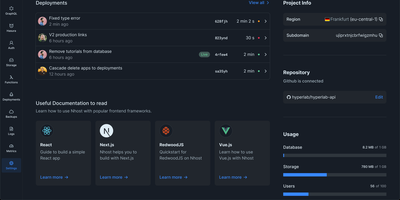
Backed by 9,200 GitHub stars and venture funding led by Nauta Capital, Nhost is the open-source Firebase alternative that replaces Google's proprietary document store with a relational PostgreSQL foundation from day one. The Hasura integration auto-generates a real-time GraphQL API with subscriptions, role-based permissions, and remote schemas from your PostgreSQL tables, while event triggers and cron triggers automate backend workflows without custom infrastructure. Authentication supports email and password, magic links, phone OTP via SMS, social OAuth providers including Google and GitHub, WebAuthn for passwordless login with Face ID, fingerprints, and YubiKeys, plus two-factor authentication. Since the Q1 2026 release, Nhost Auth also functions as a full OAuth2 and OpenID Connect provider, allowing your Nhost project to issue tokens to third-party applications the same way GitHub or Google do. The S3-compatible storage service handles file uploads with automatic image optimization, virus scanning, and presigned URLs for secure direct downloads. Node.js serverless functions deploy JavaScript and TypeScript backend logic without managing servers, while the Nhost CLI spins up the complete local stack via Docker for development with automatic database migration tracking and Hasura metadata management. The MCP server integration exposes project documentation and data schemas to AI assistants for intelligent query building. SDKs cover JavaScript, TypeScript, React, Vue, Next.js, and Dart for Flutter. Running on a dedicated VPS on RepoCloud with guaranteed CPU, RAM, and SSD, full root SSH access, and a browser serial console. MIT licensed.
CapRover
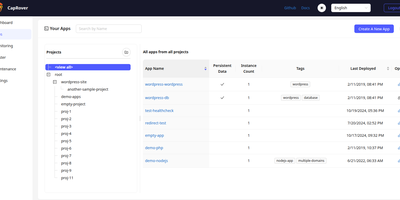
With over 15,000 GitHub stars and nearly nine years of active development, CapRover is the self-hosted PaaS that replaces Heroku's pricing with your own infrastructure while keeping the deploy-and-forget simplicity. The web dashboard manages application lifecycle from deploy through scaling — configure custom domains, environment variables, persistent volumes, instance counts, and nginx templates without touching config files or SSH. The CLI tool enables scriptable deployments with a single command from your terminal or CI/CD pipeline, while webhook-based deployment triggers automated builds from Git pushes. The one-click app marketplace provides over 100 pre-configured services including WordPress, Ghost, PostgreSQL, MySQL, MongoDB, Redis, Grafana, Portainer, and dozens more, each deployed as a Docker container with volumes and environment variables preconfigured. Automatic HTTPS provisions and renews Let's Encrypt certificates for every custom domain with one-click HTTP-to-HTTPS redirects. Under the hood, Docker Swarm orchestrates containers across multiple nodes for horizontal scaling and load balancing, while nginx handles routing with fully customizable EJS-generated configuration templates per application. Deployment supports four methods: CLI push, tarball upload through the web UI, Docker image reference, and Git repository connection. The build system supports Dockerfiles, captain-definition files with build packs, and direct Docker image pulls. NetData integration provides real-time server monitoring dashboards. Running on a dedicated VPS on RepoCloud with guaranteed CPU, RAM, and SSD, full root SSH access, and a browser serial console. Apache 2.0 licensed.
Bazarr
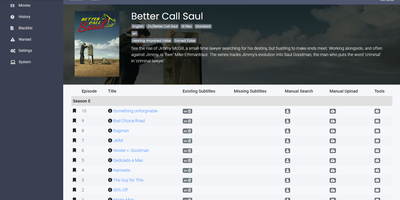
Subtitles are the one chore Sonarr and Radarr leave behind - Bazarr finishes the *arr media stack by automating them. It connects to both via their APIs and mirrors their libraries - it doesn't scan disk itself, it manages exactly what your *arr apps index. For every monitored episode and movie it checks existing internal and external subtitles against your language profiles, then hunts missing ones across dozens of providers - OpenSubtitles.com, Podnapisi, Addic7ed, Subscene, and many regional sources - covering 184 subtitle languages including forced/foreign-dialogue tracks. Matching is smarter than filename guessing: releases are compared by release group and source, some providers support exact file-hash matching, and every downloaded subtitle gets a percentage score. Set a minimum score per Sonarr/Radarr connection and Bazarr rejects weak matches; enable upgrades and it replaces previously downloaded subtitles when better ones surface. Out-of-sync files get fixed too - automatic subtitle synchronization realigns timing after download, triggered only below a configurable score threshold so good subs aren't touched. Per-show and per-movie language configuration, download history, manual on-demand search, and adaptive searching that throttles provider API calls round it out, all behind a clean Sonarr-style web UI written in Python. If your library serves multilingual viewers, this removes the last manual step.
1Panel
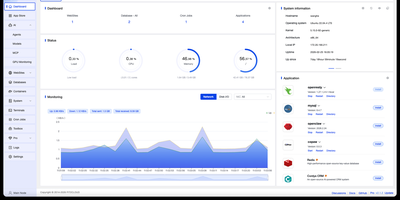
Backed by over 36,000 GitHub stars and 120 contributors with 123 releases since 2022, 1Panel has rapidly become the go-to open-source alternative to cPanel and Plesk for modern Linux server management. The platform delivers a clean Vue.js dashboard powered by a Go backend using the Gin framework, providing visual management of Docker containers, images, networks, and volumes without touching the command line. Its curated app marketplace offers one-click installation of 165+ trusted open-source applications including Nextcloud, Bitwarden, Umami analytics, WordPress, and NocoBase, each running in isolated containers for maximum security. Native AI capabilities set 1Panel apart from every competing panel: deploy Ollama LLMs directly from the dashboard, spin up OpenClaw personal agents, monitor GPU utilization, and manage AI models through a unified interface. Website management includes automatic domain binding, Let's Encrypt SSL certificate provisioning, and Nginx configuration with zero manual setup. Security runs deep with built-in firewall rules, fail2ban integration, container isolation, WAF protection, and comprehensive audit logging enabled from day one. Automated backups support AWS S3, Cloudflare R2, and local storage with one-click restore from any snapshot. The panel supports Debian, Ubuntu, CentOS, and Rocky Linux across x86_64, aarch64, armv7l, ppc64le, and s390x architectures. Running on a dedicated VPS on RepoCloud with guaranteed CPU, RAM, and SSD, full root SSH access, and a browser serial console. GPL-3.0 licensed.
ServerKit
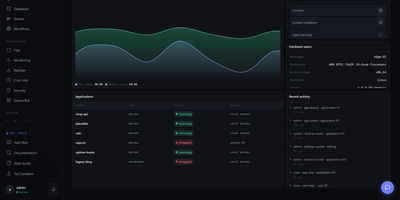
ServerKit delivers a server control panel that fits on a small VPS while managing everything from Docker containers to mail servers. The Python/Flask backend exposes 1,519 REST endpoints across 107 blueprints with full OpenAPI documentation at /api/v1/docs, while the React frontend spans 65 screens in a 1.75MB gzipped bundle served entirely from your own infrastructure. Docker management includes full container lifecycle control, Docker Compose project orchestration, real-time log streaming, and terminal access. Database panels cover MySQL/MariaDB and PostgreSQL with user management, browser-based query consoles, and automated backups to S3, Backblaze B2, or local storage. Nginx virtual host management automates Let's Encrypt certificate provisioning with hardened TLS 1.2+ configurations and Cloudflare-aware setups. The Go-based cross-platform agent enables multi-server fleet management with HMAC-SHA256 authentication over a WebSocket gateway, supporting Linux, Windows, and macOS across amd64 and ARM64 architectures. Fleet monitoring provides cross-server heatmaps, metric comparison charts, alert thresholds, anomaly detection, and capacity forecasting. A built-in marketplace distributes 106 one-click application templates using a declarative YAML schema with Docker Compose stacks. The extension system allows community plugins for Kubernetes management, Redis browsers, and WordPress site orchestration. Running on a dedicated VPS on RepoCloud with guaranteed CPU, RAM, and SSD, full root SSH access, and a browser serial console. MIT licensed.