Flexisip
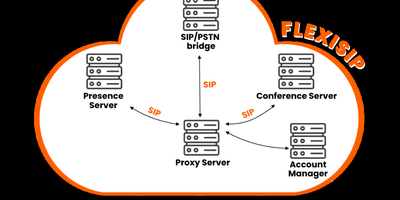
A SIP phone system lives or dies on the unglamorous middle. Something has to route every call, know who is registered, wake phones that are asleep, and translate between networks that disagree. Flexisip is that middle, built as a modular server suite where you deploy only the pieces your service needs. The proxy routes calls and messages, relays media with ICE, STUN, and TURN support, and authenticates users by digest, TLS certificates, or OpenID Connect. Its push gateway speaks RFC 8599 to Apple and Google, so incoming calls ring phones whose app is closed, and it can lend that gift to an existing Asterisk or FreeSWITCH platform that lacks push of its own. The presence server tracks who is reachable and shares contact lists, the back-to-back user agent bridges SIP networks to PSTN gateways and trunks with codec transcoding and caller identity translation, and a registration event server notifies peer domains when users register. Instances cluster with load balancing for services that outgrow one box, the same suite shrinks onto a Raspberry Pi class intercom, and it has quietly powered the public linphone.org SIP service for over a decade. Running on a dedicated VPS on RepoCloud with guaranteed CPU, RAM, and SSD, full root SSH access, and a browser serial console. AGPL-3.0 licensed.
Routr
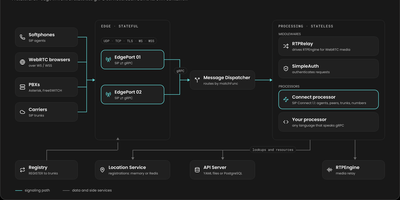
Routr is a programmable SIP server that proxies, registers, and routes calls for carriers and communication platforms, replacing racks of inherited PBX plumbing with one cloud-ready process. Phones and trunks connect over UDP, TCP, TLS, WebSocket, or secure WebSocket, register against the built-in registrar, and find each other through the location service backed by memory, Redis, or Postgres. Routing is configurable per domain with intra-domain, ingress, egress, and peer-egress strategies, and multi-tenant domains carry their own access control lists. Load balancing with session affinity spreads calls across Asterisk and FreeSWITCH media servers, and RTPEngine middleware anchors media and adds SDES-SRTP toward TLS trunks. Web phones authenticate with JWT endpoint credentials, and every call message can be recorded and replayed for debugging. Operators manage the whole system through a gRPC API, the Node.js SDK, or the rctl command-line tool, and custom Processors and Middleware written in JavaScript reshape SIP messages as they pass. OpenTelemetry traces, metrics, and logs expose the server's behaviour in production, and the same deployment runs from a single Docker container to a Kubernetes cluster through the published Helm charts. There is no single point of failure in the design, so a registrar outage never takes the dial tone with it. Running on a dedicated VPS on RepoCloud with guaranteed CPU, RAM, and SSD, full root SSH access, and a browser serial console. MIT licensed.