Xprem
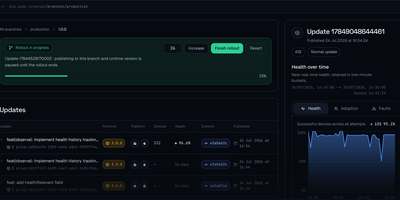
xprem is a self-hosted update server for Expo applications that speaks the official Expo Updates protocol, so any app built with expo-updates can fetch its bundles from your infrastructure instead of a hosted service. Publishing works from the eoas CLI, from CI, or from the dashboard, and devices receive the corrected bundle on their next check with no app store review in between. Channels such as production and staging map to branches, which means each build flavor receives exactly the code meant for it. A rollout can serve an update to a slice of the fleet first and widen as confidence grows, and a bad release rolls back instantly instead of stranding users. One channel can even serve two branches at once, splitting devices deterministically for A/B tests. Every manifest is signed with a private key you own, and the matching certificate embedded in the app makes expo-updates refuse anything that fails verification, so a compromised bucket cannot push code into your product. The bundles themselves live in your S3, Google Cloud Storage, Azure Blob, Cloudflare R2, MinIO, or local storage and download through your CDN, while a single server hosts as many applications as you ship. Running on a dedicated VPS on RepoCloud with guaranteed CPU, RAM, and SSD, full root SSH access, and a browser serial console. MIT licensed.
Open Lovable
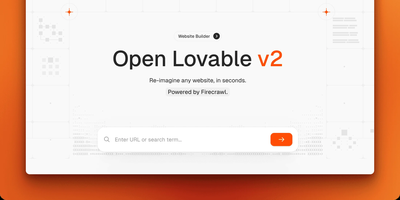
Open Lovable from the Firecrawl team delivers the first truly open-source alternative to Lovable.dev — a chat-driven AI copilot that takes any website URL and regenerates it as a complete, editable React application with TypeScript and Tailwind CSS in seconds. The pipeline combines Firecrawl's intelligent web scraping for JavaScript-rendered pages and single-page applications with your choice of AI provider — Claude, GPT-4, Google Gemini, or Groq — to analyze HTML structure, extract layouts and styling, decompose pages into proper React components, and generate production-ready code following modern best practices. Live preview runs in a secure sandbox environment using Vercel Sandbox with OIDC authentication or E2B Cloud, letting you see results immediately and iterate through natural language chat to request changes like Tailwind migration, componentization, SEO improvements, accessibility fixes, or custom form implementations. The optional Morph LLM fast-apply path accelerates small edits by applying diffs directly without full regeneration. The provider-agnostic architecture means you control costs by routing to different models — use Groq for fast iterations and Claude for complex layouts. Project structure follows Next.js conventions with organized app, components, atoms, styles, utils, and hooks directories. Deploy via pnpm with Node.js 18+ requiring only a Firecrawl API key, one AI provider key, and a sandbox provider configuration. Running on a dedicated VPS on RepoCloud with guaranteed CPU, RAM, and SSD, full root SSH access, and a browser serial console. MIT licensed.
Hot Updater
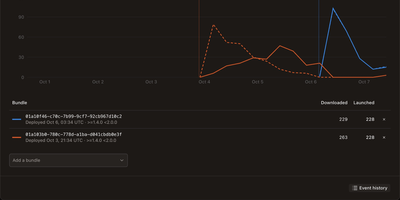
An app store review takes days, but a broken checkout flow takes minutes to cost you users: Hot Updater lets React Native teams ship JavaScript fixes straight to installed apps from a server they control, no store submission required. Deploy a new bundle with the CLI, and devices pick it up on their next update check, whether they run iOS or Android. The web console shows what you have shipped, which app versions receive which bundle, and lets you roll back a bad release before the support tickets pile up. Bundle diffing keeps downloads small: unchanged files stay on the device, changed Hermes bundles travel as compact patches, and the server quietly drops any patch that is not smaller than the full file. Releases target specific semantic app versions, so a fix built for 2.3 users never lands on 3.0 devices. Storage and metadata live where you choose, from S3-compatible buckets and Cloudflare R2 with D1 to Supabase, Firebase, Azure, or your own PostgreSQL, swapped through adapters rather than rewrites. Insights record update events so you can watch adoption as a rollout spreads, API keys gate which apps may check in, and remote configuration tunes app behavior without another binary release. The server itself runs as a compact Node service in Docker on port 3000 next to PostgreSQL, with token-protected admin routes. Running on a dedicated VPS on RepoCloud with guaranteed CPU, RAM, and SSD, full root SSH access, and a browser serial console. MIT licensed.
Keystone
Keystone turns TypeScript schema definitions into a complete GraphQL API and React Admin UI automatically, eliminating the gap between data modeling and application scaffolding. Nearly 10,000 GitHub stars and over 270 contributors across a decade of development back a framework where list definitions map directly to Prisma models on PostgreSQL or SQLite, generating database migrations and exposing every field relationship through Apollo Server's GraphQL endpoint. Granular access control operates at the list, field, and operation level with filter-based restrictions that limit which records users can see, create, update, or delete based on session data and custom logic. The document field provides a structured WYSIWYG editor with content blocks, inline relationships, and custom React components that render consistently across the Admin UI and frontend applications. Event hooks fire before and after create, update, and delete operations for validation, side effects, and external service integration. Custom GraphQL queries and mutations extend the API beyond auto-generated CRUD for bespoke business logic. The Admin UI built with Next.js and the Keystar UI component library supports custom pages, branded navigation, and internationalized interfaces. OpenTelemetry tracing provides observability into operations, queries, and hook execution. Deploys via Docker or any Node.js host with Prisma managing schema evolution. Running on a dedicated VPS on RepoCloud with guaranteed CPU, RAM, and SSD, full root SSH access, and a browser serial console. MIT licensed.