
Photofield
Instead of paging through albums, Photofield lays a whole photo library out on one zoomable canvas, where thousands of thumbnails sharpen into full-resolution pictures as you zoom. Collections come straight from directories named in a configuration file. One setting turns every subfolder into its own collection. Pick a layout per collection: album grouped by date, timeline with month markers, wall, map, highlights with dates and place names, or flex. Sort oldest first, newest first, or shuffled hourly, daily, weekly, or monthly. Tiles load progressively, and an info drawer shows the date, file name, and dimensions. A right-click menu opens or copies an image, copies its link, or finds similar images. Originals are never modified, so a read-only mount is safe. Indexing runs at up to 10,000 files per second on a fast SSD with a warm cache. JPEG, PNG, AVIF, HEIC, DNG, GIF, MP4, and MOV files are recognized. Place names resolve from an embedded database, with no external lookups. The optional photofield-ai companion adds search by words like beach sunset or cat eyes, plus a Faces layout of detected faces. Alpha tagging lets you label photos. Running on a dedicated VPS on RepoCloud with guaranteed CPU, RAM, and SSD, full root SSH access, and a browser serial console. MIT licensed.
Sulu
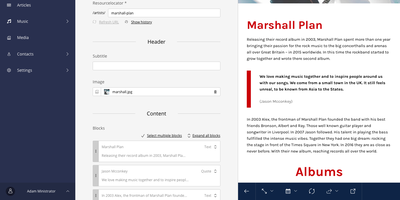
Running several multilingual websites does not mean juggling several admins: Sulu is a content management system that hosts them all in one, with a live preview beside every form. Webspaces are separate websites, each with its own page tree, languages, domains, and permissions. Pages are built from templates of fields and reorderable blocks, grouped under Content, SEO, Excerpt, and Settings tabs. Unsure how a page will look in search? The SEO tab previews it, counts characters in the meta title and description, and offers keywords, a canonical URL, and no-index and no-follow switches. Changing a page address automatically redirects the old one. Files stay organized in nestable media collections with grid and list views, and images are resized automatically to the formats a design asks for. Snippets hold content shared across pages, and smart content assembles dynamic lists of pages, contacts, or organizations. Landing pages get their own custom URLs, and target groups can show different content at the same address to different visitors. Editors who should not see everything get roles with view, add, edit, and delete rights per webspace. An activity log lists changes, and the trash restores deleted items. Contacts and organizations live in the same interface, and developers can add their own admin sections with lists, forms, and preview. Running on a dedicated VPS on RepoCloud with guaranteed CPU, RAM, and SSD, full root SSH access, and a browser serial console. MIT licensed.