imgpush
Your app needs avatars, attachments and user photos, and imgpush is the tiny service that takes them off your hands. Send one upload request with a file or a URL and you get back a filename; ask for that file with a width and height in the address and you receive exactly that crop, converted to the format you configured. Originals live on local disk or in any S3-compatible bucket (AWS S3, Cloudflare R2, MinIO or Backblaze B2), with resized variants cached locally for fast serving. Abuse controls come built in: per-IP upload quotas per minute, hour and day, an allowed-origins whitelist, and an optional nudity filter that can also sample video frames before an upload is accepted. An API key can be required for uploads, deletes remove the original together with every cached size, and a liveness endpoint keeps Docker and Kubernetes health checks honest. One Docker container on port 5000, a page of environment variables, and your application never writes image code again. Running on a dedicated VPS on RepoCloud with guaranteed CPU, RAM, and SSD, full root SSH access, and a browser serial console. MIT licensed.
KamiYomu
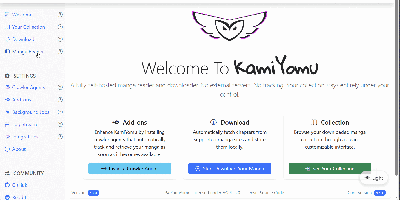
Manga readers use KamiYomu to build a private, self-hosted library: it fetches chapters from the websites they already follow, archives them locally, and serves everything back through a clean web reader on any device. The discovery flow runs on Crawler Agents, small plugins that teach KamiYomu how a particular source site lists series, chapters, and pages, so searching and fetching metadata happens inside the same interface as reading. Downloads land in a structured local archive, and reading picks up where you left off with history, filters for your library, and weekly views that surface new chapters and fresh releases. When a series is complete, export it as CBZ, PDF, or ZIP and take the files anywhere, no account or cloud library involved. Your e-reader and phone apps join through the built-in OPDS catalog, the same standard used by Moon+ Reader and KyBook, while a Swagger-documented API exposes the collection to your own scripts. Scheduled jobs keep watched series current in the background, checking sources and pulling new chapters without you babysitting tabs. Running on a dedicated VPS on RepoCloud with guaranteed CPU, RAM, and SSD, full root SSH access, and a browser serial console. AGPL-3.0 licensed.
IPTV Proxy
Your IPTV provider's login should never be typed into six televisions. IPTV Proxy is an open-source reverse proxy that takes an M3U/M3U8 playlist or an Xtream Codes account and re-serves every channel, movie, series, and guide from your own address, under a username and password you choose. Players like TiviMate, IPTV Smarters, VLC, and Kodi talk only to the proxy, so the provider's real URL and credentials stay hidden on one machine, and when the provider changes its address, your household devices keep pointing at the same stable endpoint behind your domain, HTTPS, or VPN. Each viewer can receive their own proxy account with a connection limit, regex filters trim channel lists down to what a household actually watches, playlist refreshes happen automatically, and a read-only status page shows who is watching what right now. Media servers join in too: the proxy presents live channels as an HDHomeRun network tuner, so Plex, Jellyfin, Emby, and Channels DVR record and time-shift them with guide data included. There is no database and no admin panel to secure; one small binary or container, configured by flags, is the whole deployment. Running on a dedicated VPS on RepoCloud with guaranteed CPU, RAM, and SSD, full root SSH access, and a browser serial console. GPL-3.0 licensed.
Mikochi
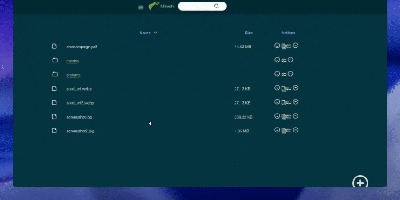
Point a browser at your server's folders and skip the FTP clients, the SSH tunnels, and the heavyweight cloud clones: Mikochi turns any directory on your machine into a clean web file browser you can open from anywhere. You browse nested folders in a fast list view, jump to files with fuzzy search, upload new material, create folders, rename items, and delete what is no longer needed. Whole directories come down as a single tar.gz archive, which makes backups and bulk transfers painless. Media files get a smarter treatment: Mikochi generates streaming links that open directly in VLC or mpv, so a film or album stored on the server plays on your screen without downloading gigabytes first. Access stays protected behind a username and password login with JWT sessions, and you can serve everything over TLS with your own certificates or disable authentication entirely on a trusted private network. Deployment takes one Docker command with a mounted data directory, and Kubernetes users get an official Helm chart. Homelab owners point it at a NAS share, developers drop it on a build box, and anyone tired of scp commands gets a permanent window into their files. Running on a dedicated VPS on RepoCloud with guaranteed CPU, RAM, and SSD, full root SSH access, and a browser serial console. MIT licensed.
SRS
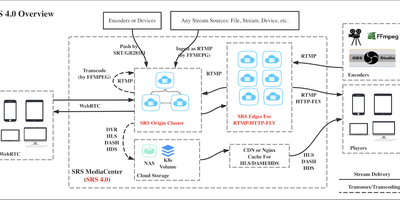
Viewers arrive on browsers, phones, and desktop players, and SRS meets each of them with the right protocol from a single published stream. A broadcaster pushing RTMP can reach browser viewers through WebRTC with sub-second latency, phone apps through HLS, and desktop players through HTTP-FLV, all from the same live source without running parallel encoders. WHIP endpoints accept WebRTC ingest from browser studios and tools like OBS, while WHEP serves WebRTC playback, so an entire publish-to-viewer path can stay on modern web protocols. Operators shape each channel with virtual hosts, authenticate publishers and players through HTTP hooks that consult your own backend, and record live streams to disk as DVR archives for replay. Forwarding republishes a stream to YouTube, Facebook, or another SRS instance, and origin clustering lets edge servers pull from a central origin so one ingest feeds viewers in several regions. The built-in HTTP API reports streams, clients, and server health for monitoring, and GB28181 support ingests surveillance camera networks alongside creator broadcasts. Configuration lives in a single reloadable file, so changing a vhost or enabling HLS rarely means restarting the listeners your audience is attached to. Running on a dedicated VPS on RepoCloud with guaranteed CPU, RAM, and SSD, full root SSH access, and a browser serial console. MIT licensed.
Shoutrrr
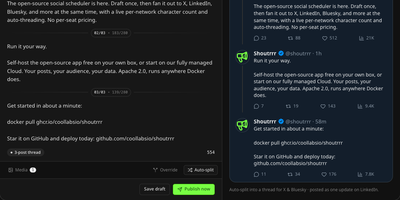
Write one post and Shoutrrr publishes it across X, Bluesky, LinkedIn, Facebook, Instagram, Threads, and Discord at the same moment, or holds it in a queue until the slot you picked. The composer counts characters against each network's limits as you type, attaches media with alt text, adjusts wording per platform when a message needs a local tweak, and splits long posts into threads where the network supports them. Recurring posting slots follow your workspace timezone, drafts drop into those slots from a month calendar, and anything can still go out instantly when news breaks. Every target publishes independently and retries on its own when a network hiccups, leaving a per-attempt trail you can inspect instead of a silent failure. Analytics chart follower and post-count trends for each account and report likes, reposts, replies, and impressions per post wherever the network's API allows. Teams share workspaces with role-based memberships and email invitations, keep clients in separate workspaces, and get in-app alerts the moment a post lands, fails, or needs an account reconnected. Account tokens sit encrypted at rest and refresh themselves, sign-in supports two-factor codes and passkeys, and the built-in MCP server hands AI assistants 22 tools to draft and schedule while publishing, retrying, and deleting refuse to run without your explicit confirmation. Running on a dedicated VPS on RepoCloud with guaranteed CPU, RAM, and SSD, full root SSH access, and a browser serial console. Apache-2.0 licensed.
Shelfarr
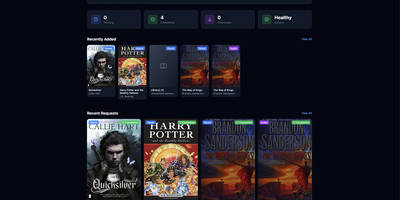
Shelfarr is the request button your book library was missing: anyone in your household can search millions of ebooks and audiobooks, request the format they want, and let automation fetch and shelve it. Discovery searches Open Library, Hardcover, and Google Books with covers, series, editions, and narrator details, so picking between the ebook and the audiobook takes a glance. Hardcover shelves and public reading lists can be previewed and requested, and following an author means their next release surfaces without a manual search. Requests wait for an admin's approval or move straight to searching, where your indexers are queried and every result is scored against your preferred formats, bitrate, and language. The winning release goes to the download client you route it to; finished files are renamed with your templates and delivered into your library's watched folders, which are told to rescan. Nothing found is not the end: searches retry with back-off and flag the request for attention instead of losing it. Family members get their own accounts with roles, two-factor authentication or single sign-on, notifications in the app or on Discord and Telegram, and admins keep manual uploads, API tokens, and download routing under their control. Running on a dedicated VPS on RepoCloud with guaranteed CPU, RAM, and SSD, full root SSH access, and a browser serial console. GPL-3.0 licensed.

Social Analyzer
Social Analyzer scans over 1,000 social media platforms in parallel to discover and correlate user profiles from a single username query, making it the most comprehensive OSINT reconnaissance tool of its kind. Three detection modes cover different accuracy and speed tradeoffs: fast HTTP library checks for rapid sweeps, Selenium WebDriver validation for JavaScript-heavy sites, and a special mode for stubborn edge cases. String analysis generates username permutations and combinations to catch related accounts with slight naming variations. Three interfaces serve different workflows: a Node.js web application on port 9005 with a browser-based GUI, a CLI for scripted batch operations, and Python plus Node.js APIs for embedding into automated investigation pipelines. The QeeqBox OSINT library extracts profile metadata, screenshots, titles, descriptions, and activity patterns, all visualized through Ixora-based force-directed graphs that map relationships between discovered accounts. Tesseract OCR analyzes profile images for additional detection vectors. Search results narrow by country codes, website categories, Alexa ranking thresholds, and confidence levels. Optional Google API and DuckDuckGo API integration adds search engine correlation alongside direct platform queries. Docker deployment bundles Node.js, Firefox ESR, Tesseract, and all dependencies into one container. Trusted by law enforcement and security researchers for digital forensics and identity verification. 23,000+ GitHub stars. AGPL-3.0 licensed.
PeerTube
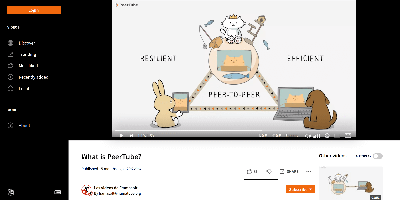
The fediverse's answer to YouTube comes from French non-profit Framasoft: PeerTube is a TypeScript/Angular video platform where hundreds of independently operated instances federate over ActivityPub into one network. Videos you publish are discoverable across the whole video fediverse, and viewers can follow your channels from Mastodon or any ActivityPub platform - or plain RSS - without needing an account on your instance. The namesake innovation attacks video hosting's core cost problem: alongside HLS delivery, an optional WebRTC-based P2P layer lets concurrent viewers' browsers share video segments with each other, so a video going viral distributes its own bandwidth demand instead of crushing your server; instance redundancy extends this by letting friendly instances cache each other's videos. Livestreaming is first-class - stream via OBS or any RTMP software, host permanent streams, enable replays, and interact through live chat. Creators get channels, playlists, analytics, built-in video editing (trim, watermark), and an embeddable player for any website. There are no ads, no data mining, and no recommendation algorithm engineered for watch-time - the project's explicit design stance. Admins control federation policy, P2P settings, and theming; a plugin system extends the rest. AGPL-licensed, 300+ contributors, in active development since 2015.
Calibre-Web Automated
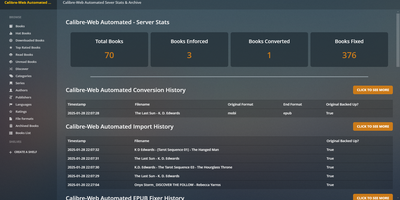
Turn any chaotic digital book archive into an autonomous, self-organizing reading portal using Calibre-Web Automated, a digital library manager featuring hands-free format conversions, metadata fetching, and e-reader synchronization. Readers can drop raw ebook files into the automated intake directory and watch the system instantly convert between twenty-eight distinct file types, repair malformed EPUB internal markup, and fetch enriched metadata from Hardcover, Kobo, and ISBN databases. The responsive web reader lets you browse collections, read directly in any desktop or mobile browser, and organize titles into dynamic rules-based Magic Shelves that update automatically. Built-in KOReader sync harmonizes reading progress and bookmarks across mobile devices and e-ink readers, while native OPDS feeds connect seamlessly to your favorite external reader applications. Administrative tools empower you to run hybrid SQL and fuzzy duplicate detection scans, perform batch metadata editing across entire series, enforce cover art changes directly into source files, and auto-dispatch newly ingested books to Kindle or Kobo devices via scheduled email delivery. Granular multi-user controls allow administrators to assign folder permissions, restrict downloads, enforce dark mode themes, and authenticate readers securely through OAuth and OpenID Connect identity providers. Running on a dedicated VPS on RepoCloud with guaranteed CPU, RAM, and SSD, full root SSH access, and a browser serial console. GNU General Public License v3.0 licensed.
Redlib
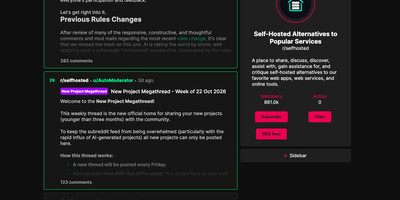
Redlib lets you read Reddit without an account, ads, or trackers, through a clean page served from a machine you control. Open any subreddit, user profile, or comment thread and the server fetches the content and relays every image and video itself, so your browser never talks to Reddit directly. Pages need no JavaScript, unless you opt in to HLS video playback with sound. Choose card, clean, or compact layouts, a wide interface, and one of more than a dozen themes, from Dracula and Nord to Gruvbox and Tokyo Night. Post and comment sorting, a search box scoped to the current subreddit, a wiki tab, and subreddit filters help you find and tame your feed. Subscriptions build a personal home page with no login. Spoilers and NSFW previews can be blurred or hidden, and an SFW-only mode blocks mature content for the whole instance. Optional RSS feeds let a feed reader follow subreddits. Links to removed posts open in a configurable undelete viewer. Operators set defaults through environment variables, add an instance banner, discourage search indexing, and route outbound traffic through an HTTP or SOCKS proxy. Settings live in a browser cookie and can be exported or imported between devices. Running on a dedicated VPS on RepoCloud with guaranteed CPU, RAM, and SSD, full root SSH access, and a browser serial console. AGPL-3.0 licensed.
Mixarr
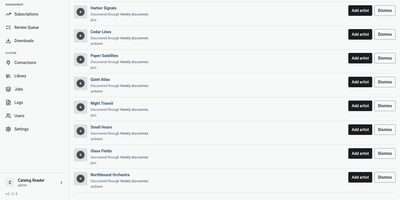
Your next favorite artist is probably already hiding in a playlist, chart, or listening history you never check. Mixarr pulls discovery sources from Spotify, TIDAL, Last.fm, ListenBrainz, Deezer, Discogs, Plex, Jellyfin, MusicBrainz, and Bandcamp into one compact catalog built for Lidarr users. Fifty-six subscription types cover playlists, charts, tags, recommendations, user libraries, and followed artists, each running on its own schedule while you get on with listening. Every discovery lands in a review queue where you preview, approve, or reject it, with clear outcomes distinguishing added, already present, failed, and identity-required results instead of silent shrugs. The artist inspector shows identity, library membership, source provenance, and release chronology without losing your place in the catalog. Its Collaboration Constellation draws an interactive graph of the musicians, producers, and engineers actually credited on records, so you can follow a session player from a rock album to a string quartet and send whoever you find straight to Lidarr. Optional AI recommendations from OpenAI, Anthropic, Gemini, or a local Ollama model analyze your library for what is missing, and library health tools repair missing metadata. One container carries the API, web interface, database, and cache to your server. Running on a dedicated VPS on RepoCloud with guaranteed CPU, RAM, and SSD, full root SSH access, and a browser serial console. GPL-3.0 licensed.

Yarrtube
Follow the channels you actually chose, and let their newest uploads land on your own disk instead of in an algorithmic feed. Yarrtube tracks public YouTube playlists and whole channels, checks them on a schedule, and downloads fresh videos automatically the moment they appear. The built-in web player lets you watch the collected library from a desktop or a phone browser without ads interrupting. Downloads are organized into media-server friendly folders, so the same collection shows up inside Plex, Jellyfin, or Kodi next to your films and shows. For Plex homes, an optional scan trigger refreshes the library right after a download finishes, so new episodes surface without manual rescans. You control download quality per source and can cap how many videos each channel keeps, which protects limited disk space from runaway back catalogs. Grouping sources into categories and smart playlists keeps a growing archive browsable instead of turning into one long dump. Everything runs from one Docker container with two persistent mounts, one for its small database and one for the video files. A free YouTube Data API v3 key powers the new-upload checks, so setup takes minutes. Running on a dedicated VPS on RepoCloud with guaranteed CPU, RAM, and SSD, full root SSH access, and a browser serial console. MIT licensed.

Doory
Design posters, social posts, presentations, invitations, resumes, thumbnails, and business cards in your browser with Doory, a self-hosted design editor that keeps your files, fonts, and brand assets on your own server. Start from one of ten starter templates or a blank canvas, then place text, shapes, lines, arrows, emoji, stickers, QR codes, and roughly 27,500 built-in icons anywhere on the page. Photo tools cover cropping, masks, filters, in-browser background removal, and 2x to 4x image upscaling, with stock photo search through Unsplash or Pexels. Layers can be renamed, locked, hidden, grouped, and reordered, while guides, snapping, rulers, per-page sizes, and format resizing keep multi-page designs tidy. Animations add 27 enter and exit effects, 12 emphasis motions, and 16 page transitions, plus Creative Commons music loops and sound effects, so decks can be presented live with speaker notes or exported as MP4, WebM, or GIF. Share links grant view, comment, or edit access with an optional password, and collaborators can pin comments, co-edit in real time, and roll back through version history. Brand kits store your colors, fonts, and logos so recurring posts stay on-brand, and exports cover PNG, JPG, SVG, and print-ready PDF with bleed and crop marks. An optional MCP server lets AI assistants create and fill designs from prompts, including bulk template filling from spreadsheet-style rows. Running on a dedicated VPS on RepoCloud with guaranteed CPU, RAM, and SSD, full root SSH access, and a browser serial console. Attribution Assurance License licensed.
Tautulli
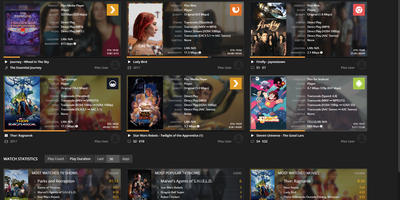
Plex's own dashboard shows current streams and forgets everything else - which is why every Plex server admin eventually installs Tautulli, the analytics layer. This Python web application (descended from PlexWatch and Headphones) logs complete watch history - what was watched, who watched it, when, where, from which device and IP, and whether it played directly or transcoded - and turns it into clean Highcharts graphs of daily plays, concurrent streams, bandwidth, and platform breakdowns. The home page surfaces top statistics over configurable windows: most-watched content, most active users, stream type ratios. For running a server shared with family and friends, this is operational truth: spot the user forcing 4K transcodes on a phone, see which libraries earn their disk space, and track sync activity across users. The notification engine triggers on server events - playback starts, transcode decision changes, recently added media, server down - through dozens of agents (Discord, Telegram, Slack, email, webhooks) with fully customizable text and conditions, plus arbitrary script execution. Scheduled newsletters email your users a styled digest of recently added content. A comprehensive API exposes every statistic for dashboards like Homarr, and an official mobile app monitors activity on the go. Themed to match Plex/Web. GPL-licensed.
Kavita
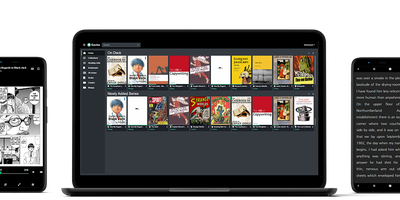
Manga, comics, ebooks, and light novels get a streaming-service-style home in Kavita - a fast, cross-platform reading server for the DRM-free collection you share with family and friends. It natively serves CBZ, CBR, CB7, ZIP/RAR/7z archives, raw images, EPUB, and PDF, with hand-crafted web readers per format: webtoon scrolling, single and dual-page spreads with advanced caching for the comic reader, and a book reader with adjustable fonts, spacing, margins, color themes, and column modes. Reading progress tracks per user, so everyone resumes exactly where they stopped on any device. Metadata parses from filenames, ComicInfo.xml, and EPUB fields, feeding index-backed search, smart filters, collections, reading lists with CBL import, and Want to Read queues. Role-based user management covers age restrictions, per-library access, and OIDC authentication. An OPDS feed connects third-party clients - Panels on iOS, Librera on Android, KOReader on e-ink devices - and a comprehensive REST API supports custom integrations. EPUB annotation and highlight support, custom theming, and full localization round it out. Built with .NET and Angular, it handles 50,000+ file libraries without strain; optional Kavita+ adds AniList scrobbling, recommendations, and external metadata.
Mstream
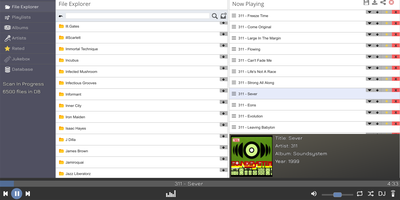
"The easiest music streaming server available" is mStream's own billing, and the claim holds up: a lightweight Node.js app that turns a folder of audio files into a private streaming service in minutes, no external database required. Its filesystem-based design is the clever part - the API mirrors your folder structure, so you can browse and play music immediately, before any library scan finishes, and your organization on disk is your organization in the app. It streams flac, mp3, wav, ogg, opus, aac, and m4a, which matters to the audiophile crowd: FLAC plays uncompressed, bit-perfect, with gapless playback for live albums and continuous mixes. The web player runs anywhere a browser does and packs personality - a Milkdrop-style visualizer (Butterchurn), playlist sharing via links, and drag-and-drop uploads straight through the file explorer. Native iOS and Android apps add the feature streaming subscriptions can't match: sync your collection to your phone for true offline playback of music you own. Multi-user support assigns separate directories and permissions per account. Resource usage is famously light - mStream is tested on multi-terabyte libraries and runs happily on a Raspberry Pi, so a small RepoCloud instance serves a lifetime's collection. GPL-licensed, with zero listening-habit telemetry.
NZBfast
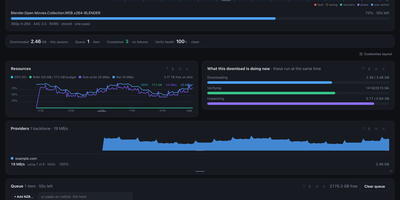
NZBfast is a drop-in SABnzbd and NZBGet replacement that downloads from Usenet at line rate and hands you finished jobs verified and extracted. Point Sonarr, Radarr, LunaSea, or nzb360 at it and they keep working untouched, because the APIs they already speak are the ones it answers. The dashboard charts live throughput and resource use beside a drag-to-reorder queue with per-job detail, a provider leaderboard, and data-usage history. Fetching, PAR2 verification, and unpacking overlap in a single pass, so archives open in the stream and a job needs about its own size in free disk. RAR, 7z, and zip sets, encrypted archives, password chains, and nested archives all go through that pipeline, with automatic PAR2 repair when articles arrive damaged. The poster wall turns your newsgroups into a browsable media library with cover art and metadata, and videos preview with real seeking mid-download. Switch on the optional built-in indexer and it scans your groups into a local index behind a Newznab endpoint your other tools can query. Watchlists grab new postings and chase quality upgrades, while RSS automation, Smart Folders, and a weekly scheduler keep recurring downloads hands-off. Every setting is editable in the browser, the log streams into the UI, and a crash-safe journal resumes an interrupted job article by article. Running on a dedicated VPS on RepoCloud with guaranteed CPU, RAM, and SSD, full root SSH access, and a browser serial console. GPL-3.0 licensed.