Flyimg
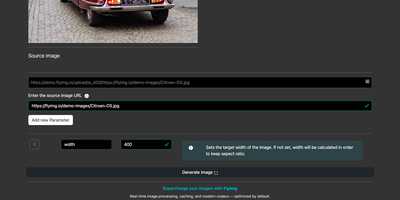
Flyimg generates every image size a website needs at request time, turning one original into resized, cropped, and compressed variants through a simple URL. Append options like width, height, crop, and quality to a request, and the service fetches the source image, transforms it, and serves the result, storing it in cache so the next request is answered instantly. Output defaults to AVIF for browsers that support it, with WebP and MozJPEG compression available for lean JPEG delivery, plus PNG and GIF when the source calls for them. Signed URLs keep strangers from using your server as a free image proxy, and domain restrictions limit which sources the service will fetch from. One Docker container gives a website or application a complete image pipeline: originals stay in whatever storage already holds them, and every thumbnail, banner, and product shot is produced at request time in exactly the dimensions the layout needs. Cache headers and repeat serving keep bandwidth costs predictable as traffic grows. Running on a dedicated VPS on RepoCloud with guaranteed CPU, RAM, and SSD, full root SSH access, and a browser serial console. AGPL-3.0 licensed.
Sora Frame
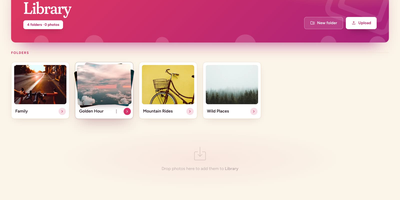
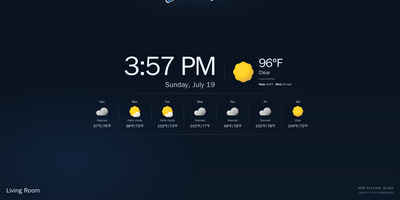
An old tablet on the shelf can show family photos all day once Sora Frame feeds it. The slideshow runs in any browser with soft cross-fades, a large clock, date, and weather widget, and it keeps the screen awake, even on iPads and phones. Install it to the home screen like an app, then pick what plays: every photo or a single folder, nested folders included. The library takes photos by drag and drop or the Upload button, builds folder covers from their own pictures, moves photos with a drag, deletes a multi-selection in one go, and offers an optional Google Photos import. JPEG, PNG, WebP, GIF, and iPhone HEIC files are accepted, and only a resized copy is stored. Notes slip a message like a visit reminder into the rotation, with up to four photos, a date range, an optional event countdown, and a choice of eight memory-book layouts. Each frame or family member gets a PIN limited to chosen folders, and a new frame pairs by scanning a QR code or opening an address that carries the PIN. The interface speaks English, Spanish, French, German, Portuguese, Italian, Dutch, Hindi, Japanese, Chinese, and Arabic, and keyboard shortcuts cover play, next, fullscreen, and photo info. A living room shelf, a grandparent's tablet, or an office desk display makes a fine home for it. Running on a dedicated VPS on RepoCloud with guaranteed CPU, RAM, and SSD, full root SSH access, and a browser serial console. AGPL-3.0 licensed.
Subarr
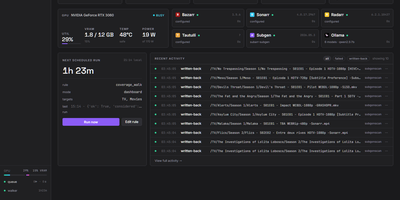
Subarr is the coordination, measurement, and quality layer for Whisper subtitle generation, sitting between Bazarr, Sonarr, Radarr, and subgen to decide what gets transcribed, in what order, and whether the result is any good. Its Coverage walk scans your whole library and scores every subtitle gap with a reason: no track, embedded-only, Bazarr-wanted, audio mislabeled, or low quality. Queue a file, a folder, or an entire series from the Library tab and watch it move through probing, transcribing, and write-back on the dashboard. The Review queue plays you the actual dialogue, picked out by voice-activity detection, so you can verify a subtitle really matches the audio language before it lands. It flags files whose default audio track is not the original language and swaps tracks in place, heading off the double-translation trap. A provider leaderboard records which subtitle sources actually deliver for your library, and the Tuning Lab lets you tune Whisper recipes against your own media. Rules and scheduled walks keep the work flowing, with Tautulli now-playing signals boosting whatever you are about to watch. Finished subtitles are written next to your media, and your Plex or Jellyfin library refreshes the moment one lands. Running on a dedicated VPS on RepoCloud with guaranteed CPU, RAM, and SSD, full root SSH access, and a browser serial console. MIT licensed.
Deadair
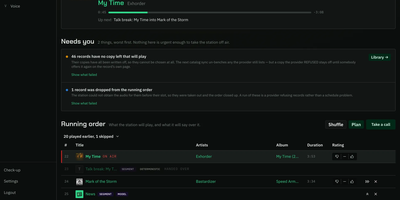
Somewhere in your house, a presenter is introducing the next record, and that presenter is a language model running on your own server. Deadair builds you a real radio station rather than another playlist: it picks records from your Navidrome, Jellyfin, Emby, or Plex library, or from Spotify, YouTube Music, Pandora, and Apple Music, writes what the host says between songs, speaks it in that host's own voice, and broadcasts the result as one shared live stream over Icecast, with no skip button and the same show for every listener. From the console you steer it in plain sentences: tell it "rap like Snoop Dogg" and the next hours programme themselves to that brief, or ask why the record on air was chosen and get an answer. The forward lineup runs several hours deep, visible and editable, and nothing reaches air until its audio is already on the machine, so the stream never stutters waiting on a download. Words and voice are separate choices, swapped live in Settings: break-writing can run on a hosted model while a local Kokoro or Chatterbox voice reads it, and a station with no model at all still talks. Twenty-seven bundled plugins cover music sources, metadata, news, weather, and speech, and third-party plugins install from the console. Running on a dedicated VPS on RepoCloud with guaranteed CPU, RAM, and SSD, full root SSH access, and a browser serial console. MIT licensed.
Piwigo
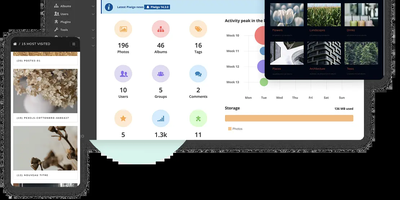
With over 3,800 GitHub stars and continuous development since 2002 spanning 24 years of active maintenance through version 16.4.0 released in May 2026, Piwigo has proven itself as one of the most battle-tested self-hosted photo gallery platforms available, trusted by professional photographers managing 150,000+ high-resolution images alongside small teams sharing event photos. The PHP backend with MySQL or MariaDB storage serves a responsive web interface that organizes photos into hierarchical albums with nested sub-albums, tag-based categorization, and smart albums generated dynamically from search criteria. Batch management tools handle bulk uploads, metadata editing, tag assignment, and album moves across thousands of images simultaneously. User permission controls define access at the album level with configurable public, private, and group-restricted visibility, while guest access allows public galleries without authentication. Image processing via ImageMagick or PHP GD generates multiple thumbnail sizes, watermarks, and responsive derivatives automatically. The plugin ecosystem with over 200 community-built extensions adds functionality from EXIF metadata display and GPS mapping to social sharing, download controls, and Lightroom synchronization for desktop workflow integration. The REST Web API with personal API key authentication enables programmatic album creation, photo uploads, and metadata queries from external applications. Mobile apps for iOS and Android provide on-the-go upload and browsing capability. Docker deployment via the official container or traditional LAMP installation on any hosting provider. Running on a dedicated VPS on RepoCloud with guaranteed CPU, RAM, and SSD, full root SSH access, and a browser serial console. GPL-2.0 licensed.
Flare
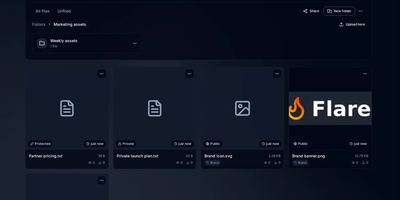
Screenshot, copy link, done: that is the loop Flare is built to make instant on your own server. Connect ShareX, Flameshot, KDE Spectacle, or a plain upload script once, and captures land in a vault you control instead of a third-party host that deletes them next month. Files live in folders with nested structure, bulk moves, automatic tagging rules, and one share link per folder, while previews handle images, video, PDFs, and syntax-highlighted code without downloading anything. Search digs through filenames, dates, and text extracted from images by OCR, so the screenshot from three weeks ago is findable by what it says. Password-protect a sensitive file, keep another private entirely, or publish it with a rich embed that unfurls properly wherever you paste the link. An appearance studio restyles branding, color palettes, and share page layouts, upload profiles carry reusable defaults between browser and screenshot tools, and the extras round out the kit: a URL shortener with click tracking, a pastebin, storage quotas, invite links, and tokens with signed webhooks for your own integrations. Running on a dedicated VPS on RepoCloud with guaranteed CPU, RAM, and SSD, full root SSH access, and a browser serial console. MIT licensed.
Comigo
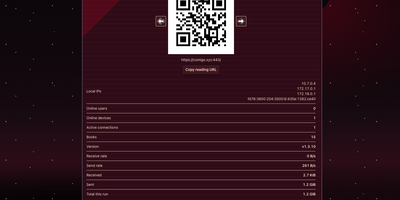
Your comic and manga collection becomes one tidy library with Comigo, readable in any browser on any device in the house. Point it at a folder and it indexes image folders plus zip, rar, tar, cbz, cbr, and epub archives, then serves pages in scroll or page-turning layouts. Pages arrive cropped and compressed for the screen in front of you, and modern heic and avif files read beside plain jpg and png. A QR code on the server screen brings phones and tablets straight into the same library, and reading position follows you between devices mid-chapter. Your history is tracked automatically, so a series paused last month reopens at the exact page where you stopped. The built-in player handles audio and video stored beside your books, which covers drama CDs and anime extras in the same shelves. Plugins add automatic page turning and an on-screen clock, and you can write your own to change how reading sessions behave. Libraries can live on another Comigo server across the network, whole image folders download in batches, and epub files convert for dedicated e-readers. The offline mode reads archives directly inside the browser with nothing uploaded, which suits borrowed machines and locked-down networks. Running on a dedicated VPS on RepoCloud with guaranteed CPU, RAM, and SSD, full root SSH access, and a browser serial console. MIT licensed.
RelayTV
Your couch becomes the control room with RelayTV, a self-hosted media hub that runs on the Linux box plugged into your TV. Connect Plex, Jellyfin, or Emby once, then search films, open a series, pick an episode, resume where you stopped, or drop the pick into the shared queue. Paste a web video link to play it on the big screen, or queue an entire YouTube playlist of up to a thousand videos in order without pausing tonight's movie. The TV idles on a dashboard with a QR code, and anyone in the room scans it to join the same remote, browse, and add picks to the queue. Add M3U playlists to build a My Channels lineup, pin favorites to the top, rewind inside the buffered window when you miss a line, and jump straight back to live. Playback, queue advancement, history, and overlays all run on the box itself, so the TV keeps playing after your phone leaves the page. Every screen appears in Home Assistant as a media player, and the local HTTP API takes play, queue, overlay, and snapshot calls from scripts and dashboards. A second RelayTV in the bedroom can receive the active queue from the living room, and the optional API token locks control down on shared networks. Running on a dedicated VPS on RepoCloud with guaranteed CPU, RAM, and SSD, full root SSH access, and a browser serial console. GPL-3.0 licensed.
Meridian
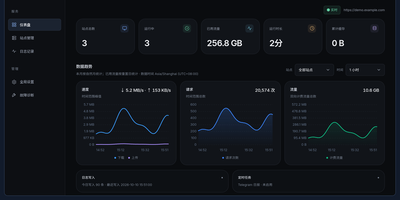
Meridian puts all of your Emby reverse proxy sites, playback routes, and day to day operations into one clean management panel instead of a pile of hand-written proxy configs. Each Emby site gets its own entry through a path, a dedicated port, or a subdomain, with primary and backup routes that switch automatically when one goes down. Three playback modes let video stream directly to clients while logins, posters, and API calls continue through the proxy, so bandwidth lands where it should. Accounts for each site are stored with passwords and expiry dates, renewal reminders arrive ahead of time, and account details can be imported or exported as JSON and CSV. Traffic trends, per-site quotas, rate limits, and static resource caching keep busy sites under control, while log filtering and connection diagnostics show exactly where a request went wrong. Certificates are handled through Cloudflare wildcard issuance and renewal, or by uploading your own, and encrypted backups protect the whole configuration. Routine administration can even happen from Telegram, checking daily reports, adding or pausing sites, and renewing accounts from chat. The whole panel runs as one small program with a built-in database and works comfortably from a phone. Running on a dedicated VPS on RepoCloud with guaranteed CPU, RAM, and SSD, full root SSH access, and a browser serial console. MIT licensed.
Mularr
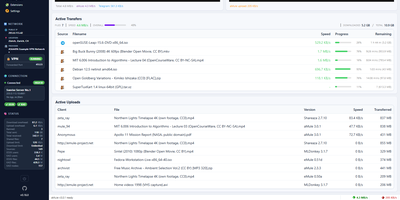
Classic eD2k and Kad downloading gets a browser interface with the look of Windows XP, Windows Classic, a clean modern dashboard, or green-on-black Hacker mode. Mularr wraps an aMule daemon and shows live download and upload graphs, active transfers with progress and remaining time, and the uploads other clients are pulling. Transfers can be started, paused, stopped, categorized, and bulk imported from ED2K links. Servers, search, shared files, categories, and extensions each get their own page. For automation it presents itself as a qBittorrent download client and a Torznab indexer, so Sonarr and Radarr can use it with their standard settings. Extensions for Sonarr and Radarr read the Wanted list and publish matches into a feed the apps can poll. Telegram can act as an extra download provider and notification channel, and Hispashare releases appear in search results next to aMule's. A VPN panel reports Gluetun health and the forwarded port, and the settings page covers ports, bandwidth limits, IP filters, a blacklist, and shared folders. One container image and a single data volume are enough to get started. Running on a dedicated VPS on RepoCloud with guaranteed CPU, RAM, and SSD, full root SSH access, and a browser serial console. MIT licensed.
Supysonic
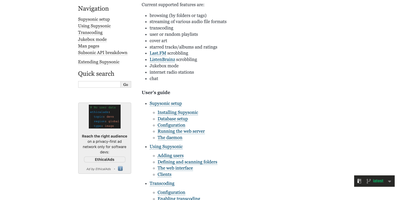
Supysonic streams a music library you own to the whole ecosystem of Subsonic clients, from phone apps to desktop and car players, from one Python server. Point it at your folders and it indexes artists, albums, and tracks, browsable by the folder layout on disk or by the tags written into the files. Streams adapt as they play, with lossless collections transcoded down for mobile data and the original files untouched on the server. Star favorites, rate albums, build playlists by hand, or let the server deal a random one for the drive. Cover art travels with the music, internet radio stations join the library, and jukebox playback plus a simple chat serve the whole household. Every play can scrobble to Last.fm and ListenBrainz, keeping a listening history that belongs to you across services. A command-line tool manages users, folders, and scans, and an optional watcher daemon notices new files the moment they land in the library. Running on a dedicated VPS on RepoCloud with guaranteed CPU, RAM, and SSD, full root SSH access, and a browser serial console. AGPL-3.0 licensed.
Reloops
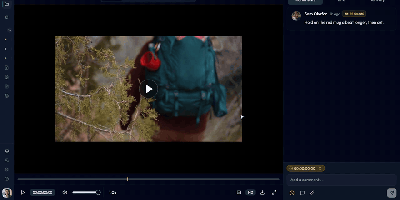
Reloops is a self-hosted creative asset workspace where teams keep every video, design, PDF, audio file, and live website in one library and collect feedback on the files themselves instead of in scattered email threads. Reviewers click anywhere on an image to pin a note to that exact spot, and on video the comments attach to the precise frame, so "fix this bit" always points at the bit in question. Every upload becomes a new version on the same asset, older cuts stay available for side-by-side comparison, and approvals are recorded on the file so nobody ships the wrong export by accident. Clients never need an account: send them a share link or a branded collection and they can watch, comment, and sign off as guests. The library searches the way people remember work, because each asset carries generated descriptions, tags, and metadata filters, so "the approved homepage with the blue button" actually finds something. Day to day, assignments and review queues keep feedback moving, while scoped API keys let agents such as Claude, OpenClaw, Zapier, and n8n upload new versions, post comments, update statuses, and manage share links inside the same workspace. Running on a dedicated VPS on RepoCloud with guaranteed CPU, RAM, and SSD, full root SSH access, and a browser serial console. AGPL-3.0 licensed.
NeXroll
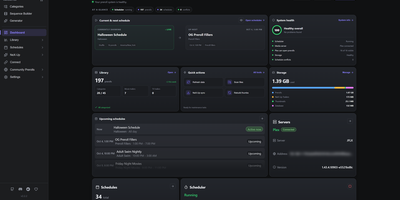
Give movie night a proper cinema preshow: NeXroll plays intros, trailers, and custom welcome screens before the feature on Plex, Jellyfin, and Emby. Build sequences in a list or a visual Flow view, with branches that pick a fallback when no trailer is available and rules for time of day, age rating, genre, or audio format. Schedules rotate the lineup automatically, with holiday themes, special event dates, priorities, and filler between them, all visible in month, week, and day calendars. Import your own videos, preview them, tag them, and sort them into categories, then pull in more from a community collection filtered by creator or platform. NeX-Up fetches upcoming movie and TV trailers through Radarr and Sonarr, and Library Trailers replays trailers for films you already own. Generator Studio makes welcome videos, announcements, QR code screens, and Coming Soon clips from your own text, logo, backdrop, and soundtrack, with a live preview. Connect several media servers to one install, switch among eight themes, back up and restore settings, and automate with the External API. Running on a dedicated VPS on RepoCloud with guaranteed CPU, RAM, and SSD, full root SSH access, and a browser serial console. MIT licensed.
SyncWatch
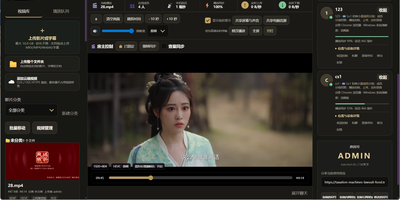
Movie night should not depend on everyone pressing play at the same second; SyncWatch runs your own watch-party server so friends in different places watch the same frame together. The host controls play, pause, seeking, and playback speed for the whole room, and late joiners or drifting clients are corrected back to the shared position automatically. You build the program from uploads or direct HTTPS media links, with subtitles, audio, images, and documents handled in the same library. Rooms can be permanent or temporary, protected by passwords and member limits, with host, admin, and permission-group control over who may operate playback. Between scenes, people talk through public and private chat, on-screen danmaku comments, emoji, voice messages, or full-room voice. Anyone can share a browser tab, window, desktop, or phone screen into the room, so a clip, a game, or a presentation becomes the shared screen. The server also keeps friends, notifications, online presence, bans, registration approvals, and an operations log, so a private community can run itself without a platform account. Uploaded media is analyzed and thumbnailed automatically, with browser-compatible versions generated for awkward formats. Backups, data export, a recycle bin, mail verification, and network diagnostics round out the admin side. Running on a dedicated VPS on RepoCloud with guaranteed CPU, RAM, and SSD, full root SSH access, and a browser serial console. Apache-2.0 licensed.
Minimax Music UI
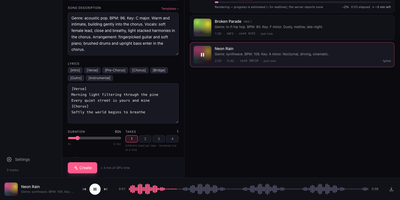
Minimax Music UI turns a self-hosted MiniMax-Music3 model into a private song factory, giving you a Suno-style studio where you describe a track, add lyrics, and watch finished songs appear in your own library. The Create panel works in Simple or Custom mode: write a style description covering genre, BPM, key, vocals, and arrangement, then shape words in a lyrics editor with one-tap [Verse], [Chorus], [Bridge], and [Instrumental] section chips. One submit can queue up to four takes at 5 to 360 seconds each, and the render queue shows queued, rendering, and done states with elapsed time, cancel, and retry, surviving a server restart without losing your place. When you run the bundled inference server, you can even press play on a track that is still rendering and hear the waveform grow in real time. A magic wand rewrites rough ideas into structured music captions, and a second wand drafts original lyrics sized to your chosen duration, both through any OpenAI-compatible model you point it at. Finished renders land in a searchable library with cover art, seeds, and render times, ready to download as WAV, reuse as a template, or open in a detail panel with the prompt and lyrics. A sticky waveform player with seek and keyboard shortcuts keeps music going while you work, and an optional access token locks the whole studio down. Running on a dedicated VPS on RepoCloud with guaranteed CPU, RAM, and SSD, full root SSH access, and a browser serial console. MIT licensed.
Music Player
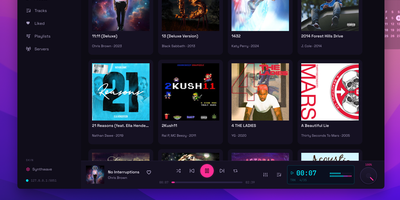
One binary scans your music folder and turns it into a server you can browse, search, and play from anywhere on your network. Start it and the daemon serves gRPC on port 5051, WebSocket events on 5052, and the web UI plus GraphQL on 5053. Later invocations detect the running daemon and act as clients, so the same command drives playback from a second terminal. Search lands instantly because tracks, albums, and artists sit in SQLite FTS5 tables kept current by database triggers. Playback handles more than 40 formats, from FLAC and Opus to WavPack, APE, and chiptunes, with EQ presets, crossfade, and ReplayGain. Browse and stream libraries hosted on Subsonic, Navidrome, and Jellyfin servers beside your own files. Cast to Chromecast and UPnP or DLNA renderers, or control another Music Player daemon as the output. Internet radio search covers Radio Browser and TuneIn stations, with bookmarks and a fullscreen now-playing view. Chromaprint fingerprints name badly tagged files from AcoustID and MusicBrainz data. Import Spotify, Last.fm, and Rocksky history into DuckDB analytics and ask about sessions, skips, and taste drift. Scrobble plays to Rocksky, sync radio bookmarks through the AT Protocol, and pick skins in the browser, desktop, or terminal interface. Running on a dedicated VPS on RepoCloud with guaranteed CPU, RAM, and SSD, full root SSH access, and a browser serial console. MIT licensed.
XianScan
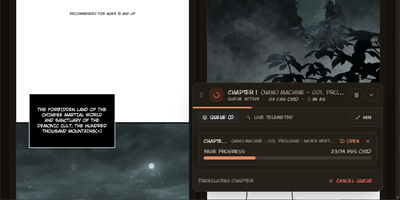
Reading a new manhwa chapter on release day usually means waiting for a scanlation group, or pasting panels into three tools yourself. XianScan collapses that whole relay into one server: point its browser extension at a chapter on a reader site and it captures every page, or drop raw pages into the studio and let the pipeline run. Speech bubbles, captions and sound effects are detected automatically, the text inside them is read by OCR supporting ten languages in vertical and horizontal layouts, and tall webtoon strips are resliced along natural panel gutters so no bubble is ever cut in half. Translation keeps a sliding memory of previous pages so speakers, pronouns and story topics stay consistent, while terminology glossaries lock character names and cultivation terms across an entire series. The original lettering is then removed by neural inpainting that rebuilds the artwork underneath, and the translation is typeset back into the bubbles with computed font sizes, line breaks and per-script fonts, including right-to-left scripts and accent fonts for attack names. Inspect OCR boxes and confidence scores, fix text before saving, then read in the web studio or stream chapters to the Mihon app on your phone. Local models through Ollama or LM Studio keep everything offline, or plug in Gemini, OpenAI, Groq or OpenRouter keys when you prefer the cloud. Running on a dedicated VPS on RepoCloud with guaranteed CPU, RAM, and SSD, full root SSH access, and a browser serial console. MIT licensed.
Openinary
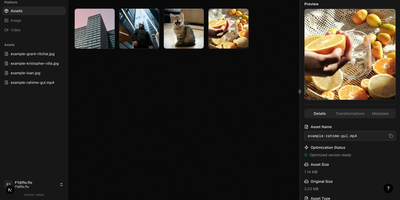
Your product photos, tutorial clips, and user uploads can live on your own server with Openinary, a media platform that resizes, crops, converts, and delivers images and videos through simple URL parameters. Request a variant by editing the address: set width and height, fill-crop around a detected face, convert to AVIF or WebP, trim a video between two timestamps, or pull a thumbnail from the fifth second. Uploads land in S3-compatible storage you control, from AWS S3 and Cloudflare R2 to MinIO, and repeat requests are served from automatic caching instead of reprocessing the original. The admin dashboard keeps assets organized for browsing, searching, and reviewing what your applications actually serve. API keys gate programmatic uploads, so a web app, mobile backend, or build script can publish media without sharing storage credentials. Setup runs through a scaffolding command that writes the Compose file and environment, then walks you through creating the first admin account. Teams escaping per-transformation pricing keep the same URL workflow their code already uses and move the bill to a fixed server. Running on a dedicated VPS on RepoCloud with guaranteed CPU, RAM, and SSD, full root SSH access, and a browser serial console. AGPL-3.0 licensed.