AbanteCart
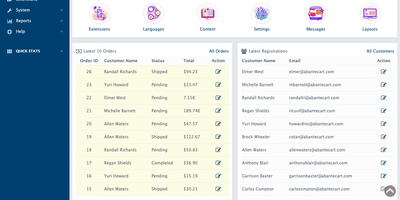
Selling online without a platform skimming every order is the idea behind AbanteCart, a free self-hosted shopping cart that ships with a storefront and a full back office. Products carry unlimited options and attributes with stock tracked per combination, plus image galleries, videos, digital downloads, reviews with approval, wishlists, and spreadsheet import and export for bulk updates. One admin can run several stores, each with its own theme, catalog, and payment methods, and a visual layout manager places blocks on each page from the admin. Checkout handles guest orders, coupons, quantity discounts, store credits, multiple languages and currencies, and more than twenty payment gateways, with live shipping rates from USPS, UPS, and FedEx. A built-in CMS and blog, a forms manager, an email template editor, scheduled banners, SEO-friendly URLs, and a content vault that restores earlier versions of descriptions round out the toolkit. Marketplace extensions add payments, tax automation, and more. Boutiques, digital goods sellers, and agencies managing client shops can all start selling from a single install. Running on a dedicated VPS on RepoCloud with guaranteed CPU, RAM, and SSD, full root SSH access, and a browser serial console. OSL-3.0 licensed.
Tagvico
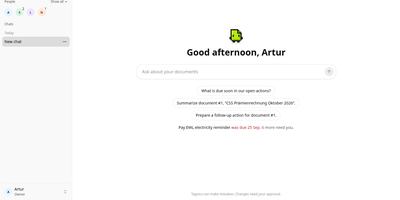
Paperless-ngx files the document; Tagvico, its companion, makes sure someone acts on it, turning letters, bills, and renewals into deadlines the whole household can see. A tax letter in the archive can become an Action Case. The case carries an owner, a due date, a priority, and up to 100 checklist steps. Needs you collects everything overdue, due this week, or due later in one list. Approvals and review items wait there too. Each family member has a profile page and a role that limits what they can approve. Ask the chat about your archive and it cites the documents behind every answer. Anything it wants to change, from a tag to a case, arrives as a proposal. An adult or the owner presses Approve, and the decision enters an audit trail. Run it on a ChatGPT Plus or Pro plan with no API key, or bring OpenAI, OpenRouter, Ollama, or any compatible endpoint. Relatives on Telegram or Discord can search, upload scans, and, if they are adults, approve from a phone. Each uses a personal Paperless token, so permissions stay with Paperless. Deadline reminders arrive once a day. New documents can also get suggested titles, tags, and dates in a review queue, with snapshots that restore the original metadata. Running on a dedicated VPS on RepoCloud with guaranteed CPU, RAM, and SSD, full root SSH access, and a browser serial console. MIT licensed.
db-ui
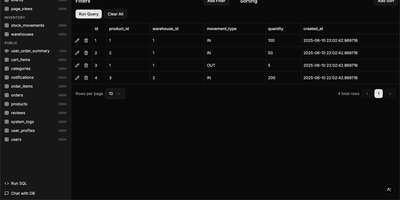
Traditional database management tools like pgAdmin and phpMyAdmin were built for DBAs, not for the rest of the team that just needs to look up a record or run a quick query. db-ui strips away the complexity and gives you a clean, modern interface that anyone can use. Browse tables in a paginated grid view with inline editing, filtering, and sorting built right into the column headers. The sidebar lists every table and view across all schemas with fuzzy search (Cmd+K to focus) that filters results as you type. Click any table to see its data, or switch to the schema introspection view to visualize columns, types, constraints, and relationships without writing a single query. The SQL editor provides syntax highlighting, result visualization in tabular format, and one-click CSV export for downstream analysis. For questions about your data model, the integrated AI chat assistant has full access to your database schema and can help you understand table relationships, write complex queries, suggest indexes, and provide optimization recommendations with streaming responses. Connect to PostgreSQL, MySQL, or Microsoft SQL Server through environment variables and deploy the whole application as a single Docker container. On RepoCloud, deploy db-ui on a dedicated VPS with root SSH access and direct connectivity to your database servers under the MIT license.
AI Inbox Agent
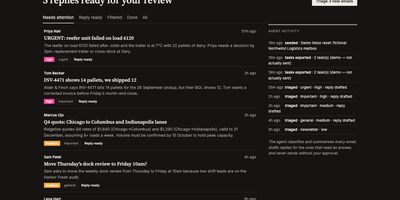
You open the inbox and AI Inbox Agent has already done the first pass: the mail sorted and summarized, and a draft in your voice waiting wherever an answer is needed. Unread Gmail lands in one of six categories, urgent through spam, with a priority, a confidence score, and a one-line reason, and phishing is flagged instead of answered. Summaries come with key points, action items with deadlines, and the sender's sentiment. Drafts come from your own history: the agent finds the closest past replies, borrows their tone, and lists the ones it used. Nothing leaves without your yes. Approve it, edit it, skip it, or type a plain-words note like "shorter, and confirm we'll cover the cost" for a rewrite. Approved replies join the examples, so drafts drift closer to how you write. Action items go to Google Tasks, Notion, or Todoist through n8n or any webhook, high-priority ones automatically and the rest in one click. High-priority threads return the next day and medium ones after a few days, with Done and Snooze. A morning digest lists what to act on first, and a stats page estimates the minutes saved. Rules decide which categories earn drafts and whether approval stays required. Bring a key for Anthropic, OpenAI, Gemini, or DeepSeek, or try the recorded demo mailbox first. Running on a dedicated VPS on RepoCloud with guaranteed CPU, RAM, and SSD, full root SSH access, and a browser serial console. MIT licensed.
Fullstack CRM
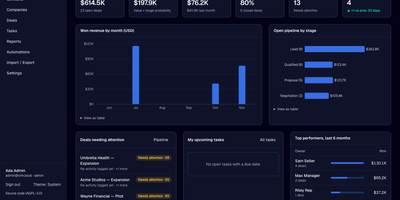
Deals slip when nobody notices a missed close date or an empty next step, so this CRM prints the reason on each open deal and keeps its AI assistant on a short leash. Contacts and companies link to deals on a drag-and-drop Kanban board, where stage probabilities feed a weighted forecast. The dashboard adds open pipeline, win rate, overdue tasks, and top performers, and reports split results by owner and lead source. Automation rules fire when a deal is won or a contact is created, adding a task, emailing the contact, or changing a status. Admins manage users and webhooks, managers see every record, and reps see only their own, in the interface, the REST API, and exports. Ctrl+K jumps to any record. Saved views and bulk actions keep long lists manageable, tagging, reassigning, or deleting many records at once. With an Anthropic key set, the assistant answers questions about overdue work, drafts follow-up emails, and summarizes a deal's timeline, but it can only propose changes, and nothing runs until the signed-in user approves it. Two-factor sign-in with recovery codes, a field-level audit trail, and HMAC-signed webhooks suit teams that must show who changed what. CSV import reports errors row by row, and per-user API keys script the rest. Running on a dedicated VPS on RepoCloud with guaranteed CPU, RAM, and SSD, full root SSH access, and a browser serial console. AGPL-3.0 licensed.
Forgejo
Governed by the non-profit Codeberg e.V. with over 150 contributors and quarterly major releases reaching v16.0 in July 2026, Forgejo delivers a complete code collaboration platform in a single Go binary that runs comfortably on 512 MB of RAM — providing full Git hosting with SSH and HTTPS, pull requests with inline code review, issue tracking with labels and milestones, kanban project boards, wikis, and an integrated package registry supporting Docker, npm, PyPI, Maven, NuGet, and Cargo. Forgejo Actions provides GitHub Actions-compatible CI/CD with reusable workflows, OpenID Connect for secure third-party access, ephemeral runners for autoscaling, and dynamic matrix support for complex build pipelines. The platform implements ActivityPub-based forge federation allowing issues, pull requests, and stars to work across independent instances — enabling a decentralized development ecosystem similar to how Mastodon federates social networks. Organizations and team permissions provide fine-grained access control, while LDAP, OAuth2, and OpenID authentication integrate with existing identity infrastructure. Code search indexes repositories for fast discovery, LFS handles large files efficiently, and mirror synchronization imports repositories from GitHub, GitLab, and other forges. Deploy via a single static binary, Docker container, or official Helm charts with SQLite for small instances or PostgreSQL and MySQL for production workloads. Running on a dedicated VPS on RepoCloud with guaranteed CPU, RAM, and SSD, full root SSH access, and a browser serial console. GPLv3+ licensed.