Ferron
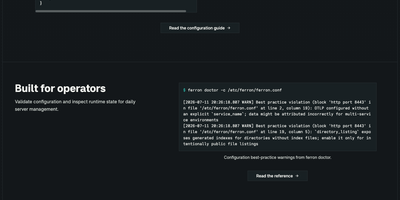
Ferron is a web server and reverse proxy that serves your sites and applications with automatic HTTPS, a configuration file you can read at a glance, and logs that explain exactly why a request failed. Declare a hostname with a root directive and it serves files from disk; swap in a proxy directive and the same block forwards traffic to your application on localhost, with PHP handled through one fcgi_php line to PHP-FPM. Every public hostname receives a TLS certificate automatically, issued and renewed without certificate paths or renewal scripts in your config. The differentiator is debugging: each request carries a trace ID printed in the access log, repeated in the error log lines it generates, and returned to the client inside JSON error responses, so one grep reconstructs the whole failure. The ferron doctor command validates a configuration before you reload it, pointing at the file, line, and column of each mistake and flagging violations like an overexposed directory listing. Its admin API answers /config and /status queries with live running state, and metrics and traces flow to Grafana or any OpenTelemetry collector through OTLP. Reverse proxying spreads requests across backend upstreams with health awareness and circuit breaker events you can watch live. HTTP/2 and HTTP/3 are on by default, and there are no worker counts or pool sizes waiting to be tuned. Running on a dedicated VPS on RepoCloud with guaranteed CPU, RAM, and SSD, full root SSH access, and a browser serial console. MIT licensed.
mitmproxy
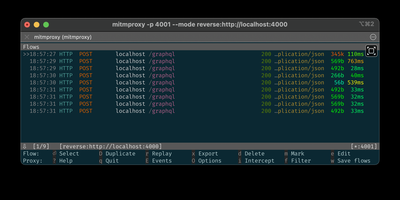
A man-in-the-middle proxy you run on purpose, mitmproxy lets developers and testers inspect, edit, and replay HTTP and HTTPS traffic from any client. Point a browser, phone, or script at it and every HTTP/1, HTTP/2, HTTP/3, WebSocket, and TLS-protected connection appears as a flow you can open, search, and filter. Content views turn payloads from HTML to Protobuf into readable text. Intercept a request or response before it moves on, change its headers, body, or status by hand, then release it, or save the flow and replay it to the client or the server later. Map local and map remote rules answer requests with files or other URLs, while blocklists, anticache, sticky cookies, and proxy authentication cover routine test chores. Choose the interface that fits the job: a keyboard-driven terminal console, mitmweb in the browser with a Capture tab that sets up WireGuard devices with a QR code, or mitmdump for unattended logging in scripts. Proxy modes include regular, local capture, WireGuard, transparent, reverse, upstream, SOCKS5, and DNS. Addons written in Python add custom rewriting, recording, and automation. Teams use it for debugging, testing, privacy measurements, and penetration testing. Running on a dedicated VPS on RepoCloud with guaranteed CPU, RAM, and SSD, full root SSH access, and a browser serial console. MIT licensed.