DevTrack
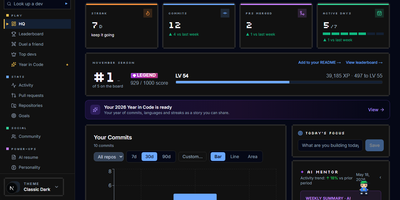
DevTrack turns your GitHub activity into a living dashboard of commit streaks, pull-request analytics, and goals that quietly update themselves. Sign in with GitHub and your last year appears as a contribution heatmap you can filter by repository and language, next to the streak you are protecting and the freeze you are saving for a holiday. Pull requests get the honest treatment: merge rate, average review time, and open-versus-closed breakdowns that show whether reviews or authors are the bottleneck. Weekly and monthly goals fill themselves in from live activity, while the consistency score and activity rings tell you whether your rhythm is steady or heroic but rare. When you want the story told back to you, an AI mentor who knows your history offers guidance, a résumé generator builds an ATS-friendly CV from merged pull requests for the role you name, and a weekly summary explains your own graphs in plain words. Opt into the public leaderboard to rank your streak, commits, and PRs against other developers, or keep everything private and share only the profile page and embeddable badges you choose. Running on a dedicated VPS on RepoCloud with guaranteed CPU, RAM, and SSD, full root SSH access, and a browser serial console. MIT licensed.
Gitea
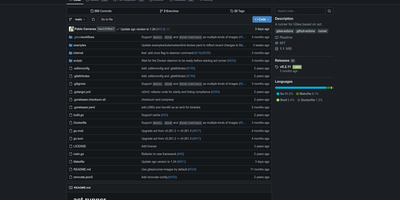
With over 57,000 GitHub stars and deployment across thousands of organizations worldwide, Gitea is the most popular self-hosted Git service, delivering a complete software development platform in a single Go binary that runs on as little as 512MB of RAM. The platform provides full repository management with pull requests featuring inline code review, branch protection rules, merge strategies including squash, rebase, and merge commit, and automated status checks through Gitea Actions. The built-in CI/CD system uses the same YAML workflow syntax as GitHub Actions and can directly reuse over 20,000 existing Actions plugins, allowing teams to migrate from GitHub with minimal pipeline rewrites using the open-source act_runner executor. The integrated package registry supports over 20 formats including npm, PyPI, Maven, NuGet, Cargo, Helm, Composer, Conda, RubyGems, Pub, and an OCI-compatible Container registry for Docker images with no additional configuration required. Project management features include issue tracking with labels, milestones, dependencies, and time tracking, alongside kanban project boards for visual workflow management. Gitea supports LFS for large file storage, built-in wiki pages per repository, webhook integrations with Slack, Discord, Telegram, Microsoft Teams, and custom HTTP endpoints, and OAuth2 authentication with LDAP, SAML, and PAM backend support. Repository mirroring enables bidirectional synchronization with GitHub, GitLab, and Bitbucket, while the comprehensive REST and GraphQL APIs power external integrations and the official tea CLI tool. Running on a dedicated VPS on RepoCloud with guaranteed CPU, RAM, and SSD, full root SSH access, and a browser serial console. MIT licensed.
OneDev
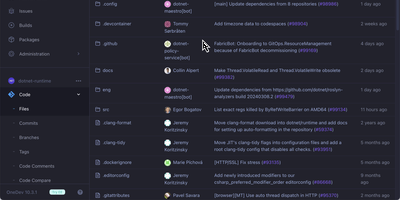
With over 15,100 GitHub stars and seven years of battle-tested production use, OneDev replaces entire DevOps toolchains — GitLab, Jenkins, Jira, Artifactory — with a single Java application that runs comfortably on a 1-core 2GB server for medium-sized projects. The platform unifies Git hosting with ANTLR-powered language-aware code search and symbol navigation, pull request workflows with configurable branch protection rules and required reviewers, and customizable issue tracking with scripted state transitions that automatically advance issues when code is committed, builds pass, or deployments complete. The GUI-based CI/CD editor creates pipelines without writing YAML, supporting typed parameters, matrix builds, job templates, cache management, and artifact publishing in a single visual interface. Jobs execute via Docker containers, bare metal shell, Kubernetes pods, or distributed agent pools, with web terminal access for live debugging and the ability to pause running jobs for inspection. Built-in package registries handle Docker images, npm packages, Maven artifacts, NuGet libraries, PyPI wheels, and RubyGems without external infrastructure. AI users can be assigned to issues and pull requests to autonomously implement features, review code, fix CI/CD failures, and resolve merge conflicts. The automated Kanban board supports rule-based card movement, time tracking, timesheets, and service desk ticket creation via email. Cluster deployment enables project replication across servers for high availability and horizontal distribution for scalability. Running on a dedicated VPS on RepoCloud with guaranteed CPU, RAM, and SSD, full root SSH access, and a browser serial console. MIT licensed.
Otter Wiki
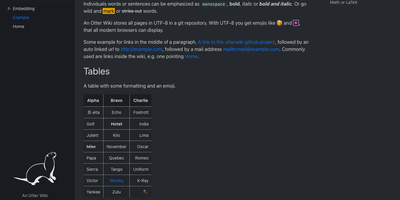
Every page in Otter Wiki is a plain Markdown file and every save is a git commit, so a small team gets a simple wiki whose history never goes missing. The editor highlights Markdown as you type, offers a toolbar for headings, lists, tables, code, alerts, and images, and can show a live preview beside the source. Paste or drop an image into the editor and it is stored as a page attachment. History, blame, and changelog views, with RSS and Atom feeds, show who changed what and when. Beyond standard Markdown you get footnotes, task lists, math formulas, Mermaid diagrams, alert boxes, and spoiler or folded blocks, plus experimental embeddings such as sortable data tables, info boxes, image frames, videos, and included pages. A customizable sidebar shows a menu, a page index, or both. Search offers case-sensitive and regular expression options. Dark mode is built in. Admins decide whether anonymous visitors, registered users, or approved users may read, write, or upload, grant rights per user, close registration, or require email confirmation. An optional, experimental git web server lets people clone, pull, and push the wiki, and changes can be pushed to or pulled from a remote repository over SSH. Running on a dedicated VPS on RepoCloud with guaranteed CPU, RAM, and SSD, full root SSH access, and a browser serial console. MIT licensed.
Pi Pocket
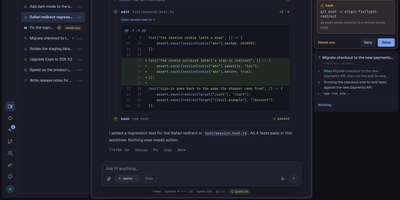
Pi Pocket puts the Pi coding agent in your phone browser, so you can start, steer, and review real coding sessions from anywhere while the work stays on your own server. Open a folder, a fresh Git worktree, or a GitHub repository, pick a model per session, and watch streamed replies with tool calls, queued follow ups, and a stop button when a run wanders. Sessions survive crashes and restarts because every model call, tool call, and subagent step is stored as it happens, and forks let you retry any reply with a different model on another branch. Invite teammates into a live session with presence, roles, and a side chat the agent never sees, or let PiP, the built in assistant, follow your other sessions and report back. GitHub watches and webhooks wake the agent when pull requests, issues, or workflows change, while scheduled messages and cron style goals keep routine work moving overnight. Spend views show cost per person and per session, and owner set limits pause new work instead of quietly burning budget. On a phone you get push notifications, dictation, share sheet intake, and a home screen app, and live reloadable extensions add routes, modules, and commands without a build step. Running on a dedicated VPS on RepoCloud with guaranteed CPU, RAM, and SSD, full root SSH access, and a browser serial console. MIT licensed.
CodeFever
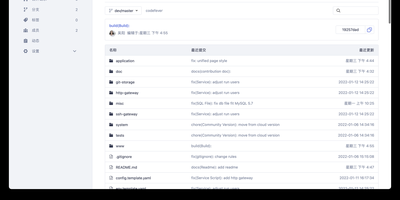
Your team's code lives on someone else's server, under someone else's terms, until you decide it should not. CodeFever is a fully open-source, self-hosted Git hosting service that gives a small team unlimited repositories, branches and tags, merge requests, and branch protection on hardware as modest as one CPU core and a gigabyte of memory. Developers browse code with highlighted version comparisons, review changes through merge requests, and organize work with repository groups, member roles, and per-member permissions. Protected branches keep important history safe and make review the normal path to main, and webhooks connect pushes and merges to the other systems your team already runs. A super-admin backend manages every project and user on the instance, and the interface speaks Chinese and English natively. Installation is a single Docker command, updates preserve your data, and there are no repository counts, seat limits, or paid tiers waiting downstream. It suits a studio keeping client work private, a lab sharing models and notebooks, or a company that wants its source behind its own firewall. Running on a dedicated VPS on RepoCloud with guaranteed CPU, RAM, and SSD, full root SSH access, and a browser serial console. MIT licensed.
Zoomies
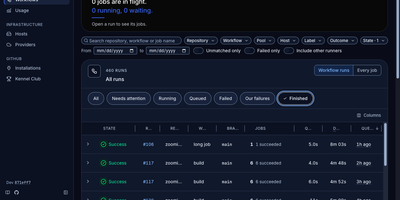
Zoomies converts servers you already own into an ephemeral GitHub Actions runner fleet, creating a clean runner for every queued job and destroying it the moment that job ends. Why rent CI minutes by the second while those machines sit idle? Point it at a GitHub organisation or a repository on a personal account and it watches for queued work through workflow_job webhooks, with polling as a fallback, then provisions capacity only on hosts matching the labels your workflow requested. One controller drives any number of agents across Ubuntu, Debian, Fedora, and Rocky Linux on amd64 and arm64, and agents connect outbound only, so a host behind NAT needs no inbound firewall rule. Registration needs no pasted tokens: Zoomies signs in as a GitHub App and mints single-use just-in-time runner registrations itself. Busy runners can borrow idle CPU and memory from quieter neighbours under rules you set. The live web UI shows pools, jobs, queue waits, and streaming logs in place, with a command palette for jumping anywhere and an audit row recorded for every change. Nightly backups seal themselves with your passphrase and ship to S3-compatible storage, restores are staged from the same tab, and you can ask the built-in assistant about your builds or connect your own tools through MCP. Running on a dedicated VPS on RepoCloud with guaranteed CPU, RAM, and SSD, full root SSH access, and a browser serial console. AGPL-3.0 licensed.
Codra
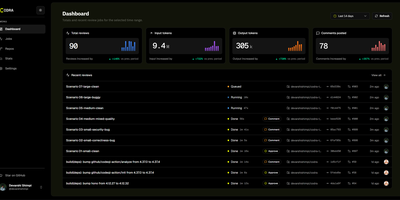
Your GitHub pull requests get reviewed by your own models, with inline findings posted in the merge flow: Codra is a self-hosted AI code review engine, so your diffs and credentials stay inside infrastructure you control. Connect a repository once and every opened, synchronized, ready-for-review, or reopened pull request starts a queued review job automatically; mention Codra for an on-demand pass instead. Findings arrive as inline GitHub comments, a summary review, and check run updates that fit the normal merge flow. Each repository gets its own review personality: triggers, skipped paths, draft handling, mention reviews, labels, custom rules, and a review budget are all tuned from the dashboard, and model routing follows global defaults, per-repository chains, fallbacks, and size-based overrides for larger pull requests. Providers from OpenAI, OpenRouter, Anthropic, Google, NVIDIA, and Cloudflare are managed behind GitHub OAuth sign-in. The operator dashboard tracks totals for reviews, input and output tokens, and comments posted, then drills into job history, webhook deliveries, failed queue runs, and model usage, so a stalled review is debuggable instead of invisible. Deploy the whole loop (GitHub App, web server, queue, database, and dashboard) on Cloudflare Workers, on Node.js 24, or with Docker on your own server. Running on a dedicated VPS on RepoCloud with guaranteed CPU, RAM, and SSD, full root SSH access, and a browser serial console. AGPL-3.0 licensed.
Happier
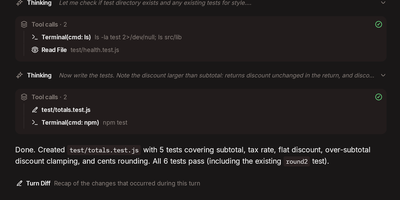
When a dozen coding agents are running at once, Happier puts every session in one list and lifts the ones waiting on you to the top. Sessions that need a decision gather under Needs attention and running ones sit under Working, so nothing stalls unseen. Start Claude Code, Codex, OpenCode, Pi, Cursor, Gemini, Copilot, Qwen, Kimi, Auggie, Kilo, Kiro, or Grok on any computer you have connected, or add a custom ACP backend for another agent CLI. Switch the agent mid-session, let Claude hand a review to Codex as a subagent, and move a live Claude Code or OpenCode session to another machine. Read the tool-call timeline, review the diff, mark exact lines, and send those notes back to the same session or a fresh one. Stage, commit, push, and open pull requests from the Git panel, or give each session its own worktree. Queue messages, steer a running turn, edit files, open a terminal, or dictate to the voice assistant. Pool several accounts so work continues when one hits a usage limit, and watch five-hour and weekly quotas reset. Share a session view-only, with edit rights, or as a public link. Content is end-to-end encrypted by default, and the relay serves the web app, so any browser can reach it. Running on a dedicated VPS on RepoCloud with guaranteed CPU, RAM, and SSD, full root SSH access, and a browser serial console. MIT licensed.
Jean
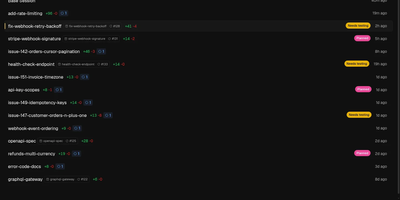
On your own server, Jean runs a team of AI coding agents, each in its own git worktree, and lets you steer them all from a browser tab. Every task starts from real context: a GitHub issue, pull request, workflow run, Dependabot alert, security advisory, Linear ticket, Sentry error, or a plain prompt. Jean creates an isolated worktree with its own chat sessions, terminal, and diff, so several agents can edit one repository without colliding. Choose the backend per task from Claude, Codex, Cursor, OpenCode, Pi, Command Code, Grok, and Kimi Code, using your own subscriptions and CLI logins. Plan, Build, and Yolo modes, plan approval, and session recaps keep long runs reviewable. Magic commands handle commits, pull request descriptions, AI code review with tracked findings, merge conflict resolution, and release notes, and every prompt is editable with its own model and reasoning effort. A split or stacked diff viewer covers uncommitted changes, branches, commits, and checkpoints, with line comments. Mr. Robot, a beta sweeper, polls open issues and drafts plans in fresh worktrees. Linked projects share context across repositories, and MCP servers can be switched on per project or per session. Token-protected web access works from a laptop or a phone, and the desktop app can attach to the same server. Running on a dedicated VPS on RepoCloud with guaranteed CPU, RAM, and SSD, full root SSH access, and a browser serial console. Apache-2.0 licensed.
Agent of Empires
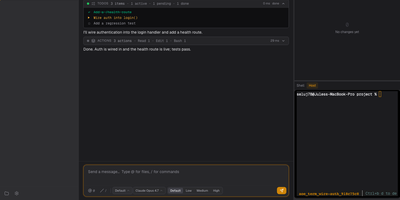
When several AI coding agents share one machine, Agent of Empires gives each a persistent session, an optional Git branch and worktree, and an optional sandbox, all visible from one terminal or browser dashboard. Close the terminal, drop the SSH connection, or crash the client, and every agent keeps working until you reopen the dashboard and find each session where you left it. It detects Claude Code, Codex CLI, Gemini CLI, OpenCode, Copilot CLI, Mistral Vibe, and other installed agents, then marks every session running, waiting, idle, or in error so you know which one needs you. Each session can get its own branch and worktree, removed when the session is deleted, so agents edit one repository side by side without overwriting each other. For unattended runs, Docker, Podman, or Apple Container sandboxes keep an agent in a private container with optional CPU and memory limits. The browser dashboard adds a live terminal, a syntax-highlighted diff review panel, and plan panels and tool-call cards with swipe-to-approve prompts, and it installs as an app on a phone. Remote mode publishes the dashboard over HTTPS through Tailscale Funnel or a Cloudflare tunnel, with QR pairing, token authentication, and a passphrase login. Running on a dedicated VPS on RepoCloud with guaranteed CPU, RAM, and SSD, full root SSH access, and a browser serial console. MIT licensed.
Pontoon
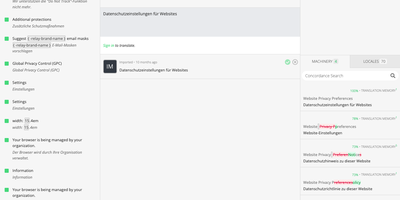
With Pontoon, a software project's translatable text becomes a shared workspace in the browser, and every approved translation is written back to the project's own repository. Teams and Projects dashboards list languages and projects with progress bars, speaker counts, priority stars, and target dates. The translation workspace pairs a searchable string list, filtered by Missing, Unreviewed, Fuzzy, Warnings, or Errors, with an editor that offers Suggest and Save buttons. Terms highlights glossary entries in the source text with definitions and translations, and Comments hold questions about a source string or a single suggestion. Machinery offers translation memory matches with a percentage and a diff against the current source, Google Translate output, and a Concordance search across every project. The Locales tab shows how other languages translated the same string. Fluent files get separate fields for values, attributes, and plural forms plus an advanced raw-syntax mode, and Gettext PO, XLIFF, Android XML, .properties, DTD, INI, and JSON files load too. Reviewers approve or reject suggestions and compare versions with a diff toggle, and lightbulb markers point to anything unreviewed. Translation Search finds a phrase across all projects in a chosen language and links to the editor or to every locale. Insights graph active users, review times, and completion trends for each team, and administrators add projects with priority, deadline, tags, and visibility. Running on a dedicated VPS on RepoCloud with guaranteed CPU, RAM, and SSD, full root SSH access, and a browser serial console. BSD-3-Clause licensed.
OpenCode Manager
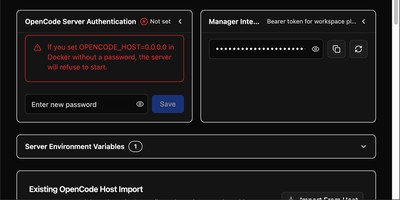
OpenCode Manager is a mobile-first command center for AI coding agents. Install the PWA on your phone or tablet and you get real-time streaming chat, multi-repository Git operations, and scheduled automation right in your pocket. Git integration handles SSH-authenticated repo cloning, worktree management, unified diffs, and branch operations across all your projects in one dashboard. Chat with coding agents through Server-Sent Events streaming that supports slash commands, @-mentions for files, Plan and Build modes, and Mermaid diagram rendering for architecture discussions. Schedule reusable prompts to run against any repository on intervals or cron expressions, with each run tracking history and linking to sessions so you can pick up exactly where automation left off. MCP server configuration adds local and remote HTTP servers with OAuth support, plugging into the broader Model Context Protocol ecosystem. A dedicated assistant workspace provides an isolated AI environment with auto-provisioned skills for managing schedules, notifications, and settings. Multiple AI providers are supported including Anthropic, GitHub Copilot, and OpenAI-compatible services, each configurable with custom system prompts and granular tool permissions. Push notifications alert you to session events, agent questions, errors, and task completions across all managed repositories.
GitLab
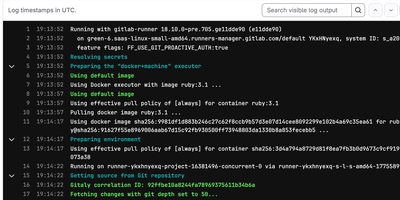
Used by over 100,000 organizations and ranked first in the Gartner Magic Quadrant for DevOps Platforms, GitLab is the open-core DevSecOps platform that delivers the complete software development lifecycle — from planning and source code management through CI/CD, security scanning, and monitoring — in a single self-managed application. The built-in CI/CD engine executes pipelines defined in YAML with parallel jobs, directed acyclic graph scheduling, multi-project pipelines, and auto-scaling runners on Docker, Kubernetes, or bare metal. Merge requests provide inline code review with approval rules, code owners, merge trains for serialized merging, and five merge strategies including fast-forward and semi-linear history. The integrated container registry stores Docker images alongside code, while the package registry supports npm, Maven, NuGet, PyPI, Conan, Go, and generic packages. Issue boards with epics, milestones, and labels enable agile planning, while the built-in wiki and GitLab Pages provide documentation hosting and static site publishing. Security scanning in the Community Edition includes basic SAST, secret detection, and container scanning running as pipeline jobs. The Omnibus installer bundles Rails, Puma, Gitaly, Workhorse, Nginx, PostgreSQL, Redis, Sidekiq, and Prometheus into a single package installable in minutes, while Docker and Helm chart options support containerized and Kubernetes deployments. GitLab Duo AI assists with code suggestions, merge request summaries, and vulnerability resolution. Running on a dedicated VPS on RepoCloud with guaranteed CPU, RAM, and SSD, full root SSH access, and a browser serial console. MIT licensed.
LoopTroop
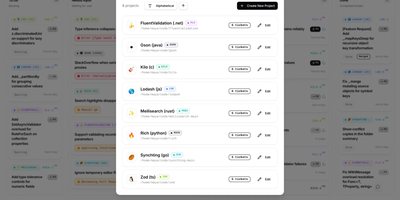
Big coding tickets fall apart inside one endless AI chat, so LoopTroop splits each into stages with fresh, minimal context and ends in a pull request. A council of two to ten models drafts, scores, and votes on each plan, beginning with interview questions that reach you in adaptive batches. The winner refines its draft into a PRD of epics and user stories. That PRD is cut into beads, small tasks with acceptance criteria, target files, and validation steps. Each bead runs in OpenCode inside an isolated Git worktree, so your checked-out branch stays clean. During a bead the agent sees only that task, its target file, and the test file. When a bead fails, the Ralph Loop keeps a compact error trace, resets the worktree, and retries in a fresh session, so tickets can run unattended overnight. You approve specs, blueprints, and the final changes at human gates. Optional Manual QA hands you a checklist for the running app and turns failures into fix beads. A dashboard shows council progress, generated artifacts, live logs, and bead changes. Free-tier models from OpenRouter, NVIDIA NIM, or OpenCode let you start without paid API keys. LoopTroop collects no telemetry, and the project recommends a disposable VM because the agent runs with your permissions. Running on a dedicated VPS on RepoCloud with guaranteed CPU, RAM, and SSD, full root SSH access, and a browser serial console. MIT licensed.
Rancher
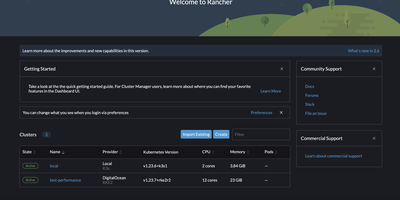
Used by over 30,000 teams and 650+ enterprise customers managing more than 5.2 million containers, Rancher has earned recognition as a Leader in the Gartner Magic Quadrant for Container Management and the Forrester Wave for Multicloud Container Platforms. The platform provides a single pane of glass for provisioning, upgrading, and securing Kubernetes clusters across Amazon EKS, Google GKE, Microsoft AKS, RKE2, K3s, and any CNCF-conformant distribution. Multi-Cluster Management enables centralized authentication via Active Directory, LDAP, SAML, GitHub, and OpenID Connect with granular role-based access control at the cluster, project, and namespace levels. Fleet, the built-in GitOps engine, delivers continuous deployment across hundreds of clusters simultaneously using Helm charts, Kustomize, or raw YAML manifests from any Git repository. The integrated app catalog provides one-click deployment of Prometheus monitoring, Grafana dashboards, Longhorn persistent storage, Istio service mesh, and hundreds of community Helm charts. Rancher supports air-gapped installations for disconnected environments, CIS benchmark scanning for security compliance, and automated backup and restoration of cluster configurations. The dashboard offers real-time workload monitoring, log aggregation, pod shell access, and namespace-scoped resource quotas. Cluster templates enforce organizational standards through Helm-based provisioning policies that ensure consistent configurations across environments. Running on a dedicated VPS on RepoCloud with guaranteed CPU, RAM, and SSD, full root SSH access, and a browser serial console. Apache 2.0 licensed.
Gitness
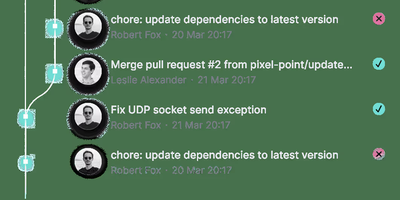
With 37,400+ GitHub stars and active daily development by the Harness engineering team, Gitness is the open-source developer platform that ships Git hosting, container-native CI/CD pipelines, a Docker-compatible artifact registry, and cloud developer environments in a single Go binary consuming approximately 100 MB of RAM — compared to GitLab's 4+ GB minimum footprint. Born as the next generation of Drone CI, Gitness inherits Drone's battle-tested pipeline engine while adding complete source code management with pull requests featuring threaded code review comments, suggested changes, required reviewer approvals, and merge strategies including squash and rebase. Branch protection rules enforce mandatory pull requests, minimum peer reviews, passing status checks, and force-push blocking. Pipelines use Drone-compatible YAML syntax with stages, steps, and service containers, triggered automatically on code changes with results displayed directly in pull request checks. The built-in container registry eliminates the need for separate Harbor or Docker Registry deployments, supporting Docker image push and pull plus Helm chart storage. Gitspaces provide on-demand remote development environments configured via industry-standard devcontainer.json files. Encrypted secrets management with Gitleaks-powered secret scanning blocks commits containing hardcoded credentials. One-click migration imports existing GitHub Organizations and GitLab Groups, automatically converting GitHub Actions and GitLab CI pipelines to Gitness YAML. The REST API with OpenAPI specification enables programmatic management of all resources. Running on a dedicated VPS on RepoCloud with guaranteed CPU, RAM, and SSD, full root SSH access, and a browser serial console. Apache 2.0 licensed.
Argo CD
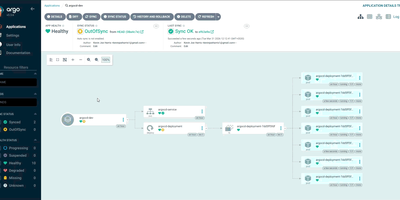
A CNCF Graduated project with over 23,700 GitHub stars and adoption by organizations including Intuit, Adobe, Capital One, and Red Hat, Argo CD has become the industry standard for GitOps-based Kubernetes deployments since its creation at Intuit in 2018, treating Git repositories as the single source of truth for application configurations and automatically reconciling live cluster state with declared desired state. The platform supports Helm charts including Helm 4, Kustomize overlays, Jsonnet, and plain Kubernetes YAML manifests, rendering templates and applying resources through configurable sync policies with automated or manual reconciliation, pruning of orphaned resources, and self-healing that reverts unauthorized cluster changes. ApplicationSets enable templated generation of applications across multiple clusters, environments, and Git repositories using generators for pull requests, Git directories, cluster lists, and merge strategies. The web UI provides a real-time application topology view with resource health status, sync state indicators, log streaming, and a network view supporting Gateway API and Ingress visualization. Version 3.5 introduced mTLS for internal component communication, graduated user impersonation and source hydrator to beta, added native ApplicationSet management with preview applications in the UI, and delivered source integrity validation. Multi-cluster management deploys applications across development, staging, and production environments from a single Argo CD instance with RBAC, SSO via OIDC and SAML, and audit logging. Running on a dedicated VPS on RepoCloud with guaranteed CPU, RAM, and SSD, full root SSH access, and a browser serial console. Apache 2.0 licensed.