colibri
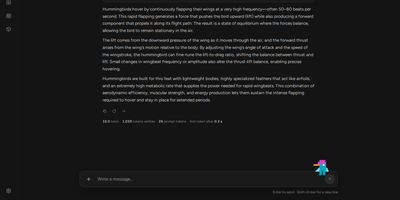
colibri lets you run huge open language models, including ones with hundreds of billions of parameters, on the computer you already own by keeping only the parts a model needs for each token in fast memory. Thirteen engines cover chat models such as GLM-5.2, DeepSeek V4 Flash, Qwen3.6, Kimi K3, and Mistral-Large-4, the Qwen-Image-2.1 picture generator, and small decision models. A one-step setup checks your RAM, disk, and graphics card, recommends a model that fits, downloads it with resume, and opens the dashboard. It runs on the CPU alone, on any Vulkan GPU, on NVIDIA cards through CUDA, and on Apple Silicon through Metal for several engines, and it reads published GGUF files as they are. One server speaks the OpenAI and Anthropic APIs, so Claude Code, coding CLIs, and SDKs connect with a base URL, and it adds tool calling, image and document input, and up to 16 simultaneous conversations. The browser dashboard has a chat with folded reasoning, an expert map, a live monitor, a profiling page, and a System One page that returns a probability for every allowed answer. A built-in MCP server lets an AI assistant detect hardware, install, start, and stop colibri. Running on a dedicated VPS on RepoCloud with guaranteed CPU, RAM, and SSD, full root SSH access, and a browser serial console. Apache-2.0 licensed.
Media Preview Generator
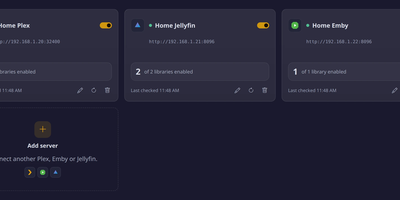
Blank seek bars on freshly imported episodes disappear once Media Preview Generator builds preview thumbnails for Plex, Emby, and Jellyfin as each file arrives, using GPU workers when you have them. When servers share a file, it decodes the video once and writes each server's own format: a BIF in Plex's data folder, a BIF beside the video for Emby, and trickplay tiles for Jellyfin. It also finds intros and end credits from chapters, online skip databases, theme songs, or the credit roll, then sends Skip Intro and Skip Credits markers to every server, and sends nothing when unsure. Named worker groups pick their GPUs, job types, worker count, and weekly hours, with CPU fallback and remote nodes for GPUs on other machines. Webhooks from Sonarr, Radarr, Sportarr, Tdarr, FileFlows, Plex, Emby, and Jellyfin start jobs, schedules poll recently added items, and a title search queues one episode or a whole show. Retries run after 1, 2, 5, 15, and 60 minutes by default while a server indexes a new file. HDR10, HLG, and HDR10+ sources are tone-mapped, and Dolby Vision profiles 7 and 8 use their HDR10 layer. A Setup Health tab names the server setting that blocks previews, and optional Plex loudness analysis runs on CPU workers. New arrivals get working timelines instead of waiting for a scheduled maintenance window. Running on a dedicated VPS on RepoCloud with guaranteed CPU, RAM, and SSD, full root SSH access, and a browser serial console. MIT licensed.