ClientSt0r
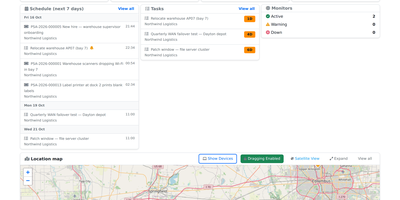
ClientSt0r is a self-hosted operations platform for managed service providers that keeps client documentation, IT assets, credentials, and the service desk in one multi-tenant system running on your own infrastructure. Open any ticket and the client's active contract, the asset it concerns, the runbook that covers it, and the vault entries you are allowed to use appear alongside the conversation, so nobody switches between four products during an outage. Readiness scoring grades every client against what should be documented, explains each gap, and queues the fixes, while versioned documents with owners and review dates keep runbooks from quietly going stale. The credential vault encrypts secrets with AES-256-GCM, isolates them per client, enforces IP, geography, and time-of-day access rules, logs every reveal, generates TOTP codes, checks passwords against known breaches, and imports existing Bitwarden or Vaultwarden libraries. Asset records cover hardware inventory, IP address management, rack layouts, and printable QR labels. The service desk adds queues, SLA timers, dispatch views, time entries, quotes with electronic signatures, invoices, contracts, approvals, a workflow rule builder, a threading email engine, and guided client portal forms, while procurement, profitability reporting, CVE scanning, SSL expiry tracking, and uptime monitoring round out daily operations. Running on a dedicated VPS on RepoCloud with guaranteed CPU, RAM, and SSD, full root SSH access, and a browser serial console. MIT licensed.
plumio
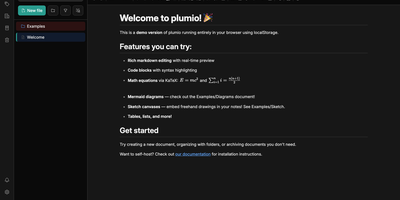
Notes belong on a server you control, and plumio gives them a quiet, fast home there with a polished markdown editor and a live preview. Write headings, task lists, tables, code blocks, math equations, and Mermaid diagrams in one document, then add a freehand sketch canvas for quick drawings. Each change saves as you type. Folders, tags, and custom colors keep a growing library tidy, favorites keep the important pages close, and full-text search finds a half-remembered phrase in seconds. Turn on AES-256 encryption and every document is protected at rest on disk. One instance can host several users and several organizations, so a family, a study group, or a small company each gets a separate workspace with roles for admins and members. Deleted notes land in a trash and archived ones stay out of the way until needed. Export everything as a zip of plain markdown files, or import a folder from another editor, Obsidian included. Webhooks announce document events to other services, API keys let scripts create and search notes, and optional SMTP email handles password resets. A daily backup job keeps compressed copies with automatic retention, and a desktop app can connect to your server. Running on a dedicated VPS on RepoCloud with guaranteed CPU, RAM, and SSD, full root SSH access, and a browser serial console. AGPL-3.0 licensed.
Typemill
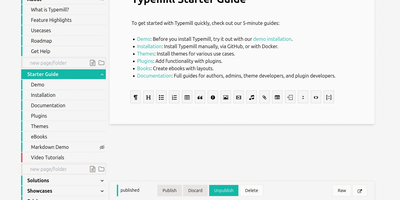
Documentation deserves better than a database nobody wants to maintain. Typemill is an open-source flat-file CMS for informational websites, manuals, knowledge bases, and handbooks: content lives as Markdown files in folders, so a site can be copied, versioned, backed up, and moved with ordinary file tools and no database server anywhere in the stack. Authors get a visual block editor for nontechnical writing and a raw Markdown editor when precision matters, with a navigation tree, drag-and-drop structure, media library, page metadata, and publish states in one workspace. The same source then publishes three ways: as a themed website, as a printable PDF manual, or as an EPUB eBook through the eBook studio, making single-source publishing real for teams tired of maintaining docs, PDFs, and handbooks as three diverging copies. Themes are built from HTML and Twig; plugins add search, analytics, diagrams, math, and integrations; and an optional AI assistant interface connects writing help to the editor. User management, restricted pages, redirects, and a REST API cover the operational side, and the whole application is small enough to run comfortably on modest shared-style hosting or a tiny server while still feeling instant. Running on a dedicated VPS on RepoCloud with guaranteed CPU, RAM, and SSD, full root SSH access, and a browser serial console. MIT licensed.
JSPWiki
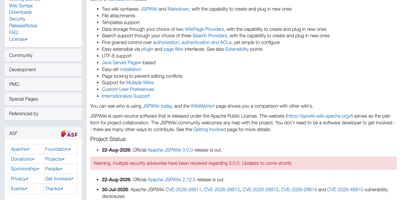
Knowledge scattered across chat threads, tickets, and shared drives gets one permanent, searchable home in JSPWiki, a wiki engine that any team member can edit from the browser. Pages can be written in classic JSPWiki markup or in Markdown, and new syntaxes plug in alongside. Every page carries its own history through the versioning file provider, so edits can be compared and rolled back, and page locking keeps two editors from colliding. Files attach directly to pages, templates restyle the whole wiki, and three interchangeable search providers, including full-text indexing, make old decisions findable again. Access stays precise: authentication and per-page access control lists decide who can view or edit each page, which suits mixed audiences of staff, partners, and the public. Plugins and page filters extend rendering with dynamic content, and one installation can host multiple separate wikis for different teams. Readers get custom preferences and internationalized interfaces. Run it as a WAR on Tomcat or pull the Docker image and open port 8080. Running on a dedicated VPS on RepoCloud with guaranteed CPU, RAM, and SSD, full root SSH access, and a browser serial console. Apache License 2.0 licensed.
SoftJL
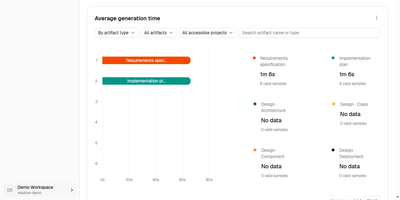
SoftJL turns a system description into the UML diagrams, test cases, and Word specifications a software project is supposed to produce, and keeps every artifact traceable back to the requirement it came from. Describe your system in chat and confirm the extracted requirement rules, then work through feasibility analysis with system context, business and system flows, and implementation options weighed by cost, benefit, and risk. From the confirmed rules it builds requirement and design models: functional structure, use cases, domain concepts, architecture, design classes, database and deployment diagrams, all editable as PlantUML with SVG export. Tests follow the same thread, with normal, exceptional, and boundary cases mapped to requirement rules in coverage and traceability matrices that show exactly which requirements lack design or test support before you submit. When a requirement changes, dependencies and update status point at the models, tests, and documents that need review, instead of leaving you to rediscover them by hand. Specifications generate from the saved models as versioned, editable DOCX files, a feasibility report, a requirements specification, and a design description, ready to compare against the diagrams and revise. An optional read-only MCP endpoint lets a coding agent read your designs and acceptance criteria, and the whole workspace runs on your own OpenAI-compatible model service. Running on a dedicated VPS on RepoCloud with guaranteed CPU, RAM, and SSD, full root SSH access, and a browser serial console. Apache-2.0 licensed.
HedgeDoc
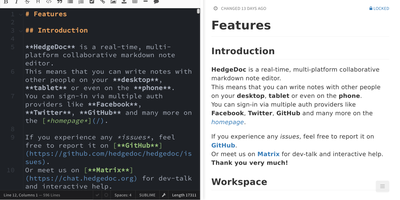
Real-time collaborative Markdown behind your own firewall: HedgeDoc (formerly CodiMD, descended from HackMD's open-source edition) keeps team notes on team infrastructure. Share a note's URL and collaborators are editing together instantly - live cursors, changes appearing keystroke by keystroke - in a three-mode interface that toggles between raw Markdown, rendered preview, and side-by-side split. The Markdown dialect is extended where engineers need it: Mermaid, Graphviz, and Vega-Lite diagrams, MathJax for equations, syntax-highlighted code blocks, embedded content, and a presentation mode that turns a note into reveal.js slides with a single YAML header. A dropdown permission system controls each note - freely editable, limited to signed-in users, or locked read-only - and published notes become clean read-only pages for wider distribution. Revisions track every change with the ability to revert to any earlier version. The AGPL-3.0 codebase is light enough to run on a Raspberry Pi and deploys via Docker with PostgreSQL, MySQL, or SQLite. Authentication covers LDAP, SAML, OAuth2, and email. It deliberately stays a focused document editor - no page trees or kanban - and does that one job with excellent keyboard-first ergonomics for meeting notes, RFCs, runbooks, and shared scratchpads.