Open Design
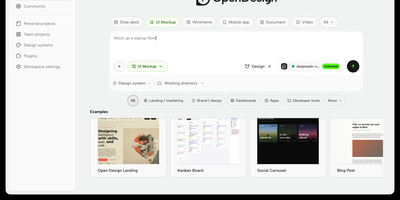
With over 84,000 GitHub stars since its April 2026 launch, Open Design has emerged as the definitive open-source alternative to Anthropic's Claude Design. Rather than shipping its own language model, Open Design acts as an agent-agnostic design orchestration layer that auto-detects 25+ coding CLI executables on your PATH — including Claude Code, Codex, Cursor, Gemini CLI, OpenCode, Qwen, GitHub Copilot CLI, Hermes, and Kimi — or connects to any OpenAI-compatible endpoint via its built-in BYOK proxy at /api/proxy/stream. The platform introduces a file-based protocol where SKILL.md files define composable design workflows and DESIGN.md files establish version-controlled brand systems, currently shipping 31 first-party skills and 72 brand-grade design systems. Output spans web and mobile prototypes, live dashboards, presentation decks, raster images, video, and HyperFrames motion graphics, with export pipelines for HTML, PDF, PPTX, MP4, and ZIP. The daemon architecture uses SQLite for project state and serves a sandboxed iframe preview renderer with vendored React and Babel for JSX artifacts. Deployment options include the native desktop app for macOS, Windows, and Linux, local daemon mode via pnpm tools-dev, a single-container Docker Compose path serving both API and Next.js frontend on port 7456, and Vercel deployment for the web layer. On RepoCloud, deploy Open Design on a dedicated VPS with full root SSH access, persistent storage for your design systems and generated artifacts, and complete control over which AI providers and agent CLIs your instance connects to, all under the Apache-2.0 license.
Webstudio
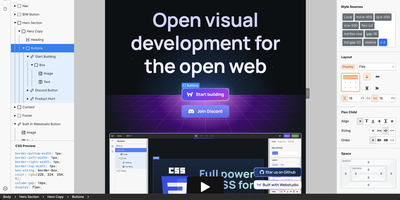
Webstudio delivers a professional-grade visual website builder that outputs semantic HTML and clean CSS without inline style pollution or JavaScript-heavy render paths. The live canvas editor provides direct manipulation of all CSS properties — flexbox, grid, spacing, typography, transforms, and filters — with real-time preview across responsive breakpoints. The component system supports reusable instances with variants and overrides, while design tokens maintain consistent colors, fonts, and spacing across the entire site. Data bindings connect to external content sources through native integrations with Strapi and Supabase, plus a generic CMS interface for any REST API backend. The Scroll Timeline API powers animations at 120 FPS off the main thread, with presets for rotate, scale, translate, opacity, color, and filter effects. Projects build as dynamic Remix applications with server-side rendering or export as static HTML, CSS, and JavaScript files. The Webstudio CLI generates Docker-ready builds that run a Node.js server on port 3000, with Nginx reverse proxy configuration for SSL termination via Let's Encrypt. The builder requires minimum 1 GB RAM and 1 CPU core for Docker builds. MCP integration enables AI agents to create and modify websites programmatically. On RepoCloud, deploy Webstudio projects on a dedicated VPS with root SSH access, persistent storage, and complete control over your hosting, custom domains, and deployment pipeline, all under the AGPL-3.0 license.
OpenPencil
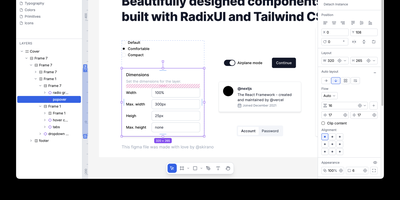
OpenPencil is the open-source design editor that reads and writes native Figma .fig files using the same Kiwi binary format — enabling bidirectional copy-paste between Figma and OpenPencil without data loss. The built-in AI assistant provides 90+ design tools through a chat interface, creating and modifying shapes, fills, strokes, auto-layout, components, variables, and boolean operations from natural language prompts, with BYOK support for Anthropic, OpenAI, Google AI, OpenRouter, Z.ai, MiniMax, and compatible endpoints. A Skia CanvasKit WASM renderer paired with Yoga WASM layout engine delivers Figma-parity rendering with flex and CSS Grid support including gap, padding, and alignment. The headless CLI inspects node trees via XPath queries, lints naming and accessibility, converts between document formats, analyzes color and typography patterns, extracts design tokens, and exports to PNG, SVG, JSX/Tailwind, and HTML. An MCP server exposes all design operations over stdio and HTTP, connecting Claude Code, Cursor, Windsurf, and Gemini CLI for AI-assisted design automation. Real-time P2P collaboration via WebRTC with Yjs CRDT synchronization requires no server and no account. The Vue SDK provides headless components for embedding the editor into custom applications. Ships as a 7 MB Tauri v2 desktop app for macOS, Windows, and Linux, or runs in any browser as a PWA. Running on a dedicated VPS on RepoCloud with guaranteed CPU, RAM, and SSD, full root SSH access, and a browser serial console. MIT licensed.
Animockup
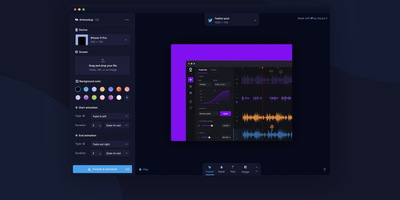
Product Hunt's Maker of the Year: Animockup delivers an alternative to expensive motion graphics tools for creating animated product teaser videos entirely in the browser. The FabricJS canvas engine provides a fully interactive editing surface where you import product videos or screenshots, place them inside device mockups ranging from iPhones and MacBooks to browser windows and smartwatches, and customize everything from background gradients to overlay text positioning. Anime.js powers the animation system with configurable start and end transitions, easing curves, and duration controls that produce smooth entrance and exit effects without timeline editors or keyframe knowledge. The built-in FFMPEG.wasm pipeline handles all video processing client-side — no server-side rendering required — exporting finished teasers to WebM, MP4, or GIF at custom framerates and resolutions up to 4K. The crop and reposition tool lets you precisely fit product footage into any device screen regardless of aspect ratio differences. Twenty-plus device frames cover phones, tablets, laptops, desktops, watches, and generic browser windows for maximum versatility. Firebase authentication handles user sessions while the optional Paddle integration manages subscriptions — or remove both for a fully free deployment. Self-hosting requires only a static web server with optional PHP for the payment webhook endpoint. Running on a dedicated VPS on RepoCloud with guaranteed CPU, RAM, and SSD, full root SSH access, and a browser serial console. MIT licensed.