Tessery
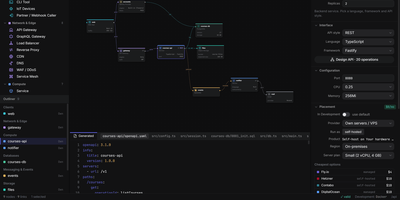
If your next system begins as a diagram, Tessery turns it into generated code, infrastructure, and a release pipeline. The canvas offers 69 technologies, from databases and queues to LLM APIs. Each node can run self-hosted, managed, or as SaaS, with cost estimates per provider. Code and config appear below the design as you edit. Separate editors cover REST, GraphQL, gRPC, and WebSocket operations, database tables, and web pages. Services come out in 14 languages. In seven of them, a REST operation named after a table in a connected database is implemented in SQL, so CRUD apps need no hand-written code. Add the built-in identity provider and Tessery writes sign-up, sign-in, sessions, a login page, and access checks. Every project gets a git repository, and Tessery merges developers' pushes with what the design generates. Releases move through environments such as development, staging, and production, each accepting only what the previous one runs. Any environment can require approval or roll back automatically. Targets are containers on the Tessery host, containers on any machine over SSH, or Kubernetes. Observe shows each request as a waterfall across services, because generated web apps and services in three languages send OpenTelemetry traces back. An MCP server with 14 tools lets Claude Code, Cursor, or any MCP client design, build, and deploy under its token's permissions. Running on a dedicated VPS on RepoCloud with guaranteed CPU, RAM, and SSD, full root SSH access, and a browser serial console. MIT licensed.
Deploy